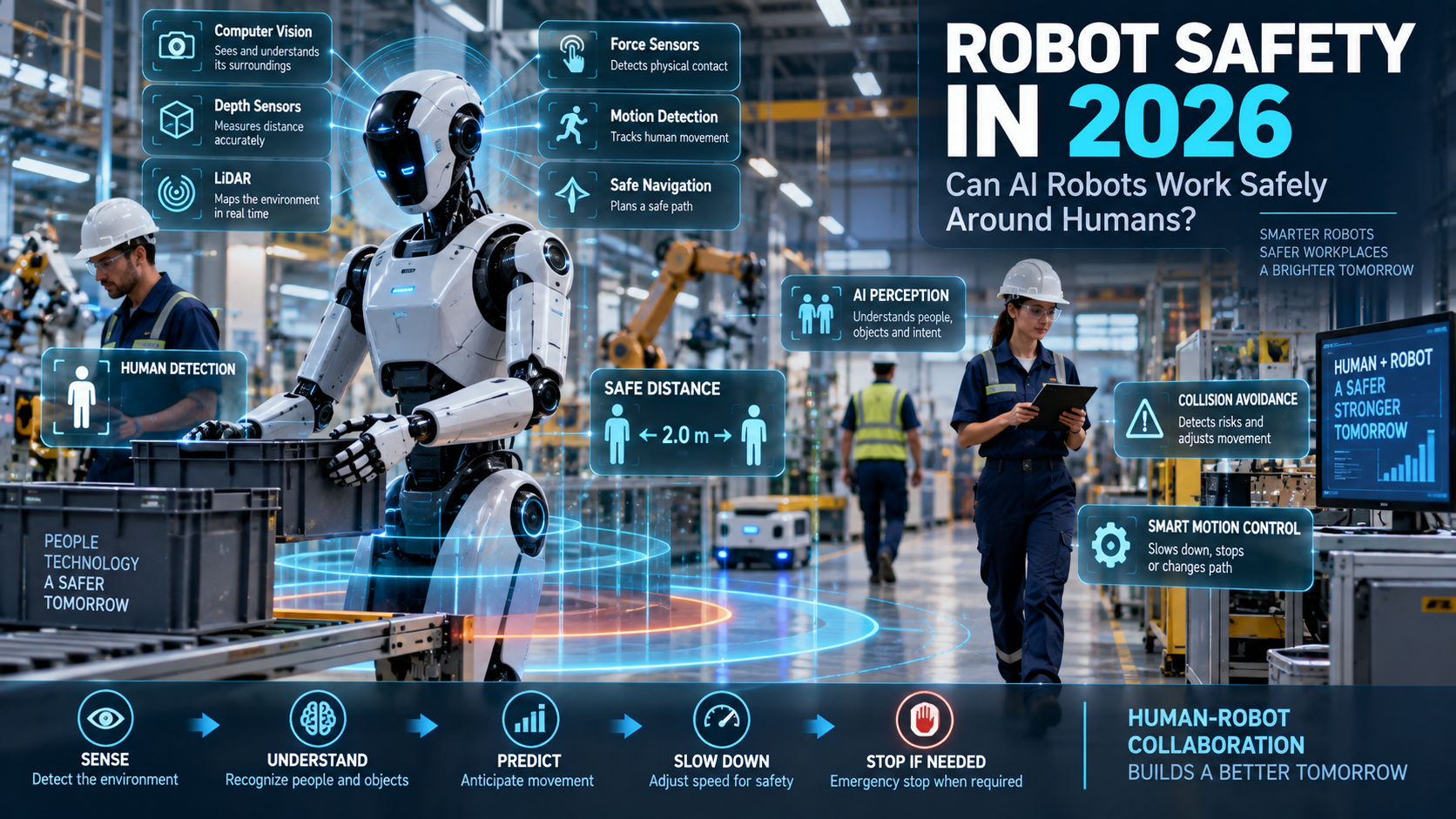
Robots are becoming smarter and more useful every year. They are now being used in factories, warehouses, logistics, healthcare, agriculture and many other industries.
Older industrial robots usually worked in fixed areas, often separated from people by fences or safety barriers. New AI-powered robots are different. They can see their surroundings, understand objects, navigate spaces and adjust their actions.
This brings an important question: Can AI robots work safely around humans?
The answer is possible, but making robots safe requires much more than simply adding artificial intelligence. Sensors, safety systems, software, hardware, risk assessment and human supervision all play an important role.
What Is Robot Safety?
Robot safety means designing and operating robots in a way that reduces the possibility of accidents and injuries.
A robot can be powerful, fast and heavy. If it moves unexpectedly or comes too close to a person, it can cause serious harm.
Robot safety is therefore designed to control risks such as:
- Unexpected movement
- Human-robot collisions
- Crushing or trapping
- Falling objects
- Excessive speed
- Mechanical failures
- Software problems
- Unsafe robot commands
The goal is simple: A robot should perform its task without putting people in unnecessary danger.
Why Is Robot Safety Becoming More Important in 2026?
Robots are no longer limited to simple, repetitive tasks.
AI is helping robots understand their surroundings and perform more flexible tasks. Humanoid robots, autonomous mobile robots and collaborative robots are being developed to operate in environments where people may also be present.
Recent robotics developments show increasing attention toward real-world deployment, including safety and reliable operation rather than only laboratory demonstrations.
As robots become more autonomous, safety becomes an even more important part of their design.
How Are AI Robots Different From Traditional Robots?
Traditional robots usually follow predefined instructions.
For example:
Move → Pick → Place → Return
The robot repeats the same sequence again and again.
AI-powered robots can use cameras, sensors and AI software to understand changing situations.
For example:
See a person → Understand the person’s position → Change movement → Continue safely
This makes robots more flexible, but it also creates new safety challenges.
How Do AI Robots Detect People?
One of the most important parts of robot safety is sensing the environment.
Robots can use technologies such as:
- Cameras
- Depth sensors
- LiDAR
- Proximity sensors
- Force sensors
- Touch sensors
- Motion detection
- Position sensors
These technologies help a robot understand where people and objects are located.
For example, if a worker suddenly walks into the robot’s path, the robot can detect the person and take an appropriate safety action.
Can AI Help Robots Avoid Collisions?
Yes, AI can help robots understand their surroundings and make better movement decisions.
Computer vision can help a robot identify people, objects and obstacles. AI algorithms can then help the robot choose a suitable path.
For example:
Person detected → Movement predicted → Safe path calculated → Robot changes direction
However, AI should not be considered the only safety layer.
A safe robotic system normally needs additional controls that can limit movement or stop the robot when a dangerous situation is detected.
What Happens When a Robot Detects a Person?
The robot’s response depends on its design and application.
It may:
- Slow down
- Stop moving
- Change direction
- Maintain a safe distance
- Reduce its movement range
- Activate an emergency stop
The important point is that the robot should not simply continue its normal movement when a person enters a dangerous area.
What Are Collaborative Robots?
Collaborative robots, often called cobots, are designed for applications where humans and robots can work in the same general workspace under appropriate safety controls.
For example, a worker might place components on a workstation while a cobot performs another part of the task.
Instead of completely separating humans and robots, collaborative systems are designed around controlled interaction.
However, being called a “cobot” does not automatically mean that every application is safe. The complete robotic application still needs appropriate risk assessment and safety measures.
How Do Robots Work Safely Around Humans?
A modern robot can use several layers of protection.
A simple example is:
Sensors → Detect People → Understand Environment → Safety System → Control Robot Movement
If something unexpected happens, the safety system can restrict or stop the robot.
This layered approach is important because AI systems can make mistakes and sensors can fail.
Is AI Alone Enough for Robot Safety?
No.
Artificial intelligence can help a robot understand its environment, but AI should not be the only protection against physical accidents.
An AI system may misunderstand an object or situation. A camera may be blocked. A sensor may stop working. A mechanical component can also fail.
That is why robot safety combines AI with traditional engineering safeguards.
The basic idea is:
AI provides intelligence. Safety systems provide controlled limits.
What Is the Difference Between Traditional Robot Safety and AI Robot Safety?
Traditional robot safety mainly focuses on controlling predictable physical movements.
AI robots can behave more dynamically because they can react to their surroundings.
| Traditional Robots | AI-Powered Robots |
|---|---|
| Follow predefined programs | Can adapt to situations |
| Often work in controlled areas | Can work in changing environments |
| Limited environmental understanding | Advanced perception |
| Predictable movements | More dynamic movements |
| Physical safety focus | Physical + software + AI safety |
| Fixed tasks | More flexible tasks |
This does not mean traditional robots are unsafe. It means that more autonomous robots can introduce additional safety considerations.
Why Are Humanoid Robots More Challenging?
Humanoid robots are designed to operate in environments built for humans.
They may need to:
- Walk around people
- Carry objects
- Pick up products
- Use tools
- Open doors
- Navigate factories
- Work on production lines
This makes them different from a robotic arm that stays inside a fixed work cell.
A humanoid robot needs to understand not only where it is, but also what is happening around it.
Recent reporting on embodied AI development highlights the importance of safety as humanoid robots move toward more complex tasks in real environments.
What Is Predictive Robot Safety?
Traditional safety can react when a dangerous situation occurs.
Predictive safety tries to identify a potential problem before it becomes an accident.
For example:
Person walking toward robot → Robot predicts movement → Robot creates more space → Robot continues safely
This could become increasingly useful in factories, warehouses and other environments where people and robots move continuously.
Can Robots Understand Human Movement?
Modern AI systems can help robots recognize human movement and estimate where a person may move next.
For example, a robot working in a warehouse might see a worker walking toward its planned path.
Instead of waiting for the worker to reach the path, the robot can potentially slow down or change its route.
This type of prediction can make human-robot interaction more natural.
However, predicting human behavior is difficult because people can suddenly stop, turn or change direction.
What Role Does Computer Vision Play?
Computer vision allows robots to process information from cameras and other visual sensors.
It can help robots identify:
- People
- Boxes
- Vehicles
- Tools
- Machines
- Obstacles
- Floor areas
- Workspaces
For AI robots, computer vision is one of the important technologies used to understand the physical world.
But vision alone is not enough. Robots may also need depth information, force sensing and other sensors.
What Happens If a Robot’s Sensor Fails?
This is an important safety problem.
Imagine a robot depends on a camera to detect people. If the camera becomes blocked or stops working, the robot should not simply continue operating as if everything is normal.
Safety engineering can use additional sensors and protective systems to handle such failures.
This is one reason why redundancy is important.
Redundancy means having more than one way to detect or respond to a potential problem.
Can AI Robots Be Hacked?
Yes, connected robots also create cybersecurity concerns.
Modern robots can communicate with:
- Factory networks
- Cloud platforms
- Other robots
- Computers
- Sensors
- Enterprise software
- Remote management systems
If these systems are not properly protected, cyberattacks could potentially affect robot operations.
Therefore, robot safety is increasingly connected with cybersecurity.
What Is the Role of Safety Standards?
Safety standards provide guidelines for designing and integrating robotic systems.
For industrial robots, ISO 10218-1:2025 covers safety requirements for industrial robots, while ISO 10218-2:2025 focuses on industrial robot applications and robot cells. The standards address areas such as safe design, risk reduction, integration, operation and maintenance.
These standards are important because robot safety cannot depend only on individual software features.
Safety needs to be considered across the complete robotic system.
What Is Risk Assessment in Robotics?
Risk assessment means identifying what could go wrong and determining how those risks can be reduced.
For example, engineers may ask:
- Could a person enter the robot’s working area?
- Could the robot drop an object?
- What happens if a sensor fails?
- What happens if the robot receives an incorrect command?
- How quickly can the robot stop?
- Could a worker become trapped?
- What happens during maintenance?
The answers help engineers design appropriate safety measures.
Can AI Robots Safely Work in Factories?
Yes, robots can be designed for safe operation in factories when the complete application is properly engineered and appropriate safety measures are used.
Factories can use:
- Safety sensors
- Emergency stops
- Physical barriers
- Speed limits
- Safe operating zones
- Monitoring systems
- Human-robot collaboration controls
The exact safety requirements depend on the robot and the task.
ISO 10218-2:2025 specifically addresses the integration, commissioning, operation, maintenance and decommissioning of industrial robot applications and robot cells.
Can AI Robots Safely Work in Warehouses?
Warehouses are more difficult because the environment is constantly changing.
A warehouse may contain:
- Human workers
- Autonomous robots
- Forklifts
- Shelves
- Packages
- Moving equipment
An autonomous robot needs to navigate around these objects while completing its task.
AI-powered perception and navigation can help, but safety systems still need to control the robot when unexpected situations occur.
What Are the Biggest Robot Safety Challenges?
1. Unexpected Human Movement
People can suddenly change direction or enter a robot’s path.
2. Sensor Problems
Cameras and sensors can become blocked, damaged or inaccurate.
3. AI Errors
AI can misunderstand objects, instructions or situations.
4. Hardware Failures
Motors, brakes and other mechanical components can fail.
5. Cybersecurity
Connected robots can become targets for cyberattacks.
6. Complex Environments
Real-world environments are much less predictable than controlled laboratories.
7. Human Trust
Workers need to understand how robots behave and when it is safe to interact with them.
What Technologies Can Make Robots Safer?
Several technologies can work together to improve robot safety:
- Computer vision
- LiDAR
- Depth sensing
- Force sensing
- Collision detection
- Safe motion planning
- Emergency-stop systems
- Speed monitoring
- Safe-distance detection
- AI perception
- Redundant sensors
- Cybersecurity controls
- Human supervision
The goal is not simply to make robots smarter.
The goal is to make robots smart enough to understand their environment while remaining within safe operating limits.
Can AI Make Robots Safer?
AI can potentially improve robot safety because it gives robots better perception and the ability to respond to changing situations.
For example, an AI-powered robot may recognize that a person has entered its path and adjust its movement.
But greater intelligence can also introduce new risks.
Therefore, AI should work together with engineering controls and safety systems.
A useful way to understand this is:
AI + Sensors + Safety Controls + Hardware Protection + Human Oversight
What Could Robot Safety Look Like in the Future?
Future robots may continuously monitor their:
Environment → People → Task → Robot Condition → Potential Risk
The robot could then change its behavior when the situation changes.
For example:
Person detected → Risk identified → Robot slows down → Safe distance maintained → Task continues
This could become increasingly important as robots move into factories, warehouses, hospitals, stores and other environments where humans are present.
Will Humanoid Robots Become Safer?
Humanoid robots are still developing, and their safety depends heavily on the specific robot, software and application.
As these systems become more capable, developers are working on better perception, control, force management and safety mechanisms.
Recent industry developments also show a growing focus on proving that humanoid robots can perform useful real-world tasks reliably rather than depending only on demonstrations.
Safety will be one of the important requirements for wider deployment.
Can AI Robots Work Safely Around Humans?
AI robots can be designed to work around humans, but AI alone cannot guarantee safety.
Safe robotic systems require multiple layers of protection, including sensors, software, hardware safeguards, risk assessment, safety standards and human oversight.
As robots become more autonomous, the important question is no longer only:
“Can a robot avoid hitting a person?”
It is also:
“Can the robot understand what is happening around it and respond safely when something unexpected happens?”
That will be one of the most important challenges for robotics in 2026 and beyond.
Conclusion
Robot safety is becoming more important as robots move from isolated work areas into environments shared with humans.
AI can help robots see, understand and react to their surroundings. Computer vision, sensors and intelligent motion planning can make robots more adaptable.
But safe robotics requires more than AI.
The future will likely combine artificial intelligence, advanced sensors, physical safety systems, cybersecurity, safety standards and human oversight.
The goal is not to create robots that simply work faster.
The goal is to create robots that can work intelligently while keeping people safe.
