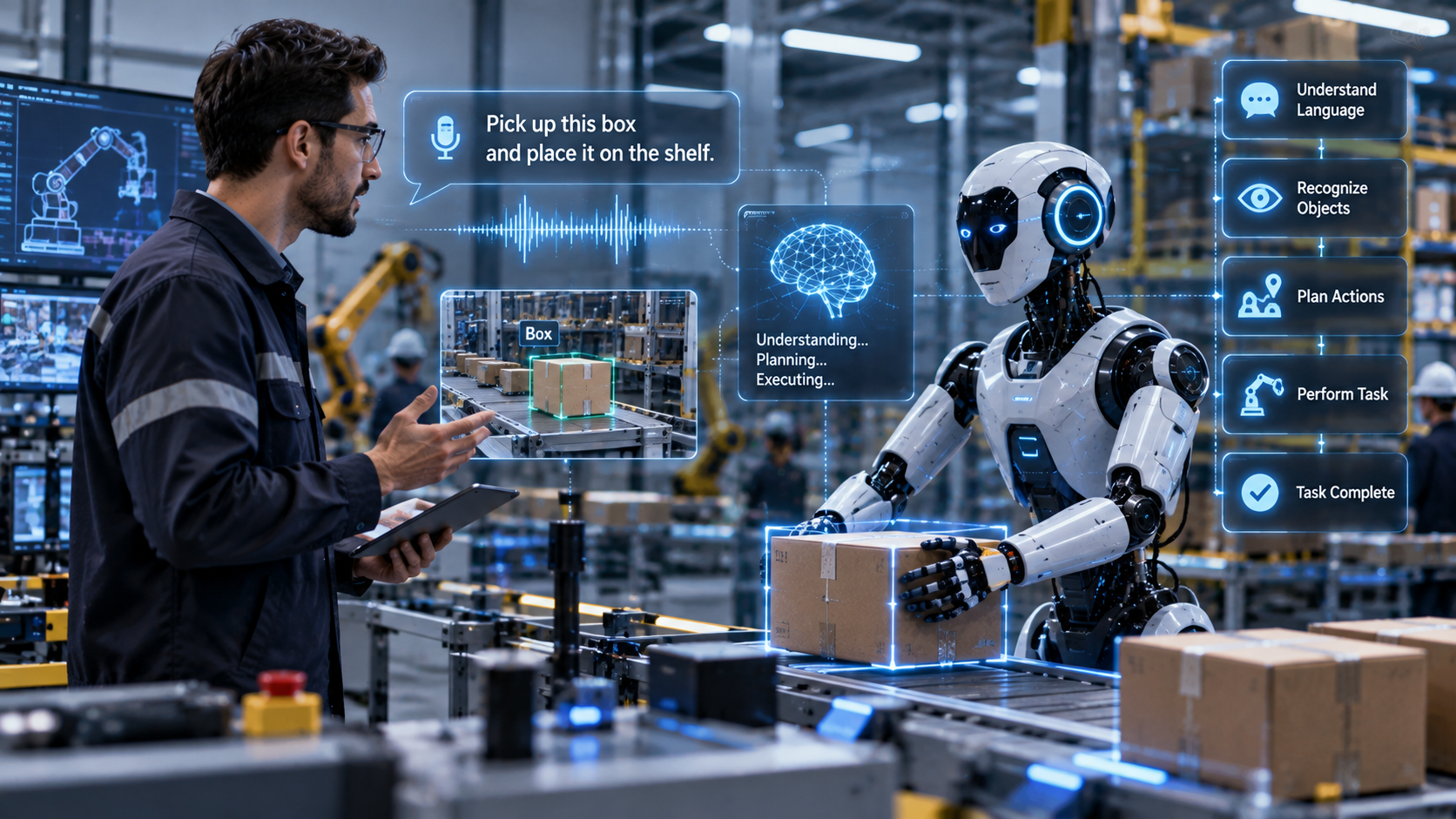
Robots have been used in factories, warehouses, hospitals, and other industries for many years. Traditionally, most robots have followed fixed instructions created by engineers. If the robot needed to perform a different task, its program often had to be changed.
Generative AI is now changing this idea. With the help of AI, robots could understand instructions given in normal human language. Instead of programming every action, people may be able to simply tell a robot what they want it to do.
For example, a person could say, “Pick up the red box and put it on the table.” An AI-powered robot could understand the instruction, identify the objects, plan the required actions, and perform the task.
This raises an important question: Can Generative AI make robots understand and respond to the way humans naturally communicate?
1. What Is Generative AI in Robotics?
Generative AI in robotics means using advanced AI models to help robots understand information and perform tasks more intelligently.
Traditional robots usually follow predefined programs. Generative AI can help robots understand language, images, instructions, and different situations.
In simple terms:
Traditional Robot: Follow fixed instructions.
AI-Powered Robot: Understand the instruction, analyze the situation, plan the task, and perform an action.
This could make robots more flexible and easier for people to interact with.
2. Can Robots Understand Natural Language?
AI-powered robots are becoming better at understanding natural-language instructions.
For example, instead of using a technical control system, a worker could tell a robot:
“Move these boxes to the storage area.”
The AI system would need to understand what the worker means, identify the boxes, locate the storage area, and determine how to complete the task.
However, understanding a sentence is only one part of the challenge. A robot also needs to understand its physical environment and safely turn the instruction into real-world actions.
3. How Does Generative AI Help Robots?
Generative AI can act as an intelligence layer between humans and robots.
A simplified process could look like this:
Human gives instruction → AI understands the language → Robot observes the environment → AI plans the task → Robot performs the action → Sensors check the result
For example, if someone says:
“Put the bottle on the kitchen table.”
The robot needs to identify the bottle, find the table, choose a safe path, pick up the bottle, move toward the table, and place it correctly.
This requires more than language understanding. It requires vision, reasoning, planning, and physical movement.
4. From Human Words to Robot Actions
One of the biggest challenges in robotics is converting human language into physical actions.
A person can easily understand:
“Move the cup closer to me.”
But a robot needs to determine:
- Which cup?
- Where is the person?
- How close should the cup be?
- How should the robot pick it up?
- Is the path safe?
AI models can help connect these different pieces of information.
This is why modern robotics increasingly combines language models, computer vision, sensors, and robotic control systems.
5. What Are Vision-Language-Action Models?
A major concept in modern AI robotics is the Vision-Language-Action (VLA) model.
The basic idea is simple:
Vision → What does the robot see?
Language → What does the person want?
Action → What should the robot do?
For example, if a person says:
“Pick up the blue bottle.”
The robot needs to understand the words, visually locate the blue bottle, and then determine the physical movements required to pick it up.
This combination could help robots interact with the real world in a much more natural way.
6. Robots Could Understand Flexible Instructions
Traditional robots generally work best with precise and predefined instructions.
Generative AI could allow robots to handle more flexible instructions.
For example:
Traditional instruction:
“Move object A from position 1 to position 2.”
Natural-language instruction:
“Take the box near the door and put it with the other boxes.”
The second instruction is more natural for humans, but it requires the robot to understand the environment and context.
This could make robotic systems easier for everyday workers to use.
7. Generative AI Can Help Robots Plan Tasks
Many real-world tasks require multiple steps.
Imagine telling a robot:
“Clean this table and prepare it for dinner.”
The robot could potentially break the request into smaller tasks:
- Identify the objects on the table.
- Remove objects that do not belong there.
- Put those objects in appropriate locations.
- Clean the table.
- Find the required plates and other items.
- Arrange them on the table.
This process is called task planning.
Generative AI could help robots understand the larger goal and divide it into smaller actions.
8. Generative AI + Computer Vision
Language alone is not enough for a physical robot.
A robot also needs to understand what is happening around it.
Computer vision can help robots recognize things such as:
- People
- Objects
- Tools
- Tables
- Doors
- Machines
- Obstacles
- Packages
For example, if someone says:
“Pick up the green box.”
The robot needs to understand the word green, identify the box, find its location, and safely reach it.
Generative AI and computer vision can work together to make this possible.
9. How Could This Help Factories?
Natural-language robotics could make factory automation more flexible.
Imagine a factory worker telling a robot:
“Move these finished products to the inspection area.”
Instead of manually programming every movement, the AI system could potentially understand the goal and help the robot complete the task.
Possible applications include:
- Material handling
- Product inspection
- Assembly
- Packaging
- Sorting
- Machine assistance
- Moving products between workstations
This could make robots easier to use in changing production environments.
10. How Could AI Robots Help Warehouses?
Warehouses are another area where AI-powered robots could be useful.
Warehouse environments can change frequently. Products, packages, workers, and storage locations may not always remain in the same place.
A worker could potentially tell a robot:
“Find the blue package and move it to the shipping area.”
The robot would need to understand the instruction, identify the package, navigate through the warehouse, and complete the task.
This could make warehouse automation more adaptable.
11. Could Robots Work Better With Humans?
Natural-language communication could make human-robot collaboration easier.
Imagine a worker standing next to a robot and saying:
“Bring me the box from the second shelf.”
Instead of using a complicated control panel, the worker could communicate with the robot using normal language.
This could make robots feel more like assistants or tools that people can communicate with, rather than machines that always require specialized programming.
12. Humanoid Robots Could Benefit From Generative AI
Humanoid robots are designed to operate in environments created for humans.
They may need to:
- Understand instructions
- Recognize objects
- Walk through different environments
- Use tools
- Manipulate objects
- Work around people
- Perform multiple types of tasks
Generative AI could provide an intelligence layer that helps humanoid robots understand what people want and determine how to perform different tasks.
This is one reason Generative AI + Physical AI + Robotics is becoming an important area of technology development.
13. What Are the Challenges?
Although AI-powered robotics is developing quickly, there are still many challenges.
Understanding Ambiguous Instructions
Human language is not always clear.
For example:
“Put that over there.”
A human may understand the context immediately. A robot needs to determine exactly what “that” and “there” mean.
Safety
Robots operate in the physical world, so incorrect decisions can potentially cause accidents or damage.
Reliability
A robot needs to perform tasks correctly and consistently, not just understand the instruction.
Changing Environments
Real-world environments are unpredictable. Objects move, people walk around, lighting changes, and unexpected situations can occur.
Computing Requirements
Advanced AI models can require significant computing power. Developers need to balance AI performance with speed, energy consumption, cost, and hardware limitations.
14. Will Generative AI Replace Robot Programmers?
Generative AI is unlikely to completely replace robotics engineers.
Instead, it may change how they work.
Engineers will still be needed to:
- Design robotic systems
- Develop safety features
- Integrate hardware and software
- Train and test AI models
- Monitor robotic behavior
- Solve complex technical problems
AI could handle some repetitive programming tasks, allowing engineers to spend more time on system design, testing, safety, and optimization.
15. What Could Robots Do in the Future?
Future AI-powered robots could potentially become much more flexible.
Instead of programming every possible situation, people may be able to give robots a goal and allow AI to determine the steps needed to complete it.
For example:
Human:
“Prepare this workspace for the next production batch.”
AI Robot:
Understand the workspace → identify required objects → create a plan → perform the tasks → check the result.
This could move robotics toward more autonomous and intelligent automation.
16. Robotics + Generative AI Could Change Automation
Traditional automation is mainly focused on repeatability.
A traditional industrial robot may perform the same movement thousands of times.
Generative AI could add another layer: flexibility and reasoning.
An AI-powered robot could potentially handle different instructions, objects, and situations without requiring a completely new program for every small change.
This does not mean robots will automatically understand everything. Instead, it means AI could make robots more adaptable than traditional fixed-program automation.
17. What Does the Future of Human-Robot Communication Look Like?
The way humans communicate with robots could become much simpler.
Today, people often need technical interfaces, programming languages, control panels, or specialized software to operate advanced robotic systems.
In the future, natural language could become another interface.
A worker might simply say:
“Move these parts to the assembly station.”
The AI system could interpret the request and help the robot determine the appropriate actions.
This could make robotics more accessible to people who do not have advanced programming skills.
18. Is Natural-Language Robotics Ready Today?
The technology is promising, but it is still developing.
AI models can help robots understand language and perform increasingly complex tasks, but real-world robotics remains much harder than interacting with a chatbot.
A chatbot only needs to generate information.
A robot has to physically interact with the world.
It must understand its surroundings, move safely, handle objects, respond to unexpected situations, and complete tasks reliably.
Therefore, natural-language robotics should be viewed as a rapidly developing technology rather than a completely solved problem.
Conclusion
Robotics + Generative AI could completely change how humans interact with machines.
Instead of learning complicated robotic programming, people could increasingly communicate with robots using everyday language.
Generative AI can potentially help robots understand instructions, analyze visual information, plan tasks, and connect human language with physical actions.
However, challenges such as safety, reliability, ambiguous instructions, computing requirements, and real-world complexity still need to be solved.
The future of robotics may not simply be about building stronger or faster machines.
It could be about building machines that can understand what humans mean and intelligently decide how to help.
The big shift could be from:
“Program the robot to do something.”
to:
“Tell the robot what you want done.”
And that could make natural-language interaction one of the most important developments in the future of robotics.
