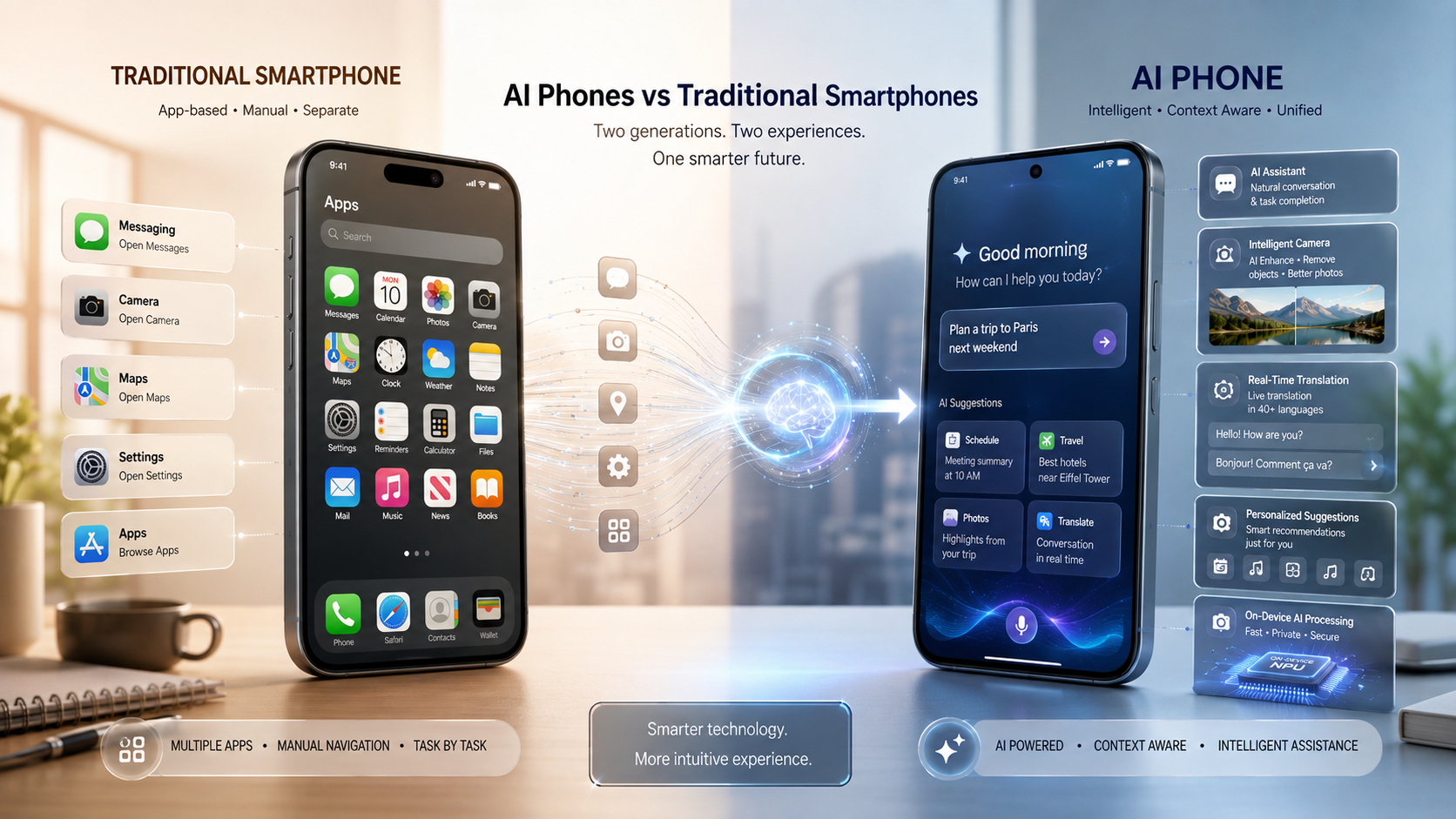
Smartphones have become an important part of our everyday lives. We use them for communication, entertainment, work, photography, shopping, navigation, and much more.
Now, a new type of smartphone is becoming popular: AI phones.
AI is being added directly into smartphone cameras, processors, apps, operating systems, and everyday features. This allows phones to understand text, recognize images, summarize information, translate languages, improve photos, and help users complete different tasks.
But what makes an AI phone different from a traditional smartphone?
Is an AI phone really better, or is “AI phone” simply another technology buzzword?
Let’s understand the difference in simple words.
What Is an AI Phone?
An AI phone is a smartphone that uses artificial intelligence across different parts of the device.
Traditional smartphones already use some AI. For example, your phone may automatically recognize faces in photos, predict the next word while typing, or improve the quality of a picture.
AI phones take this idea much further.
AI can become part of the phone’s camera, keyboard, search, assistant, photo editor, translation tools, and even the operating system.
In simple terms, an AI phone is designed to understand what you want to do and help you complete the task with less manual effort.
What Is a Traditional Smartphone?
A traditional smartphone mainly works through apps.
If you want to send a message, you open a messaging app. If you want to edit a photo, you open a photo editor. If you want to translate something, you open a translation app.
AI may already be working behind the scenes, but it is usually not the main way you interact with the phone.
The traditional smartphone experience can be described as:
Open an app → Choose a feature → Perform the task
AI phones are moving toward a different experience:
Tell the phone what you want → AI understands → AI helps complete the task
This is one of the biggest changes AI is bringing to smartphones.
AI Phone vs Traditional Smartphone
The main difference is not simply whether a phone has AI.
Almost every modern smartphone uses some form of AI.
The bigger difference is how deeply AI is integrated into the device.
A traditional smartphone may use AI for individual features such as camera improvements or keyboard suggestions.
An AI phone can use AI across multiple parts of the smartphone experience.
For example, instead of manually searching through different apps, you may be able to ask the phone to find information, summarize it, create a response, or perform a task for you.
AI Makes Smartphones Easier to Use
One of the biggest advantages of AI phones is that they can make everyday tasks simpler.
Instead of searching through menus and applications, users can describe what they need using normal language.
For example, you could ask:
“Find the photos I took during my last vacation.”
Instead of manually scrolling through hundreds of images, AI can understand the request and help find the relevant photos.
This makes the phone feel more like a personal assistant.
AI-Powered Smartphone Cameras
Smartphone cameras have already been using AI for several years.
AI can recognize faces, detect scenes, improve colors, reduce image noise, and automatically adjust camera settings.
Newer AI phones are taking this further.
AI-powered editing can help remove unwanted objects, improve image quality, change backgrounds, enhance portraits, and make other edits without requiring advanced editing skills.
This means users can create better-looking photos without needing professional photo-editing software.
AI Can Help You Write
AI can also make writing on smartphones easier.
An AI phone can help rewrite messages, correct grammar, change the tone of a sentence, summarize long content, or suggest replies.
For example, if you receive a long email or message, AI may be able to provide a short summary of the important information.
This can save time, especially for people who use their smartphones for work.
AI-Powered Translation
Language translation is another area where AI phones can be useful.
Modern AI can understand text and speech in different languages and provide more natural translations.
This can be particularly useful while traveling or communicating with people who speak different languages.
As AI translation continues to improve, smartphones could become useful communication tools for people who do not share the same language.
On-Device AI Explained
One important technology behind AI phones is on-device AI.
On-device AI means that some AI processing happens directly on the smartphone instead of sending everything to a cloud server.
This can provide several benefits.
AI features may respond faster, some functions can work without an internet connection, and certain personal information can remain on the device.
However, not every AI task can be handled locally.
Some more complex AI features may still require cloud processing.
Many modern AI phones therefore use a combination of on-device AI and cloud AI.
What Is an NPU in a Smartphone?
You may have noticed smartphone companies talking about NPUs when announcing new processors.
NPU stands for Neural Processing Unit.
It is specialized hardware designed to handle AI and machine-learning tasks efficiently.
Instead of using only the CPU or GPU for AI workloads, a smartphone can use its NPU for certain AI operations.
This can help improve AI performance while keeping power consumption under control.
As AI becomes a bigger part of smartphones, NPUs are becoming increasingly important.
Personalized Smartphone Experiences
AI can also make smartphones more personalized.
Instead of giving every user exactly the same experience, AI can learn patterns from how a person uses their device.
It may help organize information, prioritize notifications, recommend actions, or provide suggestions based on the user’s context.
For example, your phone might understand that you usually check certain information at a particular time and make that information easier to access.
However, personalization also creates an important question: How much personal information should an AI phone know about you?
Privacy and Security Concerns
AI phones can potentially process a lot of personal information.
Photos, messages, documents, voice commands, location information, and other data can be sensitive.
This makes privacy an important part of AI smartphone technology.
Before using an AI feature, users should understand what information is being processed and whether the processing happens on the device or through cloud services.
Good AI phone design should give users clear privacy controls and allow them to understand how their information is being used.
Can AI Phones Replace Smartphone Apps?
AI is unlikely to completely replace apps.
Apps will continue to be important for many tasks.
However, AI could change the way we interact with them.
Instead of manually opening several apps to complete one task, an AI assistant could potentially connect different services together.
For example, you might ask your phone to find a restaurant, check its availability, add the details to your calendar, and share the information with a friend.
Instead of switching between multiple apps, you could simply describe what you want.
This is one of the most interesting possibilities for the future of AI smartphones.
Are AI Phones Really Better?
An AI phone is not automatically better than every traditional smartphone.
It depends on how you use your phone.
If you mainly use your smartphone for calls, messaging, social media, videos, and basic apps, you may not notice a huge difference.
But if you frequently use photography, writing tools, translation, productivity features, or AI assistants, an AI phone could provide a more useful experience.
The important thing is not simply having AI.
The real value comes from how useful that AI is in everyday life.
AI Phones Are More Than AI Chatbots
Some people think an AI phone is simply a smartphone with a chatbot installed.
That’s not really the idea.
A modern AI phone can combine AI software, smartphone hardware, an NPU, cameras, operating-system features, and cloud services.
The goal is to make AI available throughout the device instead of keeping it inside one separate application.
This deeper integration is what makes AI phones different from simply installing an AI app on an older smartphone.
What Will AI Phones Look Like in the Future?
AI phones are likely to become more proactive.
Today, you usually need to ask your phone to do something.
In the future, AI may understand more of your context and suggest useful actions automatically.
For example, your phone could understand your schedule, messages, location, and current activity to provide relevant information at the right time.
The smartphone could gradually become less like a collection of separate apps and more like a personal digital assistant.
However, challenges around privacy, security, battery life, accuracy, and user control will need to be solved as AI becomes more powerful.
Should You Buy an AI Phone?
You don’t necessarily need to upgrade just because a smartphone is advertised as an AI phone.
Instead, look at the actual features.
Ask yourself whether the AI tools are useful for your daily activities. Check whether important features work without an internet connection, how the phone handles your personal data, and how long the manufacturer will provide software updates.
Most importantly, don’t choose a phone simply because it has the word “AI” in its marketing.
Choose it because the features actually make your life easier.
AI Phones vs Traditional Smartphones: The Future
AI is changing the way smartphones work.
Traditional smartphones are mainly built around apps, while AI phones are moving toward an experience where users can simply describe what they want and let AI help with the task.
This doesn’t mean traditional smartphones are disappearing overnight.
Instead, AI is gradually becoming another important layer of smartphone technology.
As processors become more powerful and AI models become smaller and faster, more AI features will likely move directly onto smartphones.
Final Thoughts
AI phones are more than a new smartphone trend.
They represent a change in how people interact with technology.
Traditional smartphones require users to find the right app and perform most tasks manually. AI phones are moving toward a more natural experience where users can simply explain what they need.
AI can help with photography, writing, translation, search, productivity, personalization, and many other everyday tasks.
But AI also brings new challenges, especially around privacy, security, accuracy, and data protection.
The future smartphone may not be about having more apps or bigger specifications.
It may be about having a phone that understands what you need and helps you get it done.
