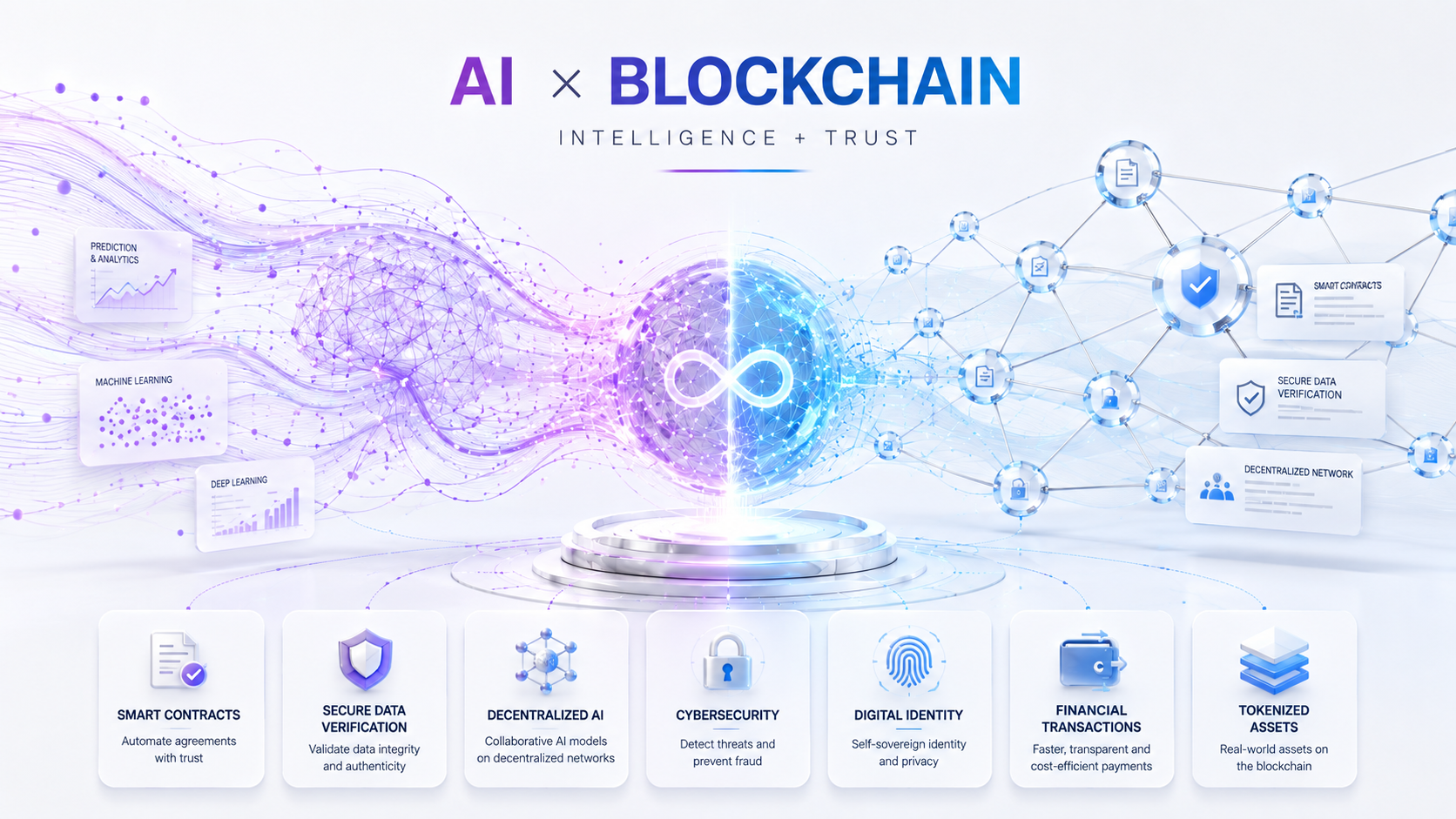
Artificial Intelligence (AI) and blockchain are two technologies changing the way we use digital systems. While they solve different problems, they can work together to create smarter, safer, and more transparent applications.
AI helps computers understand information, learn from data, and make decisions. Blockchain helps store and verify information across a decentralized network.
When these technologies are combined, AI can provide the intelligence while blockchain can provide trust, transparency, and secure records.
But how exactly do AI and blockchain work together? Let’s understand it in simple terms.
What Is Artificial Intelligence?
Artificial Intelligence, commonly called AI, allows computers to perform tasks that normally require human intelligence.
AI can understand language, recognize images, analyze data, find patterns, make predictions, and even generate content.
Today, AI is used in chatbots, recommendation systems, fraud detection, autonomous vehicles, healthcare applications, coding tools, and many other areas.
Simply put, AI helps computers understand information and make intelligent decisions.
What Is Blockchain?
Blockchain is a technology used to store and share digital information across a network of computers.
Instead of keeping all information in one central database, blockchain distributes records across multiple participants in a network.
Blockchain is best known for cryptocurrencies such as Bitcoin and Ethereum, but its uses go far beyond digital currencies.
It can also be used for digital payments, smart contracts, supply chains, digital identity, asset tokenization, and decentralized applications.
In simple words, blockchain creates a shared and verifiable record of information.
Why Combine AI and Blockchain?
AI and blockchain have different strengths.
AI is good at working with large amounts of data, finding patterns, and making predictions or decisions.
Blockchain is good at recording information, verifying transactions, tracking ownership, and creating transparency between different participants.
This makes them a natural combination for certain applications.
A simple way to understand it is:
AI provides intelligence. Blockchain provides trust.
For example, AI could analyze thousands of transactions and detect suspicious activity, while blockchain provides a reliable record of those transactions.
How AI and Blockchain Work Together
AI and blockchain can communicate through applications, APIs, smart contracts, databases, and other software systems.
AI can analyze information stored on a blockchain, while blockchain can record important information about AI-related activities.
For example, an AI system could analyze blockchain transactions and identify unusual behavior. The system could then record important events or decisions on a blockchain for future verification.
This creates a useful combination of intelligent analysis and trusted records.
AI Can Analyze Blockchain Data
Blockchain networks can generate a huge amount of data.
For large blockchain networks, manually analyzing every transaction is difficult and time-consuming.
AI can process this information much faster.
For example, an AI system can look at transaction patterns and identify activity that looks unusual.
This can help businesses and financial platforms detect possible fraud, investigate suspicious transactions, and better understand blockchain activity.
Blockchain Can Help Verify AI Data
AI systems depend heavily on data.
The quality of an AI system depends partly on the quality of the data it receives. If the data is inaccurate or has been changed without proper tracking, the AI’s results may also become unreliable.
Blockchain can help create a verifiable record of important data events.
For example, an organization could record information about when data was created, updated, or accessed.
This does not automatically make the data correct, but it can make the data history easier to track and verify.
Blockchain Can Improve AI Transparency
Many AI models can be difficult for users to understand.
People may want to know which model was used, when it was updated, what data was involved, or when a particular AI action happened.
Blockchain can be used to record important events related to an AI system.
For example, a blockchain record could contain information about a model version, data access, or an important AI transaction.
This can make certain AI workflows easier to audit and verify.
AI and Smart Contracts
Smart contracts are programs stored on a blockchain that automatically execute predefined rules.
AI can potentially work alongside smart contracts by providing analysis or predictions, while the smart contract handles predefined actions.
For example, an AI system could analyze information and provide a recommendation. A smart contract could then execute a predefined transaction if specific conditions are satisfied.
However, AI decisions should not automatically be trusted. Important applications still need validation, security checks, and human oversight where necessary.
AI Can Improve Blockchain Security
Security is an important part of blockchain and cryptocurrency systems.
AI can analyze large amounts of transaction and network data to find unusual patterns.
For example, if an account suddenly behaves very differently from its normal activity, an AI system could flag it for further investigation.
This can help security teams detect potential fraud, suspicious transactions, or unusual network behavior more quickly.
Blockchain Can Help With AI Ownership
AI creates new questions about digital ownership.
Who owns an AI-generated image?
Who created a particular AI model?
Where did the training data come from?
Blockchain can help record ownership claims, licenses, transactions, and other digital information.
This can be particularly useful for digital assets and AI-generated content where tracking ownership and usage rights is important.
AI and Decentralized Applications
Decentralized applications, often called dApps, use blockchain-based infrastructure instead of relying completely on a traditional centralized system.
AI can make these applications smarter.
For example, an AI-powered decentralized application could analyze user activity, provide recommendations, detect unusual behavior, or automate certain tasks.
This creates an interesting combination where the application can use AI for intelligence while blockchain provides decentralized infrastructure and trusted records.
AI and Blockchain in Finance
Finance is one of the strongest areas for combining AI and blockchain.
AI can analyze financial data, identify suspicious transactions, find patterns, and support financial decisions.
Blockchain can provide transparent transaction records and support digital assets and automated transactions.
Together, they can be useful for areas such as fraud detection, digital payments, decentralized finance, asset tokenization, and financial automation.
AI and Blockchain in Supply Chains
Modern supply chains involve many different companies and systems.
A product may move through manufacturers, warehouses, shipping companies, distributors, and retailers before reaching a customer.
Blockchain can record important events throughout this journey.
AI can then analyze that information to identify delays, predict demand, detect unusual activity, and improve logistics.
For example, blockchain could record when a shipment leaves a warehouse, while AI analyzes the available information to predict whether the shipment may arrive late.
AI and Blockchain for Digital Identity
Digital identity is another area where AI and blockchain can work together.
Blockchain can help manage identity-related records in a decentralized way, while AI can help detect suspicious activity or verify certain information.
This could be useful for financial services, online platforms, healthcare systems, and other applications that require identity verification.
However, privacy is extremely important in these systems. Sensitive personal information should not simply be placed on a public blockchain without careful consideration.
Decentralized AI and Blockchain
One of the more interesting ideas is decentralized AI.
Many AI systems today depend on centralized companies, servers, and infrastructure.
Blockchain could potentially help create networks where different participants contribute computing power, data, models, or other resources.
This could create new AI ecosystems where no single organization controls every part of the system.
However, decentralized AI also has challenges, including performance, cost, privacy, governance, and security.
Benefits of Combining AI and Blockchain
The combination of AI and blockchain can provide several potential benefits.
Better data tracking: Blockchain can create a verifiable history of important data and transactions.
More transparency: Blockchain records can make certain activities easier to audit.
Smarter security: AI can analyze blockchain activity and identify unusual patterns.
Better automation: AI can analyze information while smart contracts can automatically execute predefined rules.
Digital ownership: Blockchain can help track ownership and usage of digital assets.
New applications: Together, AI and blockchain can support new decentralized and intelligent services.
Challenges of AI and Blockchain
Although the combination is promising, it also comes with challenges.
Blockchain networks can have limitations related to speed, scalability, and transaction costs.
AI systems can also require large amounts of computing power and data.
Privacy is another important concern. Information stored on some blockchains can be difficult to remove, which can create problems when sensitive data is involved.
There is also an important misconception to avoid: blockchain does not automatically make AI more accurate.
If an AI system makes a wrong decision and that decision is recorded on a blockchain, the blockchain can preserve the record, but it cannot make the original decision correct.
This is why good system design, testing, security, and human oversight remain important.
The Future of AI and Blockchain
AI and blockchain are still developing, and their combination is likely to evolve further.
AI is becoming better at reasoning, automation, data analysis, and handling complex tasks. Blockchain technology is also developing through improvements in scalability, interoperability, smart contracts, tokenization, and decentralized applications.
In the future, we may see more systems that combine AI intelligence with blockchain-based verification and digital ownership.
Potential applications include decentralized AI, intelligent financial platforms, AI-powered cybersecurity, digital identity, tokenized assets, and autonomous applications.
AI and Blockchain: A Powerful Combination
AI and blockchain solve different problems, but that is what makes them interesting when used together.
AI helps computers understand information and make decisions. Blockchain helps systems create trusted records and verify digital activity.
When these technologies are combined for the right use case, they can create applications that are smarter, more transparent, and more efficient.
However, businesses should not use AI and blockchain simply because they are popular technologies. The best solutions start with a real problem and then use the technology that solves it effectively.
As both technologies continue to mature, the combination of AI and blockchain could become an important part of the next generation of digital applications.
