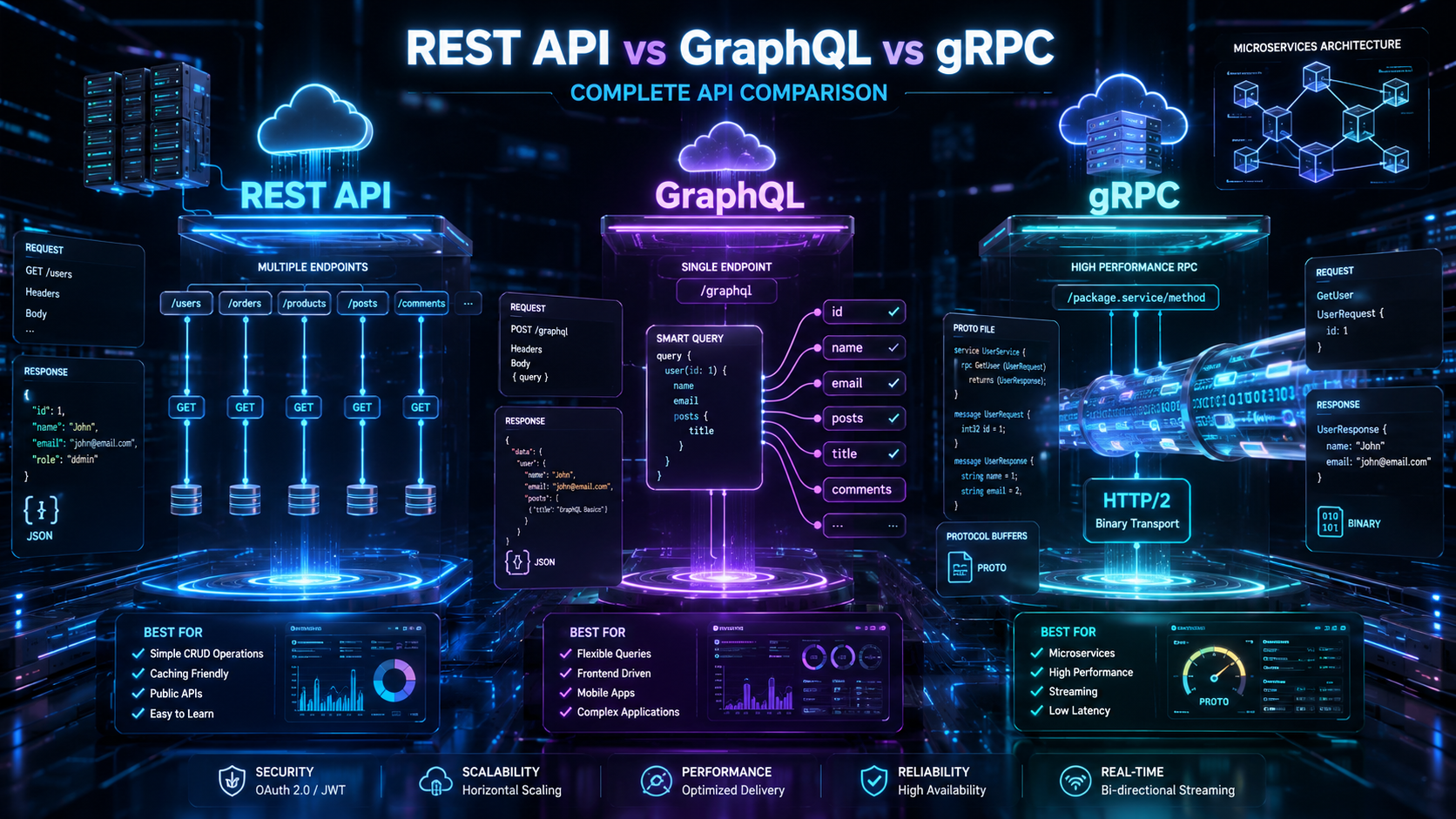
When building a website, mobile app, or software application, different parts of the system need to communicate with each other. This communication happens through APIs (Application Programming Interfaces). APIs allow applications to send requests, receive data, and work together smoothly.
Today, three API technologies are widely used: REST API, GraphQL, and gRPC. While they all help applications exchange data, they work in different ways and are designed for different purposes.
In this guide, we’ll explain each one in simple words, compare their features, and help you understand which option is best for your project.
What is an API?
Before comparing these technologies, it’s helpful to understand what an API is.
Think of an API as a waiter in a restaurant.
When you order food, you don’t go into the kitchen yourself. Instead, the waiter takes your order to the kitchen and brings your food back to you.
An API works the same way. It takes a request from an application, sends it to the server, and returns the requested information.
For example:
- A weather app requests today’s weather.
- A shopping app requests product details.
- A banking app requests your account balance.
Without APIs, modern applications wouldn’t be able to communicate with servers or other services.
What is REST API?
REST (Representational State Transfer) is the most popular and widely used API style. It has been around for many years and is used by thousands of websites and applications.
In REST, every type of data has its own URL, called an endpoint.
For example:
/users/products/orders
If an application wants user information, it sends a request to the user endpoint, and the server responds with the data, usually in JSON format.
REST uses standard HTTP methods such as:
- GET – Retrieve data
- POST – Create new data
- PUT – Update existing data
- DELETE – Remove data
Because REST follows simple rules, it is easy for beginners to learn and widely supported by almost every programming language.
Advantages of REST API
REST remains popular because it offers many benefits.
It is easy to understand, simple to build, and works with almost every platform. Most developers are already familiar with REST, making it a great choice for public APIs and standard web applications.
REST also supports browser caching, which can improve website performance and reduce server load.
Limitations of REST API
Although REST is simple, it isn’t perfect.
Sometimes an application receives more information than it actually needs. This is called over-fetching.
In other cases, one request doesn’t return enough information, forcing the application to make several additional requests. This is known as under-fetching.
As applications become larger and more complex, managing many REST endpoints can also become difficult.
What is GraphQL?
GraphQL is a newer API technology developed by Meta (Facebook). Instead of providing many different endpoints like REST, GraphQL uses a single endpoint for all requests.
The biggest advantage of GraphQL is that the client decides exactly what information it wants.
For example, imagine your application only needs a user’s name and email address.
With GraphQL, you ask for only those two fields, and the server returns exactly that data—nothing more and nothing less.
This makes applications faster because they don’t download unnecessary information.
Advantages of GraphQL
GraphQL gives developers much more flexibility.
Instead of making multiple API requests, applications can fetch everything they need in a single request. This reduces network traffic and improves performance, especially for mobile applications with slower internet connections.
Frontend developers also enjoy GraphQL because it allows them to request only the data their user interface actually needs.
Limitations of GraphQL
GraphQL is more powerful than REST, but it is also more complex.
Setting up a GraphQL server requires more planning and development effort. Caching is not as straightforward as REST, and poorly written queries can increase server load.
For smaller applications, GraphQL may be more than you actually need.
What is gRPC?
gRPC is a high-performance communication framework created by Google.
Unlike REST and GraphQL, which usually exchange JSON data, gRPC uses Protocol Buffers (Protobuf). This is a compact binary format that is much smaller and faster than JSON.
Because less data is transferred, communication between applications happens much more quickly.
This makes gRPC an excellent choice for systems where speed is extremely important.
Advantages of gRPC
The biggest strength of gRPC is performance.
It transfers data faster, uses less bandwidth, and supports real-time communication through streaming.
It also generates code automatically for many programming languages, helping developers build APIs more quickly.
Large companies often use gRPC for cloud services, distributed systems, and microservices because of its efficiency.
Limitations of gRPC
Although gRPC is very fast, it is not the easiest option for every project.
Since it uses binary data instead of JSON, developers cannot easily read responses in a browser.
It also has a steeper learning curve because developers need to understand Protocol Buffers before building APIs.
For simple websites or public APIs, REST is often easier to work with.
REST API vs GraphQL vs gRPC Comparison
| Feature | REST API | GraphQL | gRPC |
|---|---|---|---|
| Learning Difficulty | Easy | Medium | Advanced |
| Speed | Good | Better | Excellent |
| Data Format | JSON | JSON | Protocol Buffers |
| Browser Support | Excellent | Excellent | Limited |
| Data Flexibility | Fixed | Very Flexible | Fixed |
| Performance | Good | Very Good | Excellent |
| Multiple Endpoints | Yes | No | No |
| Streaming Support | Limited | Limited | Yes |
| Best For | Web APIs | Modern Apps | Microservices |
Which One Performs Better?
If your main goal is speed, gRPC is the fastest option because it sends compact binary data instead of JSON.
If your application needs flexible data and wants to avoid unnecessary requests, GraphQL performs better than REST.
For most websites and standard business applications, REST still provides excellent performance while remaining simple and reliable.
Which API Should You Choose?
The right choice depends on the type of application you’re building.
Choose REST API if you’re creating a public API, business website, eCommerce platform, or any application with standard CRUD operations. It’s easy to learn, widely supported, and simple to maintain.
Choose GraphQL if you’re building dashboards, social media platforms, SaaS products, or mobile applications where users need different types of data on the same screen. Its flexible queries help reduce unnecessary data transfers.
Choose gRPC if you’re developing microservices, cloud-native systems, IoT platforms, AI applications, or other high-performance software. Its speed and efficient communication make it ideal for large-scale distributed systems.
Real-World Examples
Many well-known companies use these API technologies in different ways.
REST APIs are commonly used by services like Stripe and PayPal because they are simple and easy for developers to integrate.
GraphQL powers applications such as Facebook, GitHub, and Shopify, where clients often need flexible access to data.
gRPC is widely used by Google Cloud, Kubernetes, Netflix, and other large platforms that require fast and efficient communication between internal services.
Conclusion
REST API, GraphQL, and gRPC all solve the same problem—helping applications communicate—but they do it in different ways.
REST is simple, reliable, and a great choice for most web applications. GraphQL gives developers more control over the data they receive, making it ideal for modern frontend and mobile apps. gRPC focuses on speed and efficiency, making it the preferred option for microservices and high-performance systems.
Instead of asking which technology is the “best,” think about what your project needs. Choosing the right API based on your application’s size, performance requirements, and development goals will help you build faster, more scalable, and easier-to-maintain software.
