Technology has become a major part of everyday life. From checking messages in the morning to watching videos at night, people spend hours looking at smartphones, laptops, tablets, televisions, and smartwatches.
Screens are useful, but constantly checking them can also be distracting. This is one reason technology companies and researchers are exploring a different idea: screenless wearables.
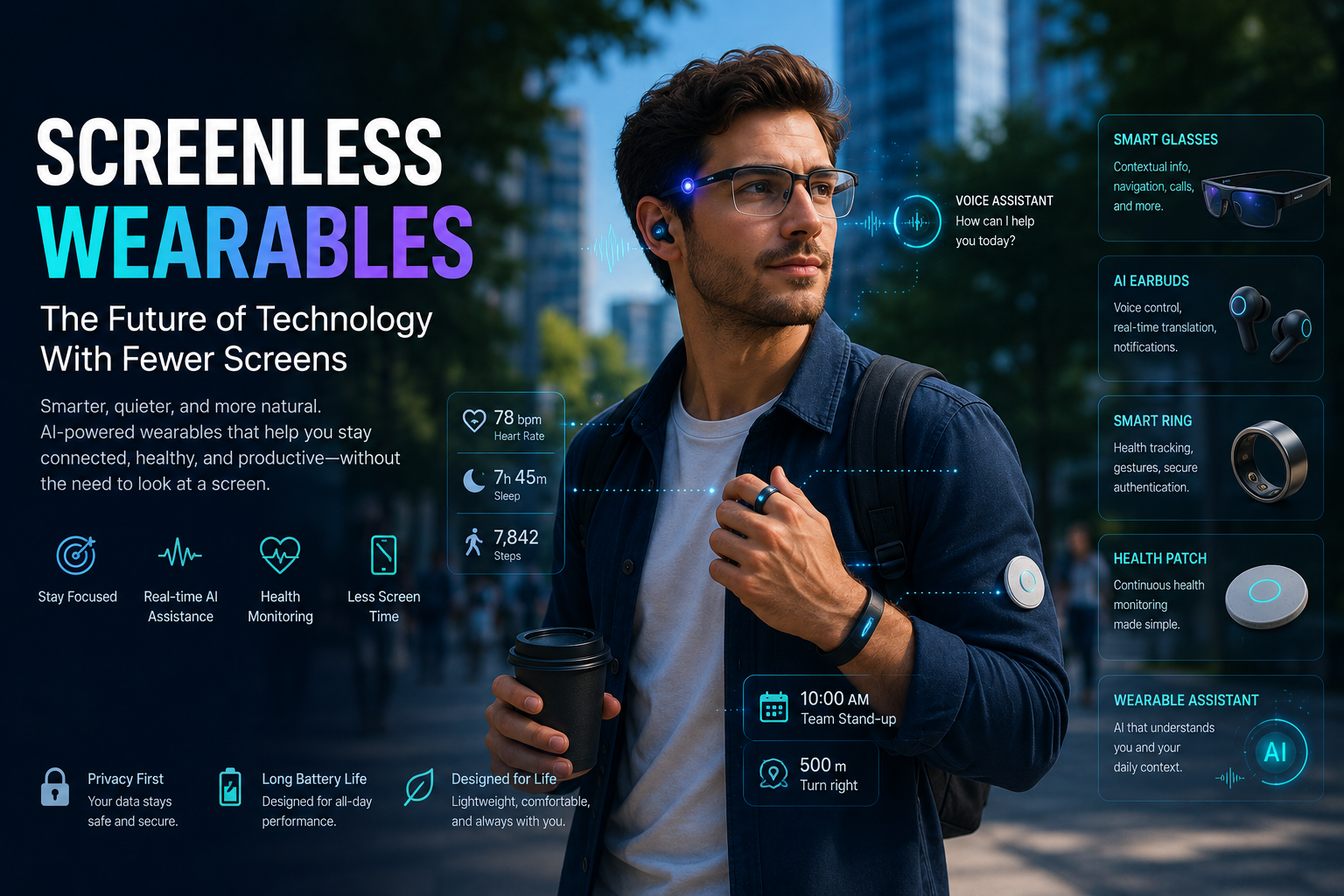
Screenless wearables are small, smart devices that can provide information and assistance without requiring users to constantly look at a display. They can use voice commands, audio, vibrations, gestures, artificial intelligence, and smart sensors to communicate with users.
The future may not be completely screen-free. Instead, technology could become less dependent on screens and fit more naturally into everyday life.
What Are Screenless Wearables?
Screenless wearables are electronic devices worn on the body that work without a traditional screen or use very little visual interaction.
Instead of opening an app and tapping through menus, users may interact with these devices through voice commands, touch, movement, audio feedback, or simple vibrations.
For example, smart earbuds can read notifications aloud, provide navigation directions, and allow users to talk with an AI assistant. A smart ring can track sleep and activity without showing a screen. A health patch can continuously collect useful body data while the user continues with normal daily activities.
The main goal is simple: provide useful technology without constantly demanding visual attention.
Why Are People Looking for Alternatives to Screens?
Most people use multiple screens every day. Smartphones are used for communication, entertainment, shopping, navigation, banking, work, and many other activities.
The problem is not that screens are bad. The challenge is that many digital experiences require people to stop what they are doing and look at a device.
Imagine walking in an unfamiliar city. Today, you may need to repeatedly check a map on your phone. A screenless wearable could provide simple audio directions or gentle vibration signals that guide you without requiring you to keep looking down.
This type of interaction could make technology feel less distracting and more connected to real-world activities.
How Do Screenless Wearables Work?
Screenless wearable technology combines several technologies to create a simple user experience.
Sensors can collect information about movement, activity, surroundings, and other useful signals. Microphones can receive voice commands. Speakers or earbuds can provide audio responses. Haptic systems can communicate through different vibration patterns.
Artificial intelligence can connect these technologies together.
For example, a user might ask a wearable AI assistant, “What is my next meeting?” The device could understand the request, check the connected calendar, and provide a short audio answer.
The user receives the required information without opening a phone, finding an app, or navigating through several screens.
The Role of AI in Screenless Technology
Artificial intelligence is one of the main technologies making screenless wearables more practical.
Traditional devices depend heavily on menus, buttons, and visual interfaces. AI allows people to communicate with technology using more natural language.
Instead of finding the correct setting manually, a person could simply ask the device what they need. AI can understand the request, process available information, and provide a useful response.
AI can also help personalize the experience. Over time, a wearable device may learn which notifications are important, when the user prefers fewer interruptions, and what type of information is most useful in different situations.
The goal is not to provide more notifications. A well-designed AI wearable should help reduce unnecessary digital noise.
Smart Rings Are a Simple Example of Screenless Wearables
Smart rings are one of the clearest examples of screenless wearable technology.
Unlike smartwatches, most smart rings do not have a display. They quietly collect information about sleep, activity, heart rate patterns, recovery, and other wellness signals.
Users can check detailed information later through a connected application, but they do not need to interact with a screen throughout the day.
This background approach is an important idea behind screenless technology. The device works quietly and provides useful information when the user wants it.
Smart Earbuds Are Becoming More Intelligent
Wireless earbuds were originally designed mainly for listening to music and making calls. Today, they are becoming much smarter.
Modern earbuds can support voice assistants, translate conversations, read notifications, provide navigation instructions, improve sound based on surroundings, and offer intelligent noise control.
As AI technology improves, earbuds could become an important interface for screenless computing.
Instead of taking out a phone for every small question, users could ask their earbuds for quick information and receive a short spoken response.
Because people already use earbuds regularly, this type of technology may feel more natural than introducing completely new devices.
Smart Glasses Could Reduce Phone Checking
Smart glasses are another important part of the future of wearable technology.
Some smart glasses focus on cameras, audio, calls, music, and AI assistance. Others use small visual displays to show limited information.
Although glasses with displays are not completely screenless, they may still reduce dependence on traditional screens. Instead of constantly holding a smartphone, users could receive short information directly through audio or a small visual interface.
Future smart glasses may help with navigation, translation, photography, communication, work instructions, and AI assistance.
The challenge is to make these devices comfortable, useful, private, and socially acceptable.
Wearable AI Assistants Could Change Daily Interactions
One of the most interesting ideas in screenless technology is the wearable AI assistant.
Imagine having a small device that can answer questions, summarize messages, create reminders, provide directions, translate languages, and help organize daily tasks.
Instead of opening multiple apps, the user could communicate with one intelligent assistant.
For example, a person could say, “Remind me to call the client when I reach the office.” The wearable could understand both the task and the context, then provide the reminder at the right time.
This kind of contextual assistance could make digital technology feel more helpful and less demanding.
Health Monitoring May Become More Invisible
Health and wellness technology is another area where screenless wearables could become important.
Devices such as smart rings, sensor patches, smart clothing, and other compact wearables can collect information without requiring regular interaction.
The user does not need to constantly check numbers or graphs. Instead, the system can analyze patterns and highlight meaningful changes or useful trends.
For example, a wearable may notice changes in sleep patterns, recovery, activity, or stress-related signals. Rather than showing endless data, it could provide a simple and understandable summary.
However, health-related information needs careful design, strong privacy protection, and responsible communication. Wearable devices should support informed decisions rather than create unnecessary worry.
Screenless Technology Could Help Reduce Digital Distraction
One possible benefit of screenless wearables is reduced digital distraction.
People often unlock their phones for one small task and then spend much longer checking messages, social media, videos, or other apps.
A screenless device could provide only the information needed at that moment.
For example, checking the weather could be a five-second voice interaction. Getting directions could happen through audio instructions. An important message could be summarized instead of requiring the user to open several applications.
The idea is to make technology available without making it the center of attention.
Privacy Is a Major Challenge
Screenless wearables also create important privacy concerns.
Many devices depend on microphones, cameras, location information, and personal data. Users need to understand what information is collected, where it is processed, how long it is stored, and who can access it.
Devices with cameras can also affect people nearby who have not chosen to use the technology.
Clear recording indicators, strong security, transparent privacy controls, and responsible product design will be essential for building trust.
Convenience should not come at the cost of user privacy.
Battery Life Remains an Important Problem
Wearable devices are small, which means they have limited space for batteries.
Features such as continuous sensing, wireless connectivity, audio processing, cameras, and AI can use significant power.
A screenless design can save energy because displays often consume power. However, advanced sensors and AI features can still create battery challenges.
Future improvements in efficient processors, battery technology, charging methods, and low-power AI processing will help make wearables more practical for everyday use.
Will Screenless Wearables Replace Smartphones?
Screenless wearables are unlikely to completely replace smartphones in the near future.
Phones are still better for activities such as watching videos, editing documents, browsing complex websites, gaming, reading long content, and completing tasks that need a large visual interface.
The more realistic future is a combination of devices.
A smartphone may remain the main computing device, while wearables handle smaller and more immediate interactions. Users could receive directions through earbuds, track wellness with a smart ring, ask questions through an AI assistant, and use a phone only when a larger screen is actually useful.
This could reduce unnecessary screen time without removing screens completely.
What Does the Future of Wearable Technology Look Like?
The future of wearable technology is likely to focus on devices that are smaller, smarter, and less demanding.
Instead of asking users to constantly open apps and check notifications, future wearables may work quietly in the background.
AI could help decide what information is important. Sensors could understand context. Audio and haptic feedback could provide simple information without interrupting what the user is doing.
The most successful wearable devices may not be the ones with the most features. They may be the devices that know when to help and when to stay quiet.
Final Thoughts
Screenless wearables represent an interesting shift in how people interact with technology.
For many years, digital innovation has focused on adding more screens to everyday life. Now, the next stage of technology may focus on reducing the need to look at them.
Smart rings, intelligent earbuds, smart glasses, health patches, smart clothing, and wearable AI assistants show how technology can become more integrated into daily routines.
The future will probably not be completely screenless. Screens will remain useful for many activities. However, people may no longer need to look at a screen for every message, question, direction, reminder, or update.
The real promise of screenless wearable technology is not simply removing displays. It is creating technology that feels more natural, less distracting, and more helpful in everyday life.
