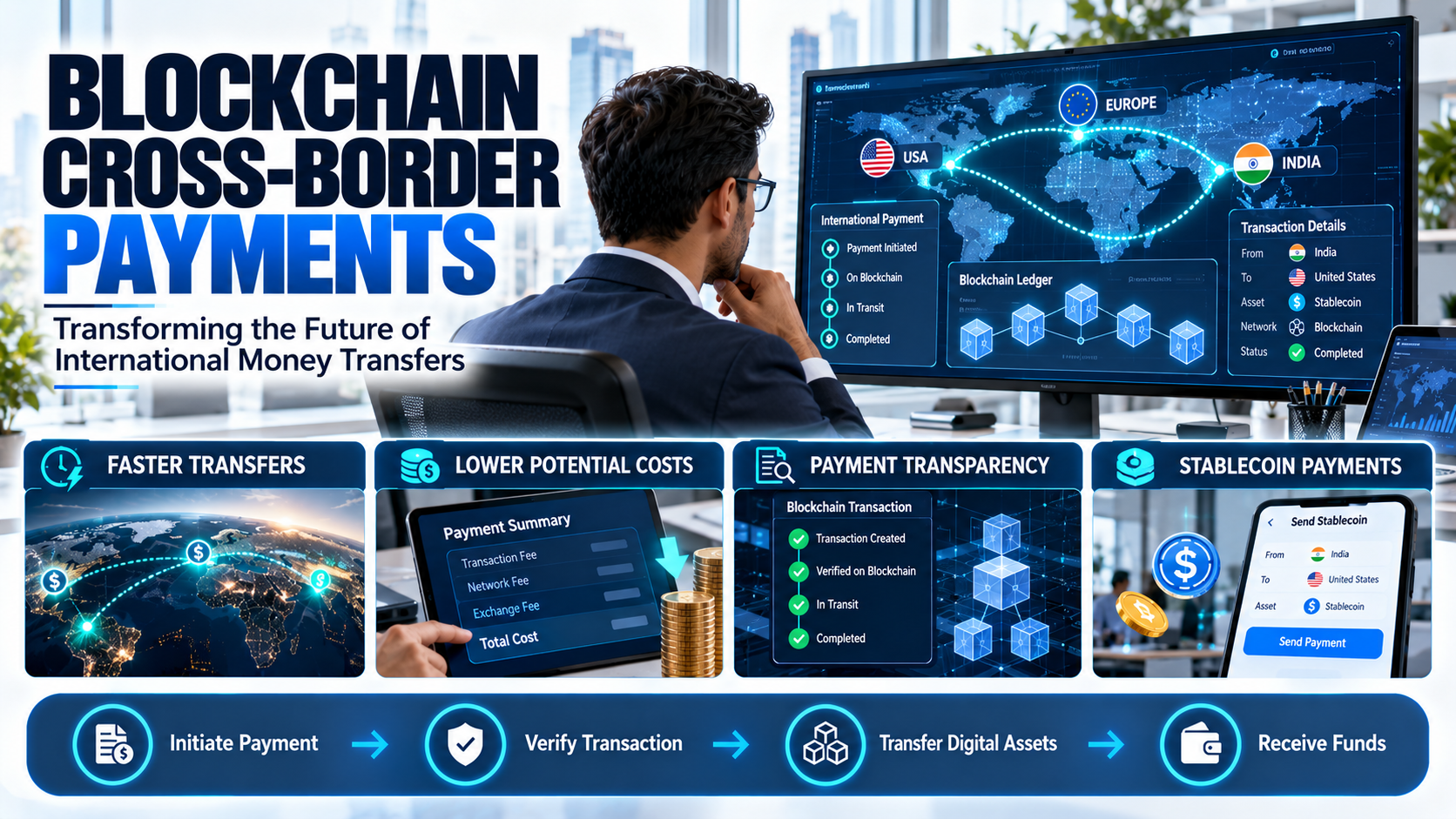
Sending money from one country to another is an important part of the global economy. Businesses use international payments to pay suppliers, freelancers, and employees, while individuals send money to family members living abroad. However, traditional cross-border payments can involve high fees, currency conversion costs, processing delays, and multiple financial intermediaries.
Blockchain technology is creating new ways to transfer money internationally. By using distributed digital ledgers and blockchain-based payment networks, financial service providers can process certain transactions more directly and improve payment tracking.
Stablecoins, which are digital assets designed to maintain a relatively stable value against a reference currency, are also becoming part of the discussion around international payments. However, blockchain payments are not automatically cheaper or faster in every situation. Their effectiveness depends on the network, exchange rates, service providers, and local regulations.
What Are Cross-Border Payments?
Cross-border payments are financial transactions in which the sender and recipient are located in different countries.
For example, imagine a company in India purchasing software development services from a company in the United States. The Indian company needs to send money in a way that allows the American company to receive the payment in an accepted currency.
Traditional international transfers may involve the sender’s bank, one or more intermediary banks, and the recipient’s bank. Each institution may have its own processing procedures, fees, and compliance requirements.
Common examples of cross-border payments include:
- International business transactions.
- Payments to overseas suppliers.
- Remittances sent to family members.
- Payments to international freelancers.
- Global e-commerce transactions.
- International payroll and contractor payments.
Although digital banking has made international transfers more convenient, the underlying payment process can still be complex.
What Is Blockchain Technology?
Blockchain is a type of distributed digital ledger that records transactions across a network of computers. Depending on the blockchain, transactions are validated through a defined consensus mechanism and recorded in a way that makes unauthorized changes difficult.
Instead of relying exclusively on a single database maintained by one institution, a blockchain network allows participating systems to share a consistent record of transactions.
Blockchain technology can support financial applications such as digital asset transfers, smart contracts, and payment settlement.
For international payments, blockchain can provide a shared transaction record and a way to transfer supported digital assets between blockchain addresses.
However, blockchain does not eliminate every financial intermediary. Users may still need banks, payment providers, currency exchanges, or digital asset platforms to convert money between traditional currencies and blockchain-based assets.
How Does Blockchain Transform Cross-Border Payments?
Blockchain can change how certain international payments are initiated, transferred, recorded, and settled.
1. Faster International Transactions
Traditional international bank transfers can take hours or several business days, depending on the payment route, banking hours, compliance checks, and intermediary institutions.
Some blockchain networks can confirm transactions within seconds or minutes. These networks may operate continuously, including outside conventional banking hours.
This can help businesses transfer supported digital assets without waiting for every step of a traditional banking process.
However, blockchain transaction confirmation does not always mean the recipient has immediately received usable local currency. Currency conversion, withdrawal processing, banking procedures, and compliance checks can introduce additional delays.
2. Potentially Lower Transaction Costs
International transfers can include bank fees, intermediary charges, currency conversion margins, and recipient-side fees.
Blockchain-based payment systems may reduce certain intermediary costs by moving supported assets directly between participants.
For example, a business making an international payment through a blockchain-based service might pay a network transaction fee and a service-provider fee instead of paying several traditional transfer charges.
However, total costs depend on the complete transaction process. Buying digital assets, converting them into another currency, withdrawing funds, and complying with local requirements can all create additional expenses.
Therefore, businesses should compare the full cost of a blockchain-based transfer with the total cost of conventional payment services before choosing a method.
3. Better Payment Transparency
Tracking an international bank transfer can sometimes be difficult when several financial institutions participate in the payment process.
A blockchain can provide a shared record of transactions and allow users to check transaction status using the relevant network’s tools.
Depending on the blockchain and payment service, users may be able to verify transaction details, including the transaction identifier, confirmation status, and destination address.
This visibility can help businesses investigate payment delays and maintain financial records.
However, public blockchain data does not necessarily reveal the real-world identity of the people involved. Furthermore, a visible blockchain transaction does not guarantee that a payment provider has completed the associated currency conversion or bank payout.
4. Fewer Intermediaries in Some Payment Routes
Traditional cross-border payments may pass through multiple correspondent banks before reaching the recipient.
Some blockchain-based payment systems can reduce the number of intermediaries required to transfer digital assets between participating wallets.
For example, a business may transfer a supported stablecoin from its payment account to a supplier’s compatible wallet through a blockchain network.
This can simplify the digital asset transfer itself.
Nevertheless, regulated service providers, stablecoin issuers, exchanges, and local payment partners may still participate in the overall process. Their services can be essential for identity verification, currency conversion, compliance, and access to local banking systems.
5. Continuous Payment Availability
Many blockchain networks operate around the clock. Transactions can therefore be submitted outside normal banking hours, including weekends and public holidays.
This can be useful for international businesses working with suppliers and employees in different time zones.
For example, a company may initiate a blockchain-based payment on a weekend rather than waiting for the next banking business day.
The actual time needed to complete the payment still depends on network conditions, payment-provider operating hours, compliance reviews, and the recipient’s withdrawal options.
6. Automated Payments Through Smart Contracts
Smart contracts are programs deployed on compatible blockchain networks. They can execute predefined actions when specified conditions are met.
In cross-border business transactions, smart contracts may support automated payment workflows.
For example, a business could design a payment process in which funds are released after a delivery confirmation or another agreed digital condition is verified.
This approach may reduce manual steps and improve coordination between payment and business processes.
However, smart contracts cannot automatically verify every real-world event. External information may need to be supplied by trusted systems or services, and programming errors can create financial risks.
What Are Stablecoins and Why Do They Matter?
Stablecoins are digital assets designed to maintain a stable value relative to a reference asset, most commonly a national currency such as the US dollar.
Unlike Bitcoin, whose market price can fluctuate substantially, fiat-referenced stablecoins aim to maintain a more predictable value relative to their reference currency.
Examples include USDC and USDT, which are designed to track the US dollar.
Stablecoins can be transferred using supported blockchain networks, making them relevant to some international payment applications.
A typical stablecoin payment may involve three main stages:
Step 1: Currency conversion
The sender converts traditional money into a supported stablecoin through an appropriate provider.
Step 2: Blockchain transfer
The stablecoin is transferred to the recipient’s compatible wallet or payment service.
Step 3: Conversion to local currency
The recipient can hold the stablecoin or convert it into an accepted local currency through a supported provider, where legally permitted.
This process can provide an alternative way to move digital value across borders. However, the sender and recipient must consider exchange rates, network fees, platform charges, liquidity, stablecoin backing, and local regulations.
A stablecoin’s intended price stability does not make it risk-free or guarantee that it can always be redeemed at its target value.
Real-World Applications of Blockchain in Cross-Border Payments
Blockchain-based payment infrastructure can support several types of international transactions.
1. International Money Transfers
People working abroad often send money to family members in their home countries.
Blockchain-based payment services may offer another way to move value internationally, particularly where the required digital asset and local currency conversion services are available.
The final cost and speed depend on the payment route, local infrastructure, and service providers.
2. International Business Payments
Companies regularly pay overseas suppliers, manufacturers, and service providers.
Blockchain-based payment systems may help businesses transfer supported digital assets and maintain transaction records for reconciliation.
Before using such a system, companies need to evaluate supplier acceptance, accounting requirements, compliance obligations, and the process for converting funds into the required currency.
3. Freelancer and Remote Worker Payments
Businesses increasingly work with contractors located in different countries.
Depending on the countries involved and the available payment services, blockchain-based transfers may provide an additional option for paying international freelancers.
Businesses should also consider tax reporting, employment classification, payment documentation, and the recipient’s ability to access local currency.
4. Global E-Commerce
Online businesses may receive payments from customers or partners located around the world.
Blockchain-based payment services can support digital asset payments and potentially simplify certain settlement processes.
However, merchants must consider customer preferences, payment volatility, refunds, consumer protection, and the practical requirements of converting receipts into operating currency.
5. International Treasury Operations
Large companies often move funds between accounts and business entities in different countries.
Blockchain-based settlement systems may help eligible institutions coordinate certain transfers and improve transaction visibility.
Institutional use requires careful attention to liquidity, internal controls, regulatory compliance, and the legal status of the assets involved.
Blockchain Payments vs Traditional International Transfers
The differences between blockchain-based payments and traditional bank transfers depend on the specific systems being compared.
| Feature | Traditional Bank Transfers | Blockchain-Based Payments |
|---|---|---|
| Payment infrastructure | Banking and correspondent networks | Blockchain networks and connected services |
| Processing availability | May depend on banking hours and payment systems | Many networks operate continuously |
| Settlement speed | Can range from near-real-time to several business days | Network confirmation may take seconds or minutes, depending on the network |
| Transaction costs | May include bank fees and currency conversion charges | May include network, platform, conversion, and withdrawal fees |
| Transaction tracking | Depends on the banks and payment providers | Blockchain records may provide transaction-level visibility |
| Currency conversion | Usually handled through financial institutions or payment providers | May require exchanges or other conversion services |
| Reversals and disputes | Recall or dispute processes may be available, subject to the payment method | Confirmed on-chain transfers are often difficult or impossible to reverse |
| Regulatory requirements | Subject to applicable financial rules | Also subject to applicable laws and compliance requirements |
Neither approach is universally better. The appropriate option depends on the countries involved, transaction size, payment purpose, total cost, and the sender’s and recipient’s requirements.
Benefits of Blockchain-Based Cross-Border Payments
Blockchain can offer several potential advantages when implemented through reliable and appropriate payment systems.
Faster settlement: Some networks can confirm digital asset transfers much faster than conventional international banking routes.
Improved visibility: Transaction records can make it easier to check the status of supported blockchain transfers.
Continuous availability: Many blockchain networks can process transactions outside conventional banking hours.
Payment automation: Smart contracts can automate certain predefined payment steps.
Alternative payment infrastructure: Blockchain can provide another option for transferring digital value between supported services.
Potential cost savings: Some payment routes may reduce costs, although the overall result depends on conversion fees, liquidity, and service-provider charges.
These advantages are possibilities rather than guarantees. A practical comparison should consider the entire payment journey, not just the blockchain transaction fee.
Challenges and Risks of Blockchain Cross-Border Payments
Despite its potential, blockchain technology does not solve every problem associated with international money transfers.
1. Regulatory Uncertainty
Countries have different rules for cryptocurrencies, stablecoins, payment services, taxation, and international money transfers.
A transaction that is permitted in one jurisdiction may face restrictions or additional requirements in another.
Businesses and individuals should check the rules that apply to their location and the countries involved.
2. Cryptocurrency Price Volatility
Cryptocurrencies such as Bitcoin and Ether can experience significant price changes.
If a payment is made using a volatile cryptocurrency, its value may change between the time it is sent and the time it is converted into local currency.
Stablecoins can reduce exposure to this particular type of price volatility, but they introduce other risks, including reserve, redemption, issuer, and depegging risks.
3. Conversion and Withdrawal Fees
Blockchain transaction fees are only one part of the total payment cost.
Users may also pay fees to purchase digital assets, exchange currencies, convert stablecoins into local money, or withdraw funds through a payment provider.
In some cases, these combined costs can make a blockchain-based transfer no cheaper than a traditional bank transfer.
4. Security Risks
Blockchain payments can be exposed to phishing attacks, compromised wallets, stolen private keys, malicious smart contracts, and fraudulent platforms.
Many confirmed blockchain transactions cannot simply be cancelled. Sending assets to the wrong address may result in permanent loss.
Users should carefully verify recipient details and use secure wallets and trustworthy service providers.
5. Limited Adoption and Liquidity
Not every business, bank, or individual accepts blockchain-based payments.
Some countries and currencies also have limited liquidity for converting digital assets into local money.
A technically successful transfer may therefore be difficult or expensive to convert into spendable funds.
6. Compliance and Identity Verification
Payment providers may need to verify customers, screen transactions, comply with anti-money-laundering rules, and meet sanctions requirements.
Blockchain technology does not automatically remove these obligations.
Businesses must understand the compliance responsibilities that apply to their payment arrangements.
Is Blockchain the Future of Cross-Border Payments?
Blockchain is likely to remain part of the development of international payment infrastructure, but it should not be viewed as a complete replacement for traditional banking.
Financial institutions and payment providers can explore blockchain-based settlement, stablecoin transfers, and other digital payment technologies to improve particular processes.
The most useful solutions will be those that combine reliable technology with accessible currency conversion, adequate liquidity, clear regulations, consumer protection, and dependable customer support.
For many businesses, the future may involve several payment methods operating together. Traditional bank transfers, modern digital payment services, and blockchain-based systems can each serve different needs.
The main objective is not simply to use blockchain. It is to make international payments more reliable, transparent, accessible, and cost-effective for the people and businesses that depend on them.
The Future of Blockchain Payments in India
India has a large international workforce, a significant remittance market, and an expanding digital payments ecosystem.
Blockchain-based payment systems may provide additional options for international business payments and digital asset transfers as the technology and supporting services develop.
However, domestic digital payment infrastructure and cross-border blockchain payments are not the same thing. India’s established digital payment systems do not automatically make cryptocurrency or stablecoin transfers equivalent to regulated domestic payment methods.
Anyone considering blockchain-based international transfers should check applicable Indian regulations, tax obligations, foreign exchange requirements, and the legal status of the service being used.
For businesses, the practical questions include whether the recipient can receive the payment legally, whether funds can be converted into the required currency, and whether the complete process meets accounting and compliance requirements.
The future development of blockchain payments in India will depend on technology, regulation, financial institutions, and the availability of reliable services for users.
Conclusion
Blockchain is creating new possibilities for cross-border payments by supporting digital asset transfers, improving transaction visibility, enabling continuous network availability, and automating certain payment processes.
Stablecoins are particularly relevant because they are designed to maintain a relatively stable value against a reference currency and can move across supported blockchain networks.
However, blockchain payments still face challenges involving regulation, security, currency conversion, liquidity, and service-provider fees. Faster blockchain confirmation does not necessarily mean faster access to local currency, and lower network fees do not guarantee lower overall costs.
For individuals and businesses, the best payment method depends on the transaction’s purpose, destination, cost, speed, and legal requirements.
As digital financial infrastructure develops, blockchain may become an increasingly useful component of international payments alongside traditional banking and modern payment services.
