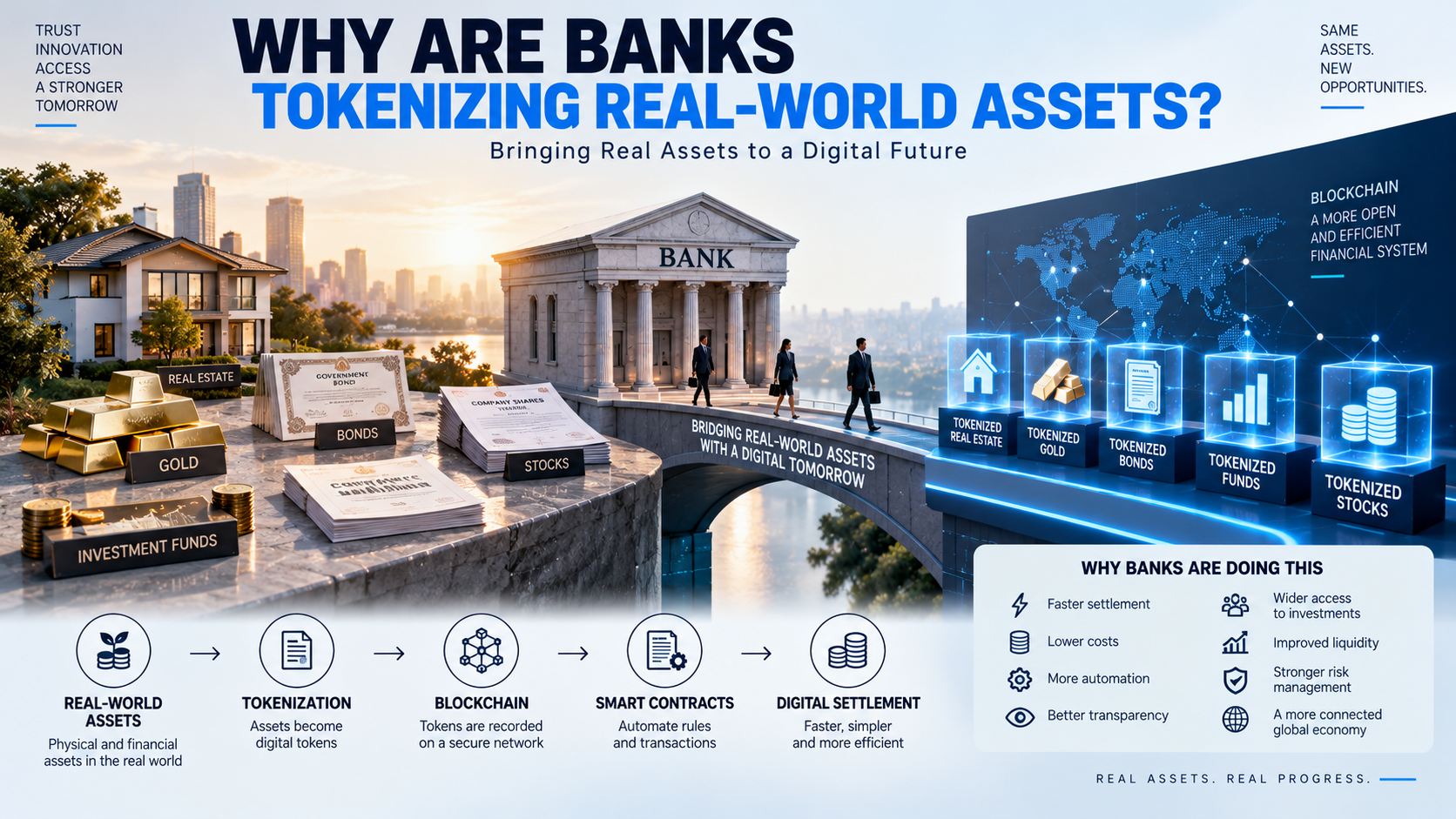
Blockchain is known mainly for cryptocurrencies such as Bitcoin and Ethereum. But banks are now exploring blockchain for another important purpose: tokenizing real-world assets.
This means creating digital tokens that represent real financial or physical assets.
Banks are interested in tokenization because it could make some financial processes faster, easier to automate, and simpler to manage.
But what exactly are real-world assets, and why are banks putting them on blockchain?
What Are Real-World Assets?
Understanding Real-World Assets
Real-world assets are things that already exist outside the blockchain.
Some common examples include:
- Government bonds
- Corporate bonds
- Stocks
- Real estate
- Gold
- Investment funds
- Loans
- Other financial assets
These assets can be represented digitally using blockchain-based tokens.
What Is Asset Tokenization?
Turning Assets Into Digital Tokens
Asset tokenization means creating a digital token that represents an asset or a financial right connected to an asset.
For example, imagine a company owns a bond.
A token can be created to represent the ownership or rights connected to that bond. The token can then be recorded and transferred using blockchain technology.
In simple words:
Real Asset → Digital Token → Blockchain
Tokenization does not mean the physical asset disappears. The important legal and ownership connection between the token and the underlying asset still needs to be properly established.
Why Are Banks Interested in Tokenization?
Faster Financial Transactions
Traditional financial transactions can involve several systems and organizations.
Information may need to move between banks, brokers, custodians and settlement systems.
Tokenization can bring some of these activities onto shared digital infrastructure.
This could help reduce delays and unnecessary manual work. The BIS has identified potential efficiency improvements in areas such as trading, settlement and collateral management.
Can Tokenization Make Settlement Faster?
Understanding Financial Settlement
Settlement is the final step of a financial transaction.
For example, when someone buys a bond:
Buyer sends money → Seller transfers the bond
In traditional systems, these processes can involve different systems.
With tokenized assets, the payment and asset transfer can potentially happen together.
This is often called Delivery versus Payment (DvP).
In simple terms:
Money moves + Asset moves = Transaction completed
Can Smart Contracts Automate Banking?
What Are Smart Contracts?
Smart contracts are programs that automatically follow predefined rules.
For example:
If payment is received → transfer the asset.
Another example:
When a bond reaches its payment date → process the payment.
This can reduce some manual work and make certain financial processes easier to automate.
Tokenized financial systems can use smart contracts to automate activities such as payments, transfers and other asset-related processes.
What Assets Can Banks Tokenize?
Tokenized Bonds
Government and corporate bonds are examples of financial assets that can be represented digitally.
A tokenized bond can use blockchain infrastructure to record ownership and support transactions.
Tokenized Real Estate
Real estate is another possible use case.
A tokenized structure can represent ownership or an investment interest connected to a property.
However, property laws and legal ownership still need to be handled properly outside or alongside the blockchain.
Tokenized Gold
Gold can also be represented by digital tokens when there is a suitable system connecting the tokens to the underlying physical gold.
This can allow the ownership record to be managed digitally.
Tokenized Investment Funds
Investment funds are another area where tokenization is developing.
For example, J.P. Morgan Asset Management launched a tokenized money market fund on Ethereum in May 2026, showing how traditional investment products can be represented and managed on blockchain infrastructure.
Can Tokenization Reduce Banking Costs?
Less Manual Work
Banks operate large and complicated financial systems.
Many processes require:
- Data entry
- Record keeping
- Reconciliation
- Settlement
- Reporting
- Multiple intermediaries
Tokenization could automate some of these processes.
However, blockchain does not automatically make every financial system cheaper. Banks still need to consider technology costs, regulations, security and integration with existing systems.
Can Blockchain Improve Transparency?
One Shared Digital Record
Blockchain can provide a shared record of transactions.
Instead of different organizations maintaining completely separate records, a blockchain-based system can allow authorized participants to work from a common digital record.
This can potentially reduce differences between systems and make transaction tracking easier.
The exact level of transparency depends on whether the blockchain is public or permissioned and who is allowed to access the information.
Why Is Programmability Important?
Making Financial Assets Smarter
One major benefit of tokenization is programmability.
A tokenized asset can be connected to software rules.
For example:
Payment received → Transfer asset
Maturity reached → Make payment
Condition satisfied → Execute transaction
This can turn some financial processes into automated digital workflows.
Can Tokenization Help With Collateral?
Using Assets More Efficiently
Banks and financial companies often use assets as collateral for loans and other transactions.
Managing collateral can involve multiple systems and manual processes.
Tokenization can make it easier to track and transfer certain assets digitally.
J.P. Morgan’s Tokenized Collateral Network, for example, is designed to let institutions use tokenized assets as collateral while keeping the underlying investment exposure.
Can Tokenized Assets Improve Liquidity?
Making Assets Easier to Move
Liquidity means how easily an asset can be bought, sold or transferred.
Some assets, such as private investments or certain financial products, can be difficult to transfer quickly.
Tokenization could make some assets easier to transfer and potentially create new ways to access liquidity.
However, tokenization alone does not guarantee that an asset will become highly liquid. Buyers, sellers, market rules and regulations are still important.
Can Tokenized Assets Work 24/7?
Always-On Financial Infrastructure
Blockchain networks can operate continuously.
This means tokenized assets can potentially be transferred outside traditional market hours.
Some financial institutions are already building blockchain infrastructure designed for continuous digital asset movement and settlement.
But this does not mean every financial market will immediately become a 24/7 market. Market rules, regulations and liquidity still matter.
Are Banks Actually Using Tokenization?
From Experiments to Real Products
Tokenization is no longer only a theoretical idea.
Banks and financial institutions are testing and launching tokenized products and infrastructure.
For example, J.P. Morgan offers asset-tokenization services that can bring traditional assets onto public or private blockchain networks.
Its 2026 tokenized money market fund launch is another example of a traditional investment product being represented on a public blockchain.
What Are the Main Benefits?
Why Could Banks Use Tokenized Assets?
Tokenization could provide several benefits:
- Faster settlement
- More automation
- Easier transaction tracking
- Digital ownership records
- Better collateral management
- Less manual reconciliation
- Programmable transactions
- Potentially lower operational costs
- New ways to distribute financial products
These are potential benefits. The actual results depend on how the system is designed and adopted.
What Are the Challenges?
Tokenization Is Not Perfect
Banks also face several challenges when using blockchain.
Regulation
Financial assets are regulated.
Banks need to follow rules covering ownership, investor protection, reporting and other requirements.
Legal Ownership
A token must have a clear legal connection to the underlying asset.
Simply putting a token on a blockchain does not automatically prove ownership of a physical asset.
Security
Blockchain systems, wallets and smart contracts need strong security.
A technical problem can create serious financial risks.
Interoperability
Different blockchain networks need to communicate with each other.
If every bank uses a completely different system, moving assets between networks can become difficult.
Existing Banking Systems
Banks already use large legacy systems.
Connecting blockchain technology with these systems can take time and investment.
Is Tokenization the Same as Cryptocurrency?
Tokenized Assets vs Crypto
Tokenized assets and cryptocurrencies are not the same thing.
Cryptocurrency:
A digital asset such as Bitcoin that exists natively on a blockchain.
Tokenized asset:
A digital token representing an existing asset or financial right.
For example:
Bitcoin → Native digital asset
Tokenized bond → Digital representation of a traditional financial asset
This difference is important when discussing blockchain in banking.
Will Tokenization Replace Banks?
Blockchain and Banks Could Work Together
Tokenization does not necessarily mean banks will disappear.
Banks still provide services such as:
- Loans
- Payments
- Custody
- Compliance
- Risk management
- Customer services
- Financial products
Instead, blockchain could become another technology used by banks to improve parts of their existing infrastructure.
The BIS has described tokenization as part of the possible development of future financial infrastructure rather than simply a replacement for the existing financial system.
What Could Banking Look Like in the Future?
A More Connected Financial System
Imagine buying a tokenized bond in the future.
The process could look like this:
Step 1: Verify the customer
Step 2: Check available funds
Step 3: Transfer digital money
Step 4: Transfer the tokenized bond
Step 5: Record the transaction
Step 6: Automatically process future payments
Much of this process could be connected through blockchain and smart contracts.
Why Is Tokenization Becoming Important in 2026?
Blockchain Is Moving Beyond Crypto
One of the biggest changes is that blockchain is increasingly being explored for traditional financial activities.
Banks are looking at tokenization for:
- Securities
- Investment funds
- Collateral
- Payments
- Settlement
- Asset management
J.P. Morgan’s 2026 infrastructure describes tokenization as a way to move assets, automate processes and connect blockchain applications with existing financial systems.
What Is the Future of Real-World Asset Tokenization?
More Financial Assets Could Move On-Chain
The future could involve more traditional assets being represented digitally.
We could see greater use of:
- Tokenized bonds
- Tokenized funds
- Tokenized real estate
- Tokenized commodities
- Tokenized collateral
- Tokenized deposits
- Blockchain-based settlement
But widespread adoption will depend on regulation, technology, security, interoperability and demand.
Why Are Banks Tokenizing Real-World Assets?
The Simple Answer
Banks are exploring real-world asset tokenization because blockchain can potentially make financial assets easier to manage, transfer and automate.
The idea is not simply to put assets on a blockchain.
The bigger goal is to create a financial system where:
Assets + Money + Rules + Transactions
can work together on digital infrastructure.
Conclusion
Real-world asset tokenization is becoming an important part of the conversation around the future of banking.
Banks are exploring it because tokenized assets could support faster settlement, automated transactions, better collateral management, improved tracking and new financial products.
However, there are still challenges involving regulation, security, legal ownership, interoperability and existing banking systems.
In simple words:
Tokenization could turn traditional assets into programmable digital assets and change how banks manage, transfer and settle financial products.
The future of blockchain may therefore be about much more than cryptocurrency. It could also become part of the infrastructure behind traditional finance.
