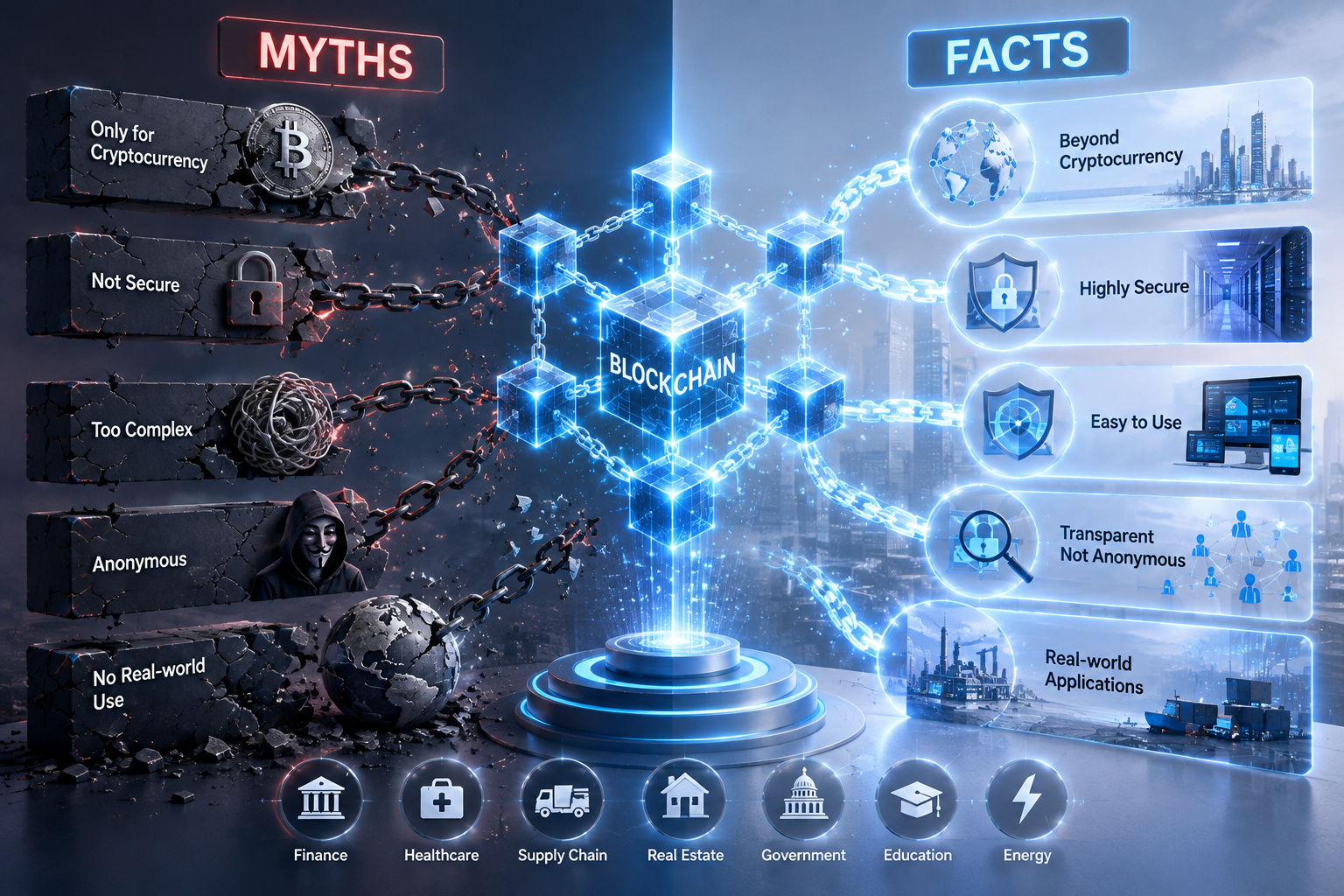
Blockchain has become one of the most talked-about technologies in recent years. Many people know it because of cryptocurrencies like Bitcoin and Ethereum, but blockchain is much more than digital money.
As blockchain continues to grow, so do the misunderstandings about it. Some people believe it is only used for cryptocurrency, while others think it is completely anonymous or too complicated for businesses.
The truth is that many of these ideas are myths. Understanding what blockchain really is can help businesses and individuals make better decisions about using this technology.
In this article, we’ll clear up some of the biggest blockchain myths in simple language and explain the real facts behind them.
Blockchain Is Only About Cryptocurrency
This is probably the biggest myth.
While cryptocurrencies use blockchain technology, blockchain itself has many other applications.
Today, businesses use blockchain to track products in supply chains, manage digital identities, improve healthcare records, protect important documents, and create secure business transactions.
Think of blockchain as the technology, while cryptocurrency is just one of its many uses.
Blockchain Is Only for Large Companies
Many people think blockchain is only useful for big corporations with huge budgets.
In reality, businesses of all sizes can benefit from blockchain.
Small businesses can use blockchain to improve payment systems, secure customer data, verify products, and simplify record keeping.
As blockchain platforms become more affordable, they are becoming accessible to startups and small businesses as well.
Blockchain and Bitcoin Are the Same Thing
People often use the words “blockchain” and “Bitcoin” as if they mean the same thing.
They don’t.
Bitcoin is a cryptocurrency.
Blockchain is the technology that makes Bitcoin possible.
Just like email uses the internet, Bitcoin uses blockchain.
The technology can exist without Bitcoin and is now being used in many industries beyond finance.
Blockchain Is Completely Anonymous
Another common misunderstanding is that blockchain hides everyone’s identity.
Most public blockchains are actually transparent, not anonymous.
Every transaction is recorded permanently and can be viewed by anyone.
While users are identified through wallet addresses instead of names, many transactions can still be traced with the right tools.
Some blockchain networks also require identity verification depending on their purpose.
Blockchain Cannot Be Hacked
Blockchain is one of the most secure technologies available, but it is not impossible to attack.
The blockchain itself is protected using advanced cryptography and decentralized validation.
However, hackers often target cryptocurrency wallets, smart contracts, exchanges, or users rather than the blockchain network itself.
In most cases, security problems happen because of weak passwords, phishing attacks, or software vulnerabilities—not because the blockchain has failed.
Blockchain Is Too Slow for Business
Early blockchain networks sometimes struggled with transaction speed.
Modern blockchain platforms have improved significantly.
Many newer networks can process thousands of transactions every second, making them suitable for payment systems, supply chains, and enterprise applications.
Developers continue to improve blockchain performance through better consensus mechanisms and scaling technologies.
Blockchain Uses Too Much Energy
This myth became popular because Bitcoin uses a system called Proof of Work, which requires significant computing power.
However, not every blockchain works this way.
Many modern blockchain platforms now use Proof of Stake and other energy-efficient methods that consume far less electricity.
As blockchain technology evolves, sustainability has become a major focus for developers.
Blockchain Data Can Be Changed Anytime
One of blockchain’s biggest strengths is that records are extremely difficult to modify.
Once information is added and confirmed by the network, changing it would require altering copies stored across many computers at the same time.
This makes blockchain an excellent solution for keeping accurate and trustworthy records.
Although updates can be added, previous records remain visible, creating a transparent history.
Blockchain Will Replace Every Traditional System
Some people believe blockchain will completely replace banks, databases, and existing business systems.
The reality is different.
Blockchain is a powerful tool, but it is not the best solution for every problem.
Many organizations combine blockchain with traditional databases and cloud services to build more efficient systems.
Businesses should use blockchain where it adds value instead of replacing everything they already use.
Blockchain Has No Real-World Applications
Blockchain is already being used in many industries around the world.
Some common examples include:
Supply Chain
Companies track products from manufacturers to customers, helping improve transparency and reduce fraud.
Healthcare
Medical records can be shared securely while protecting patient privacy.
Banking
Financial institutions use blockchain for faster international payments and secure transactions.
Real Estate
Property ownership records can be managed more efficiently and securely.
Digital Identity
Blockchain helps create secure digital identities that reduce identity theft and simplify online verification.
These examples show that blockchain is becoming much more than just a technology for cryptocurrency.
Challenges Businesses Should Understand
Although blockchain offers many advantages, it also comes with challenges.
Businesses need to consider factors such as implementation costs, integration with existing systems, employee training, and regulatory compliance.
Not every project requires blockchain, so companies should first identify whether it solves a real business problem before investing in it.
A well-planned blockchain strategy delivers much better results than adopting the technology simply because it is popular.
The Future of Blockchain
Blockchain technology continues to evolve rapidly.
New developments such as tokenized assets, decentralized identity, cross-chain communication, enterprise blockchain platforms, and AI-powered blockchain applications are expanding its capabilities.
As businesses continue exploring secure and transparent digital systems, blockchain is expected to play an even bigger role across industries in the coming years.
Final Thoughts
Blockchain is one of the most innovative technologies of the digital age, but it is also one of the most misunderstood.
Many common beliefs—such as blockchain being only for cryptocurrency, completely anonymous, or useful only for large companies—are simply myths.
The reality is that blockchain is a flexible technology with applications in finance, healthcare, logistics, digital identity, and many other industries.
