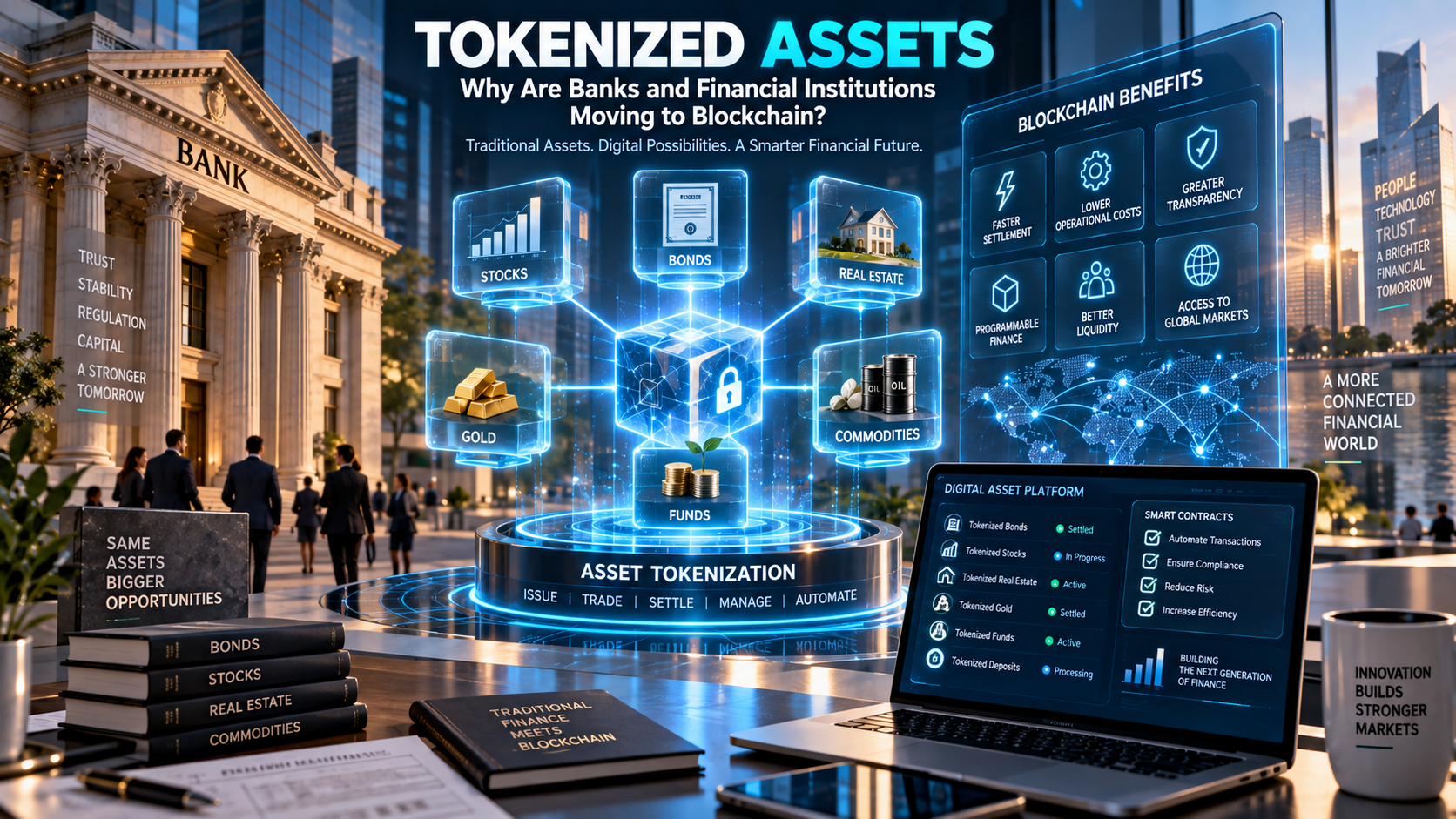
Blockchain is no longer being used only for cryptocurrencies such as Bitcoin and Ethereum. Banks, financial institutions, investment companies, and financial-market organizations are increasingly exploring another use of blockchain: tokenized assets.
Tokenization can turn traditional financial assets into digital tokens that can be recorded and transferred using blockchain or distributed-ledger technology. Bonds, stocks, funds, deposits, real estate, gold, and other assets can potentially be represented digitally.
But why are financial institutions interested in this technology? Can blockchain make financial transactions faster, easier, and more efficient? Let’s understand tokenized assets in simple terms.
What Are Tokenized Assets?
Tokenized assets are traditional assets that are represented digitally as tokens on a blockchain or distributed ledger.
For example, imagine a company issues a bond. Traditionally, information about that bond may be maintained across several financial systems. With tokenization, the bond can be represented by a digital token on a blockchain network.
The token can contain information about the asset and can be used as part of a digital system for transferring, recording, or managing that asset.
In simple words:
Tokenization means converting information or ownership rights connected to an asset into a digital token.
Is Tokenization the Same as Cryptocurrency?
No. Tokenized assets and cryptocurrencies are different.
Bitcoin is a cryptocurrency created as a native digital asset on its blockchain. A tokenized bond, on the other hand, can represent a claim or ownership interest in a traditional financial asset.
For example, a token could represent a corporate bond. The underlying bond still has its own legal and financial characteristics. The blockchain is being used as part of the infrastructure for representing and managing it.
So, tokenization does not necessarily mean creating a new cryptocurrency.
Why Are Banks Interested in Blockchain?
Banks handle millions of financial transactions every day. These transactions can involve different systems, institutions, databases, intermediaries, and settlement processes.
Blockchain and distributed-ledger technology could help connect some of these processes through shared digital records.
This is one reason financial institutions are exploring blockchain for areas such as asset issuance, trading, settlement, collateral management, and recordkeeping.
The goal is not simply to “put banking on blockchain.” The larger goal is to create financial infrastructure that can potentially be more automated and efficient.
How Does Asset Tokenization Work?
The basic process can be explained in a few simple steps.
First, a traditional asset is identified, such as a bond or investment fund.
Next, information or rights related to that asset are represented through a digital token.
The token is then issued on a suitable blockchain or distributed-ledger network.
Depending on the system, participants can use the digital infrastructure to transfer, manage, settle, or track the asset.
Smart contracts can also be used to automate certain rules and processes.
Why Could Tokenized Assets Be Faster?
Traditional financial transactions can pass through several stages before they are completed.
For example, one system may record a trade, another may handle clearing, another may manage settlement, and another may maintain ownership records.
Tokenization could connect more of these processes through digital infrastructure.
This could reduce some manual steps and reconciliation work and potentially make certain transactions faster.
However, the actual speed depends on the technology, financial institutions, regulations, and systems involved.
Can Blockchain Reduce Banking Complexity?
Financial institutions often use many different systems to manage financial information.
When two systems contain different versions of information, they need to be checked and reconciled.
A shared ledger can provide participating organizations with a common record of transactions.
This does not automatically remove every banking system, but it could reduce some duplication and make certain processes easier to coordinate.
What Are Smart Contracts?
Smart contracts are programs that can automatically perform actions when predefined conditions are met.
For example, imagine a digital bond with a rule that says:
“When the payment date arrives, send the required payment to the eligible investor.”
A smart contract could automate this type of predefined process.
This is one of the important reasons tokenization is interesting to financial institutions. Assets can potentially become programmable.
What Does Programmable Finance Mean?
Programmable finance means using software to automate certain financial processes.
Instead of requiring people or separate systems to manually perform every step, predefined rules can be built into digital financial infrastructure.
For example, tokenized assets could potentially support automated payments, compliance checks, collateral movements, or other financial processes.
This could make some financial operations more efficient.
What Assets Can Be Tokenized?
A wide range of assets can potentially be tokenized.
These can include:
- Government bonds
- Corporate bonds
- Stocks and equities
- Investment funds
- Money-market funds
- Bank deposits
- Real estate
- Gold
- Other commodities
- Private-market assets
- Financial collateral
Different assets have different legal and technical requirements, so tokenization does not work in exactly the same way for every asset.
Why Are Tokenized Bonds Becoming Important?
Bonds are one of the areas where financial institutions are exploring tokenization.
A tokenized bond can represent a bond digitally and can potentially use blockchain-based infrastructure for parts of its lifecycle.
This could help automate processes related to issuance, transfer, settlement, payments, and recordkeeping.
For banks and other financial institutions, the potential benefit is not simply having a digital bond. It is the possibility of creating a more connected and programmable process around that bond.
Can Tokenization Help With Settlement?
Settlement is the process through which a financial transaction is completed and the relevant asset and payment are transferred.
In traditional markets, settlement can involve multiple organizations and systems.
Tokenized assets could potentially allow asset transfer and payment processes to become more closely connected.
This could reduce delays and operational complexity in some use cases.
However, faster settlement still requires compatible payment systems, legal frameworks, market infrastructure, and sufficient participation.
How Can Tokenization Help With Collateral?
Financial institutions frequently use assets as collateral.
Managing collateral can involve moving assets between different accounts and systems and keeping track of their value and status.
Tokenized assets could potentially make these processes more automated.
For example, a digital system could track collateral and automatically perform certain actions when predefined conditions are met.
This could be particularly useful in institutional finance.
Can Tokenized Assets Make Finance More Transparent?
Blockchain can provide a shared record of transactions.
Depending on how the network is designed, authorized participants can have access to consistent transaction information.
This could improve visibility into certain financial processes.
However, blockchain does not automatically make every transaction public. Many institutional blockchain systems can use permissioned networks where access is restricted to authorized participants.
Why Don’t Banks Just Use Normal Databases?
This is an important question.
Banks already have highly advanced databases, so blockchain is not automatically better than a traditional database.
The potential value of blockchain comes from combining features such as shared records, programmable transactions, digital tokens, and coordinated settlement.
If a normal database can solve a particular problem more efficiently, there may be no reason to use blockchain.
Therefore, financial institutions are generally interested in specific use cases where distributed-ledger technology can provide a practical advantage.
Are Banks Actually Moving to Blockchain?
Banks and financial institutions are actively exploring blockchain and tokenization, but it would be inaccurate to say that the entire banking industry has already moved to blockchain.
Many projects are still in testing, pilot, or early production stages.
Financial institutions are exploring tokenized bonds, funds, deposits, collateral, settlement systems, and other applications.
This means tokenization is developing gradually rather than replacing traditional financial infrastructure overnight.
What Are the Benefits of Tokenized Assets?
Tokenized assets could provide several potential benefits.
Faster Processes
Digital infrastructure could reduce some manual processes and delays.
Automation
Smart contracts can automate predefined financial activities.
Better Recordkeeping
Shared digital records can make transaction information easier for participating organizations to coordinate.
Improved Settlement
Tokenization could potentially make asset transfer and settlement more integrated.
Programmable Assets
Digital tokens can interact with software and smart contracts.
More Efficient Operations
Reducing repetitive reconciliation and manual work could lower operational complexity in some areas.
These are potential benefits, not guarantees. The results depend on how the technology is implemented.
What Are the Challenges of Tokenization?
Tokenization also comes with significant challenges.
One major challenge is regulation.
Financial assets are governed by laws and regulations, and putting an asset on a blockchain does not remove those legal requirements.
Other challenges include cybersecurity, privacy, smart-contract vulnerabilities, identity verification, custody, interoperability, and integration with existing financial systems.
Financial institutions also need to ensure that digital tokens have clear legal and economic meaning.
What Is Blockchain Interoperability?
Interoperability means allowing different blockchain networks and financial systems to communicate with each other.
Imagine one bank using Blockchain A while another financial institution uses Blockchain B.
If the two systems cannot communicate, tokenized assets may become trapped inside separate digital networks.
For tokenization to scale across financial markets, different systems may need common standards and reliable ways to interact.
Can Tokenization Create More Liquidity?
Tokenization could make certain assets easier to access and transfer digitally, but creating a token does not automatically create liquidity.
Liquidity means having enough buyers and sellers available to trade an asset.
If a tokenized asset has very few participants, it can still be difficult to trade.
Therefore, successful tokenization requires not only technology but also market participation, regulatory clarity, infrastructure, and demand.
Is Tokenization Useful for Real Estate?
Real estate is another area frequently discussed in connection with tokenization.
A property could potentially be represented through digital tokens that correspond to defined ownership or economic rights.
This could make certain investment structures more digital and potentially allow smaller units of ownership to be represented.
However, real estate tokenization involves complex legal, ownership, regulatory, and property-registration requirements.
So the technology alone cannot solve all of the challenges involved in real estate investment.
What About Tokenized Gold?
Gold can also be represented through blockchain-based tokens.
In a tokenized gold model, a digital token may represent a defined amount of physical gold or a related financial claim, depending on the structure.
This can make gold easier to represent and transfer digitally.
But users still need to understand how the underlying gold is stored, who owns it, how it is audited, and what legal rights the token provides.
How Could Blockchain Change Traditional Finance?
The biggest change may not be that banks completely replace their existing systems.
Instead, blockchain could become another layer of financial infrastructure.
Banks could use tokenized assets, digital currencies, smart contracts, and distributed ledgers alongside existing financial technologies.
Over time, this could create more connected financial markets where assets and payments can interact digitally.
Could AI and Tokenized Assets Work Together?
Artificial intelligence could become another important part of tokenized finance.
Imagine an AI system analyzing financial information and identifying suitable investment opportunities, while blockchain infrastructure handles the digital representation and transfer of assets.
AI agents could potentially interact with tokenized assets under predefined permissions and financial rules.
This could lead to new forms of AI-powered financial automation and agentic commerce.
However, security, authorization, regulation, and human oversight would remain important.
What Could the Future of Tokenized Finance Look Like?
The future could involve a combination of:
Tokenized Assets + Smart Contracts + Digital Payments + AI + Blockchain Infrastructure
For example, a tokenized bond could be issued digitally, traded through a regulated platform, settled using digital money, and have certain administrative processes automated through smart contracts.
This represents a broader shift toward programmable financial infrastructure.
Will Blockchain Replace Banks?
Tokenization does not necessarily mean that banks will disappear.
Banks provide many services beyond maintaining transaction records, including lending, custody, payments, compliance, risk management, investment services, and customer relationships.
Blockchain is more likely to become one of the technologies that financial institutions use to improve specific parts of their operations.
The future could therefore be less about “Blockchain vs Banks” and more about “Banks using blockchain where it provides value.”
Why Is Tokenization Becoming Important in 2026?
Financial institutions are increasingly exploring digital financial infrastructure, while regulators, exchanges, banks, and technology companies are working on ways to bring tokenized assets into regulated markets.
The growing interest is being driven by several factors:
- Demand for faster financial infrastructure
- Growth of digital assets
- Interest in programmable finance
- Stablecoin development
- Institutional blockchain projects
- Improvements in blockchain technology
- Demand for automated settlement
- Growth of AI-powered financial services
This makes tokenization an important blockchain trend to watch.
Conclusion
Tokenized assets represent one of the most important ways blockchain could influence traditional finance.
Instead of using blockchain only for cryptocurrencies, financial institutions are exploring how the technology can represent bonds, funds, deposits, equities, collateral, gold, and other assets digitally.
The potential benefits include faster settlement, automation, programmable financial products, improved coordination, and reduced operational complexity.
However, tokenization still faces challenges involving regulation, security, interoperability, liquidity, privacy, and integration with existing financial systems.
Blockchain may not replace traditional finance overnight. Instead, tokenization could gradually change the way financial assets are issued, transferred, settled, and managed.
The bigger question is no longer simply whether blockchain can support cryptocurrencies. It is whether blockchain can become part of the next generation of financial infrastructure.
