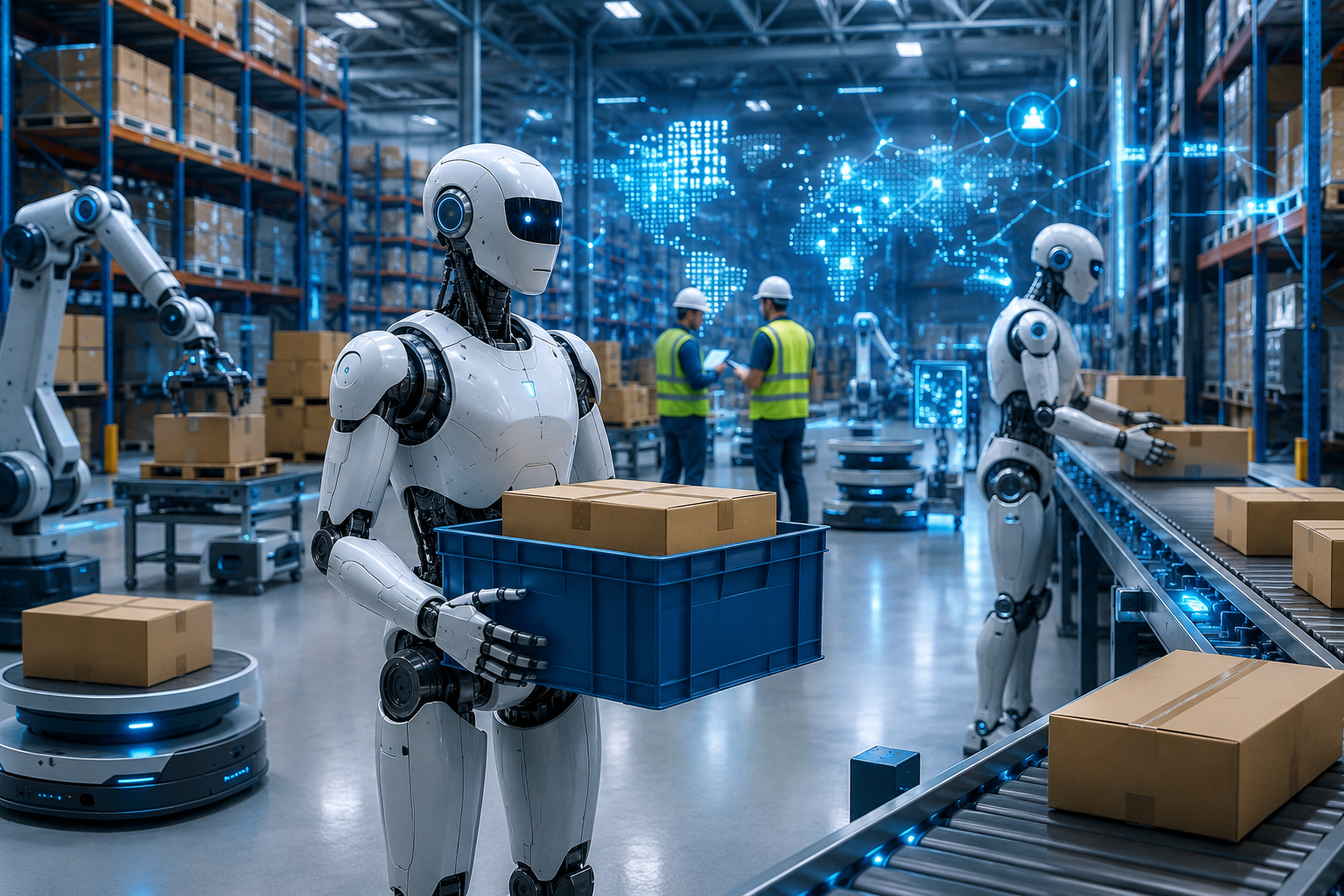
Warehouses are changing quickly. Many companies are already using robots and automation to move products, sort packages, and manage repetitive work. Now, a new type of robot is attracting attention: humanoid robots.
These robots are designed with a human-like shape, including arms, legs, cameras, and sensors. Companies are testing them to see if they can perform physical tasks that are normally done by warehouse workers.
The goal is not simply to replace people. Companies want to understand how humanoid robots can make warehouses faster, safer, and more flexible.
What Are Humanoid Robots?
Humanoid robots are machines designed to look and move somewhat like humans. They can have two legs, two arms, cameras, sensors, and AI-powered software.
Their human-like design can help them work in places that were originally built for people.
For example, warehouses already have shelves, workstations, pathways, doors, and other equipment designed around human workers. A humanoid robot may be able to work in these areas without requiring major changes to the warehouse.
Why Are Warehouses Testing Humanoid Robots?
One of the biggest reasons is flexibility.
Traditional robots are often built for a specific task. A robotic arm may be designed to pick products, while another machine may only move boxes from one location to another.
Humanoid robots are being developed to perform different types of physical tasks.
Depending on their capabilities, they could potentially move containers, pick up objects, transport items, load materials, and perform other repetitive activities.
This flexibility could make them useful in modern warehouses.
Repetitive Warehouse Tasks Are a Good Starting Point
Warehouses contain many repetitive jobs.
Workers may need to pick up containers, move products, sort items, transfer boxes, or perform the same physical movement hundreds of times during a shift.
These tasks can become tiring and physically demanding.
This is why companies are testing robots on simple and repetitive activities first. Instead of asking a robot to manage an entire warehouse, companies can start with one specific task and measure its performance.
For example, Amazon has tested Agility Robotics’ Digit robot for moving empty storage totes as part of its warehouse operations and robotics research.
AI Is Making Robots Smarter
Modern humanoid robots are becoming more capable because of artificial intelligence.
Older industrial robots usually follow fixed instructions. They are excellent at repeating the same movement again and again, but they may struggle when the environment changes.
AI-powered robots can use cameras and sensors to understand their surroundings.
A robot could potentially identify an object, understand where it needs to go, avoid obstacles, and decide how to complete a task.
This combination of AI and robotics is helping create a new generation of more flexible machines.
Robots Can Work With Humans
Humanoid robots do not necessarily need to replace warehouse workers.
A more realistic approach is human-robot collaboration.
Robots can handle repetitive, physically demanding, or tiring tasks, while people can focus on jobs that require decision-making, communication, problem-solving, and supervision.
For example, a robot could repeatedly move heavy containers while workers manage inventory, inspect products, or handle unexpected problems.
This could create a workplace where humans and robots work together.
Why Warehouses Are Good Places to Test Robots
Warehouses are useful environments for testing robotics because many activities are structured and repetitive.
A company can clearly measure things such as:
- How quickly a robot completes a task
- How often it makes mistakes
- How much human assistance it needs
- How safely it operates
- How much money it can save
- Whether it improves productivity
This makes it easier to understand whether a humanoid robot is actually useful in a real business environment.
Companies Are Moving From Testing to Real-World Use
Humanoid robotics is no longer limited to science-fiction ideas or laboratory demonstrations.
Companies are beginning to test humanoid robots in real working environments.
For example, GXO has worked with Agility Robotics to test Digit in warehouse operations. Amazon has also tested Digit as part of its broader robotics and automation efforts.
These real-world tests are important because a robot that works well in a demonstration must still prove that it can operate reliably for long periods in a busy warehouse.
Humanoid Robots Still Have Challenges
Humanoid robots have significant potential, but they also have limitations.
The technology is still developing, and companies need to solve several problems before large-scale deployment becomes practical.
Cost
Advanced robots require expensive hardware, sensors, batteries, motors, and AI computing systems.
Companies need to determine whether using robots provides enough financial benefit compared with other automation options.
Battery Life
Humanoid robots need energy to walk, move objects, and operate their sensors and computers.
Long working hours can be challenging if the robot needs frequent charging.
Reliability
A warehouse depends on continuous operations.
If a robot frequently stops, falls, needs maintenance, or requires human assistance, it may reduce the expected benefits of automation.
Safety
Humanoid robots will often work close to people.
They need to safely move around employees, shelves, machines, packages, and other robots.
Safety will become especially important as robots become faster and more autonomous.
AI Limitations
AI can make robots more flexible, but it does not make them perfect.
Warehouses can contain unexpected situations such as damaged packages, objects in unusual positions, blocked pathways, or changing workflows.
Robots need to handle these situations reliably before companies can depend on them for larger numbers of tasks.
Will Humanoid Robots Replace Warehouse Workers?
It is too early to say that humanoid robots will completely replace warehouse workers.
The more likely future is a combination of people, robots, and AI.
Robots may handle repetitive and physically demanding work, while humans continue to perform tasks that require judgment, creativity, communication, and problem-solving.
As the technology improves, robots may gradually take on more responsibilities.
The Future of Warehouse Automation
Humanoid robots could become an important part of future warehouse automation.
They may work alongside autonomous mobile robots, robotic arms, conveyor systems, computer vision, AI software, and human workers.
Instead of using one type of robot for everything, future warehouses could use different machines for different jobs.
The most successful humanoid robots will not necessarily be the ones that look the most human. They will be the robots that can perform useful tasks safely, reliably, quickly, and at a reasonable cost.
Final Thoughts
Companies are testing humanoid robots in warehouses because these machines could offer something traditional automation sometimes lacks: flexibility.
Their human-like design could allow them to work in environments already designed for people. AI could also help them understand their surroundings and perform different physical tasks.
However, humanoid robots still need to overcome challenges related to cost, battery life, reliability, safety, and AI performance.
The future of warehouse automation may not be about robots replacing humans.
Instead, it could be about humans and robots working together to create faster, safer, and more efficient warehouses.
