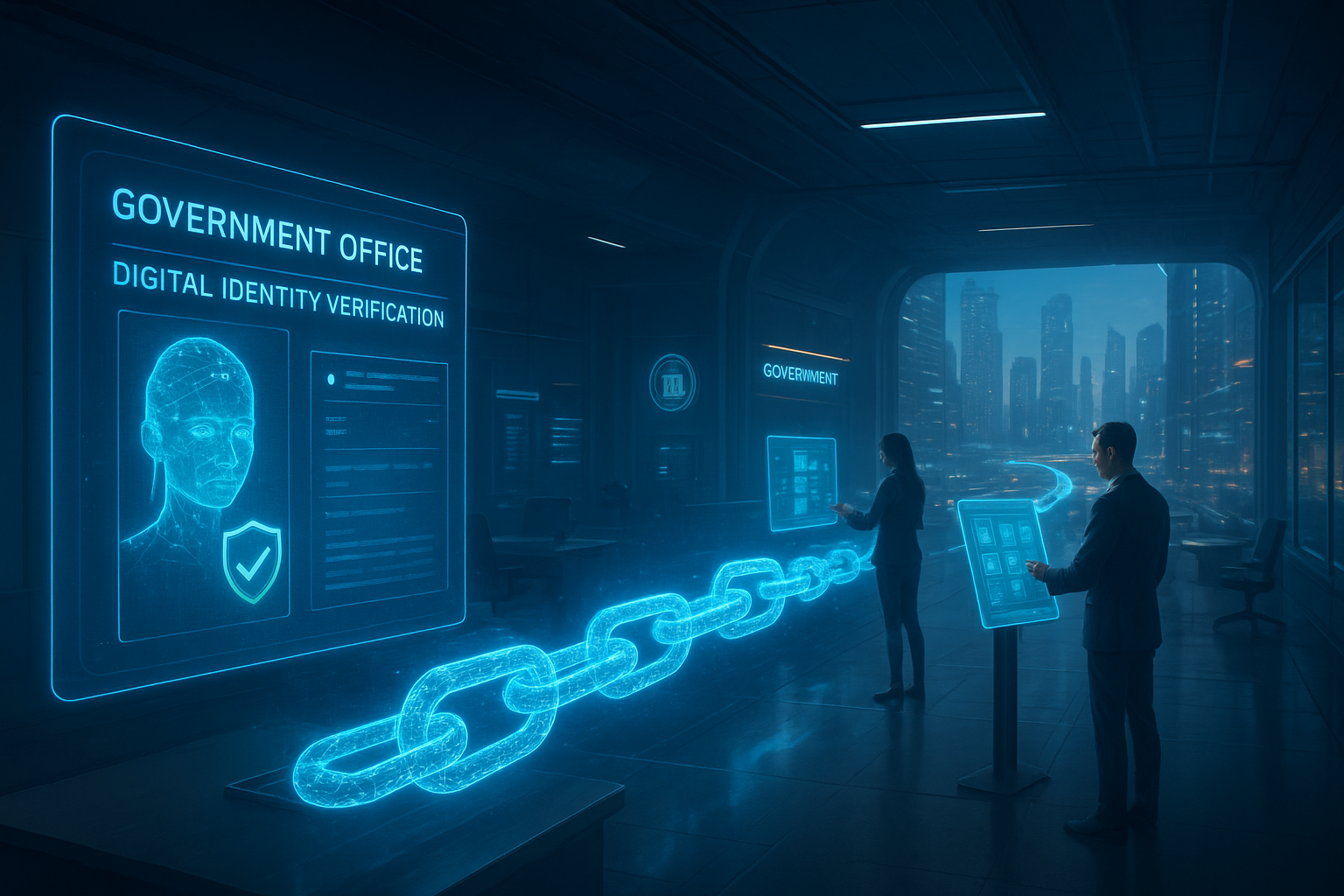
Introduction to Blockchain in Government Systems
Most government services today have gone digital. Everything from identity cards, land records, and tax filing is now available online. However, along with the conveniences come various risks such as data theft, identity fraud, hacking, and misuse of personal information. Blockchain technology can help in such a situation. With blockchain, government systems become secure, transparent, and reliable.
Understanding Digital Identity
A digital identity refers to a person’s identity in the real world, represented online. It consists of the person’s name, address, Aadhaar or national ID number, driving license, and biometric data. Generally, these pieces of information are kept in government databases. The issue is that centralized databases are vulnerable to hacking and may be misused. Hence, blockchain comes up with a more secure method to keep and defend this highly confidential data.
What e-Governance Means
e-Governance is the use of digital technologies in the delivery of government services to the citizens. It covers such online services as tax payments, land records, welfare schemes, business registration, digital court services, and more. The purpose of e-Governance is to make government works faster, less expensive, and more transparent for the public.
How Blockchain Makes Digital Identity More Secure
Information on the blockchain is kept in a very secure and encrypted manner. Changing the data already stored on the blockchain is not straightforward. Hence, the risk of tamping with the identity as well as the occurrence of fraud is almost zero. Through blockchain-powered identity, users are allowed to have full control over the identity as well as share the minimum necessary information. This method is also known as self-controlled or self-sovereign identity.
How Blockchain Improves e-Governance Systems
With blockchain, the government record becomes open and lasting. Timely, every transaction is recorded and will be there forever. As a consequence, no official can secretly alter land records, tax data, or public documents. People are thus given the possibility to trust that government data is accurate and cannot be tampered with.
Use of Blockchain in National Identity Systems
Governments are in a position to provide digital IDs built on a blockchain that is not duplicatable or counterfeitable. These digital identities can be utilized in sectors like banking, travel, healthcare, education, and government services. Hence, the occurrence of faked IDs as well as identity theft is minimized.
Use of Blockchain in Land and Property Records
One of the major problems associated with land in numerous countries is land fraud. Blockchain records ownership in a digital format which is not only secure but also easy to access. After the land information is recorded, it is not possible to change it unless the approval is given. Thus, it facilitates ownership proving, fraud prevention, and transparent property transfers.
Use of Blockchain in Voting Systems
Voting online through blockchain is possible. Furthermore, it guarantees that every vote is accurately accounted for, no one can vote twice, and results cannot be tampered with. The result of this is the presence of transparency and trust in elections.
Use of Blockchain in Welfare and Subsidy Programs
With the help of blockchain, administration of government benefits to the needs comes to exactly the right people, and directly too is made sure. Different categories of corruption like duplicate beneficiaries, middlemen, and corruption are thus eliminated. Money is transferred to the citizens in a faster and more transparent manner.
Use of Blockchain in Education and Certificates
Educational certificates saved on a blockchain platform are nearly impossible to be forged. Verification of documents can be done instantly by schools, colleges, and employers. Thus, the problem of fake degrees is solved and trust is built.
Major Benefits of Blockchain for Digital Identity and e-Governance
Blockchain provides robust protection for individuals’ private data and government records. It helps public services be more transparent. Citizens are given more power to handle their personal information. Fraud and corruption get toned down. Service delivery becomes quicker, cheaper, and more dependable.
Challenges in Using Blockchain for Government
Among the good features of blockchain, it also has some drawbacks. Starting the facility needs a large amount of money. The operation requires qualified technical staff. Government rules need to be changed. Old systems should be combined. Moreover, people should get informed and trained in digital skills to be able to use blockchain services without problems.
Blockchain and Digital Governance in India
India has already established sturdy digital systems such as Aadhaar, DigiLocker, UPI, and online government portals. By blocking data tampering, making things more transparent and giving more control to the user over his/her digital identity, blockchain can be an added security layer for the above systems.
Global Use of Blockchain in e-Governance
Several countries have started employing blockchain for public services. For example, Estonia utilizes blockchain for healthcare and national identity services. Dubai is striving to be a government completely powered by the blockchain. The European countries are mutually constructing the cross-border blockchain identity systems. These are just a few instances that reflect the worldwide acceptance of blockchain in governance.
Future of Blockchain in Digital Government
Eventually, it will be used for smart cities, digital citizenship, automated consents, secured public expenditure, and international identity verification, etc., along with AI and cloud technology.
How Blockchain Benefits Common Citizens
For citizens, blockchain is a blessing that exempts them from submitting the same documents over and over again, speeds up service approvals, improves data privacy, reduces corruption, and engenders more trust in government systems. People will need to waste less time waiting in queues and will be able to obtain services with just a few clicks.
Why This Topic Is Trending in 2025
This subject is on people’s lips due to the fact that governments are going fully digital, the number of cyber crimes is on the rise, people are getting more and more concerned about data privacy, and blockchain is emerging as one of the most efficient security solutions. The growth of Web3 and smart cities is making blockchain in e-governance a topical issue all over the world.
Conclusion
The use of Blockchain for Digital Identity and e-Governance is a revolutionary concept in Government works. It helps make public services safer, more transparent, quicker, and less prone to corruption. Despite the difficulties, the benefits to the citizens and governments in the long run are enormous. Blockchain is going to be the backbone of future digital governments worldwide.
