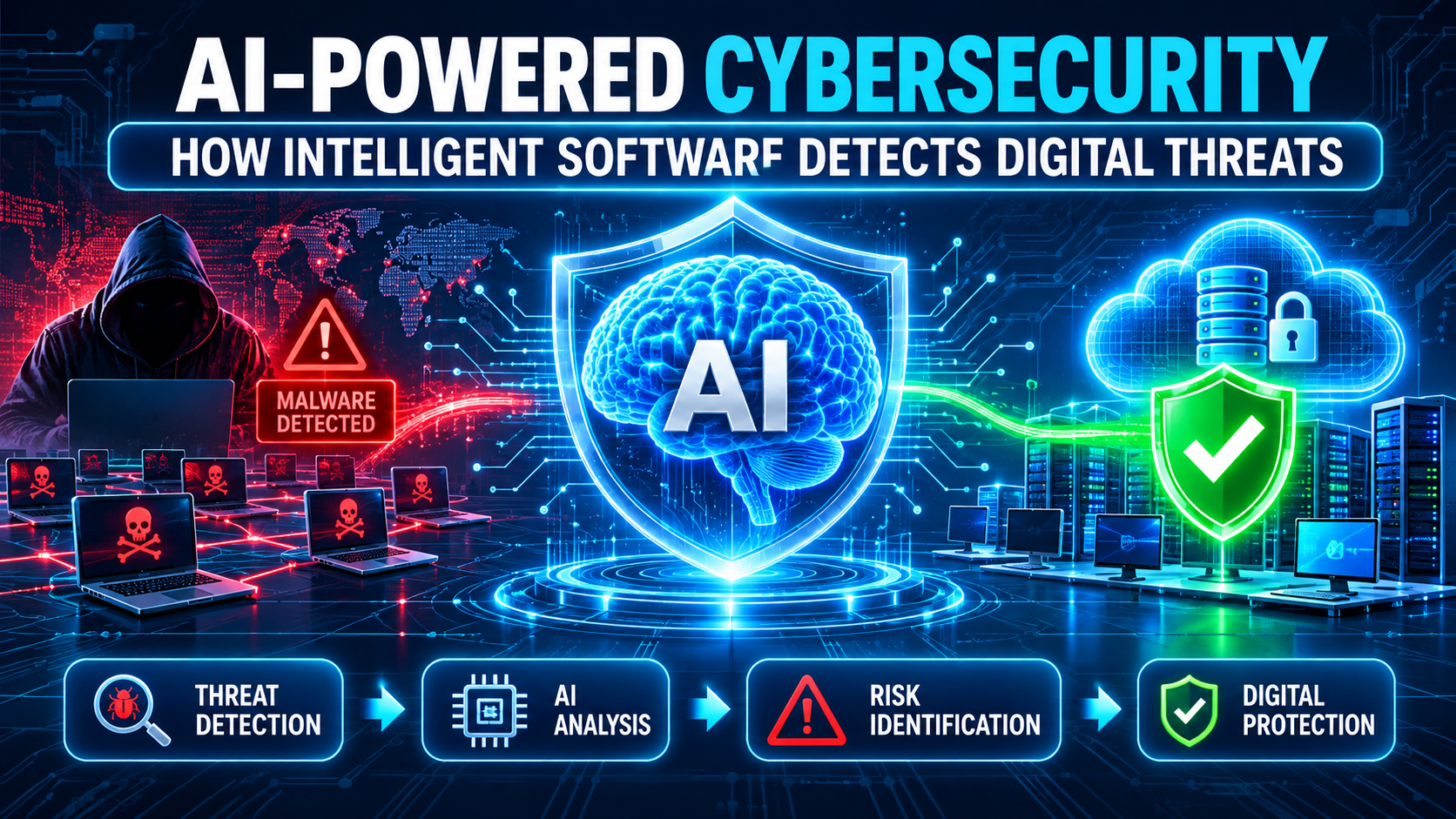
Today, people and businesses use the internet for almost everything, including online payments, shopping, communication, data storage, and business operations. As technology grows, cyber threats are also increasing. Hackers use different methods to steal personal information, access computer systems, and damage important digital data.
Traditional security software mainly uses predefined rules to identify known threats. However, modern cyberattacks are becoming more advanced, making some threats difficult to detect using traditional methods alone.
This is where Artificial Intelligence (AI) helps. AI-powered cybersecurity uses intelligent software to monitor digital activities, identify unusual behavior, and detect possible security threats. It helps businesses protect their computer systems, networks, applications, and sensitive information.
1. What Is AI-Powered Cybersecurity?
AI-powered cybersecurity is the use of Artificial Intelligence and machine learning to identify, analyze, and respond to digital security threats.
Traditional security systems often depend on known threat information and predefined security rules. AI-powered systems can also study large amounts of data and learn patterns from normal and suspicious activities.
For example, imagine an employee normally accesses a company account from India during working hours. Suddenly, someone tries to access the same account from another country at midnight. An AI-powered security system may recognize this unusual activity and send an alert to the security team.
In simple words, AI-powered cybersecurity helps computers understand normal digital activities and identify actions that may be dangerous.
2. How Does AI-Powered Cybersecurity Work?
AI-powered cybersecurity works by continuously monitoring digital systems, analyzing activities, and identifying possible security risks. It uses several steps to help protect computers, networks, and applications.
2.1 Data Collection and Monitoring
The first step is collecting information from different sources, such as computers, servers, applications, user accounts, and networks.
The system monitors activities such as login attempts, file downloads, network connections, and data transfers. This information helps the security software understand what is happening inside the digital environment.
2.2 Data Analysis
After collecting information, AI analyzes the data to understand normal activities and identify unusual patterns.
For example, if an account suddenly tries to log in hundreds of times within a few minutes, the system may recognize this behavior as suspicious.
2.3 Identifying Security Threats
AI algorithms examine the collected information to find possible security problems. These may include suspicious login attempts, unusual network traffic, harmful files, and unexpected account activities.
The system can also use previously learned patterns and available threat information to identify potential attacks.
2.4 Generating Security Alerts
When the system identifies suspicious activity, it can generate a security alert. Depending on the situation, the alert may be classified as low, medium, or high risk.
For example, an unusual login attempt may create a warning, while suspicious access to confidential company information may require immediate investigation.
2.5 Taking Security Actions
Some AI-powered security systems can automatically take action when they detect a possible threat.
For example, they may block a suspicious connection, temporarily disable an account, isolate an infected computer, or notify the security team.
This helps organizations respond to potential cyberattacks more quickly.
3. Important Technologies Used in AI-Powered Cybersecurity
AI-powered cybersecurity uses different technologies to understand digital activities and identify security threats. Each technology performs a specific role in protecting computer systems.
3.1 Machine Learning
Machine Learning is a technology that allows computers to learn from data and recognize patterns without requiring a separate instruction for every possible situation.
In cybersecurity, machine learning can study login activities, network traffic, and file behavior to identify unusual patterns. This helps security software recognize activities that may indicate a cyberattack.
3.2 Deep Learning
Deep Learning is an advanced type of machine learning that uses artificial neural networks to understand complex information.
It can help cybersecurity systems analyze complicated patterns in network activities, suspicious files, and digital communications.
3.3 Natural Language Processing (NLP)
Natural Language Processing allows computers to understand and analyze human language.
In cybersecurity, NLP can help examine emails, messages, and website content to identify suspicious language or possible phishing attempts.
3.4 Behavioral Analytics
Behavioral analytics studies the normal activities of users and devices.
For example, if an employee usually downloads a few files but suddenly downloads thousands of confidential documents, the system may identify this activity as unusual and generate a security alert.
3.5 Generative AI
Generative AI can help cybersecurity professionals understand security alerts, summarize technical reports, and analyze suspicious activities.
It can also assist security teams in investigating incidents and understanding possible security problems. However, important security decisions should still be reviewed by qualified professionals.
4. Real-World Applications of AI-Powered Cybersecurity
AI-powered cybersecurity is used in different industries to protect digital information and prevent security problems. Some important applications are explained below.
4.1 Malware and Virus Detection
Malware is harmful software designed to damage computer systems, steal information, or gain unauthorized access.
AI-powered security tools can examine files and their behavior to identify suspicious activities. This helps security systems detect certain malware threats, including some previously unseen variations.
4.2 Phishing Attack Detection
Phishing is a cyberattack in which hackers send fake emails, messages, or websites to trick people into sharing passwords, banking information, or personal details.
AI can examine email content, sender information, suspicious links, and message patterns to identify possible phishing attempts.
For example, if someone receives a fake banking email asking them to update their account password through an unknown website, an AI-powered security tool may identify it as suspicious.
4.3 Network Security Monitoring
Businesses use computer networks to connect employees, applications, servers, and other digital devices.
AI-powered security software can monitor network activities and identify unusual connections, unexpected data transfers, and suspicious communication patterns.
This helps security teams investigate possible network attacks.
4.4 Cloud Security Protection
Many businesses use cloud platforms to store information and run applications. Protecting cloud-based systems is important because unauthorized access can expose sensitive company information.
AI-powered cloud security tools can monitor user activities, identify unusual access patterns, and help detect possible security risks.
4.5 Online Payment and Fraud Detection
Online banking and digital payment platforms process thousands or even millions of transactions.
AI can analyze transaction details, payment patterns, device information, and user behavior to identify potentially fraudulent activities.
For example, if someone suddenly makes an unusual payment from an unfamiliar device, the security system may flag the transaction for additional verification.
4.6 Identity and Account Protection
AI-powered security systems can monitor account login activities and identify unusual behavior.
They may examine login locations, devices, access times, and other activity patterns to detect possible account misuse.
This helps businesses protect employee accounts and important digital information.
5. Benefits of AI-Powered Cybersecurity
AI-powered cybersecurity provides several benefits for businesses, organizations, and individuals.
5.1 Faster Threat Detection
AI can analyze large amounts of information quickly and help identify suspicious activities. This can reduce the time needed to discover certain security threats.
5.2 Continuous Security Monitoring
AI-powered security systems can monitor digital environments continuously. This helps organizations identify possible threats even outside normal working hours.
5.3 Better Threat Analysis
Machine learning can recognize unusual patterns in network traffic, user behavior, and system activities. This helps security teams understand and investigate possible attacks.
5.4 Automated Security Responses
Some security platforms can automatically perform predefined actions when suspicious activities are detected. This may include blocking harmful connections or isolating affected devices.
5.5 Reduced Manual Work
AI can help organize security alerts, analyze information, and identify important warnings. This allows cybersecurity professionals to focus more on serious security problems.
5.6 Improved Data Protection
By identifying suspicious access and unusual activities, AI-powered security tools can help businesses protect confidential information and important digital resources.
6. Challenges and Limitations of AI in Cybersecurity
Although AI improves many cybersecurity processes, it also has some limitations. Organizations must understand these challenges before depending on AI-based security solutions.
6.1 False Security Alerts
Sometimes AI systems identify normal activities as suspicious. These incorrect warnings are called false positives.
Too many false alerts can make it difficult for security teams to identify genuine threats.
6.2 Data Privacy Problems
AI-powered security systems may analyze large amounts of information, including user activities and business data.
Organizations must protect this information and follow appropriate privacy and data protection practices.
6.3 Changing Cyberattack Methods
Hackers continuously develop new techniques to avoid security detection. AI systems also need regular updates and improvements to recognize changing attack methods.
6.4 High Implementation Costs
Advanced AI security systems may require specialized software, powerful computers, skilled professionals, and regular maintenance.
These requirements can make implementation expensive, especially for small businesses.
6.5 AI Can Also Be Used by Hackers
AI is not only used by cybersecurity professionals. Cybercriminals can also use AI to create convincing phishing messages, automate certain attacks, and identify security weaknesses.
This makes it important for organizations to improve their security systems continuously.
6.6 Need for Human Experts
AI can help detect and analyze security threats, but it cannot guarantee complete protection.
Cybersecurity professionals are still required to investigate incidents, understand risks, manage security policies, and make important decisions.
7. Difference Between Traditional Cybersecurity and AI-Powered Cybersecurity
Traditional cybersecurity and AI-powered cybersecurity both aim to protect digital systems, but they use different approaches.
Traditional security software mainly depends on predefined rules, known threat signatures, and manual security configurations. AI-powered systems can additionally analyze large amounts of information and identify unusual patterns.
For example, traditional antivirus software may detect a known virus using its stored signature, while AI-based security tools may also identify suspicious file behavior that could indicate a new or modified threat.
However, AI does not completely replace traditional cybersecurity. Both approaches can work together to provide stronger digital protection.
8. Future of AI-Powered Cybersecurity
The future of AI-powered cybersecurity looks promising as Artificial Intelligence and machine learning continue to develop.
In the coming years, AI may help security teams monitor networks, investigate suspicious activities, and manage security incidents more efficiently. AI agents may also assist with analyzing alerts and coordinating certain security tasks under approved rules.
Another important development is predictive security analysis. Instead of only identifying active cyberattacks, advanced systems may help organizations discover weaknesses and unusual patterns before they cause serious damage.
AI-powered cybersecurity is also expected to play an important role in cloud computing, online banking, business applications, identity protection, and data security.
However, future cybersecurity systems will need to focus on accuracy, privacy, responsible AI use, and human supervision.
9. Conclusion
AI-powered cybersecurity is changing the way businesses and organizations protect their digital systems and sensitive information. By using Artificial Intelligence, machine learning, and behavioral analysis, modern security software can identify unusual activities, analyze potential threats, and support faster security responses.
From malware detection and phishing protection to cloud security and online fraud prevention, AI is creating new opportunities to improve digital protection.
Although challenges such as false alerts, privacy concerns, high costs, and AI-based cyberattacks still exist, combining AI with traditional cybersecurity methods can help organizations build stronger security systems.
As digital threats continue to evolve, AI-powered cybersecurity will remain an important technology for protecting businesses, applications, computer networks, and online information.
