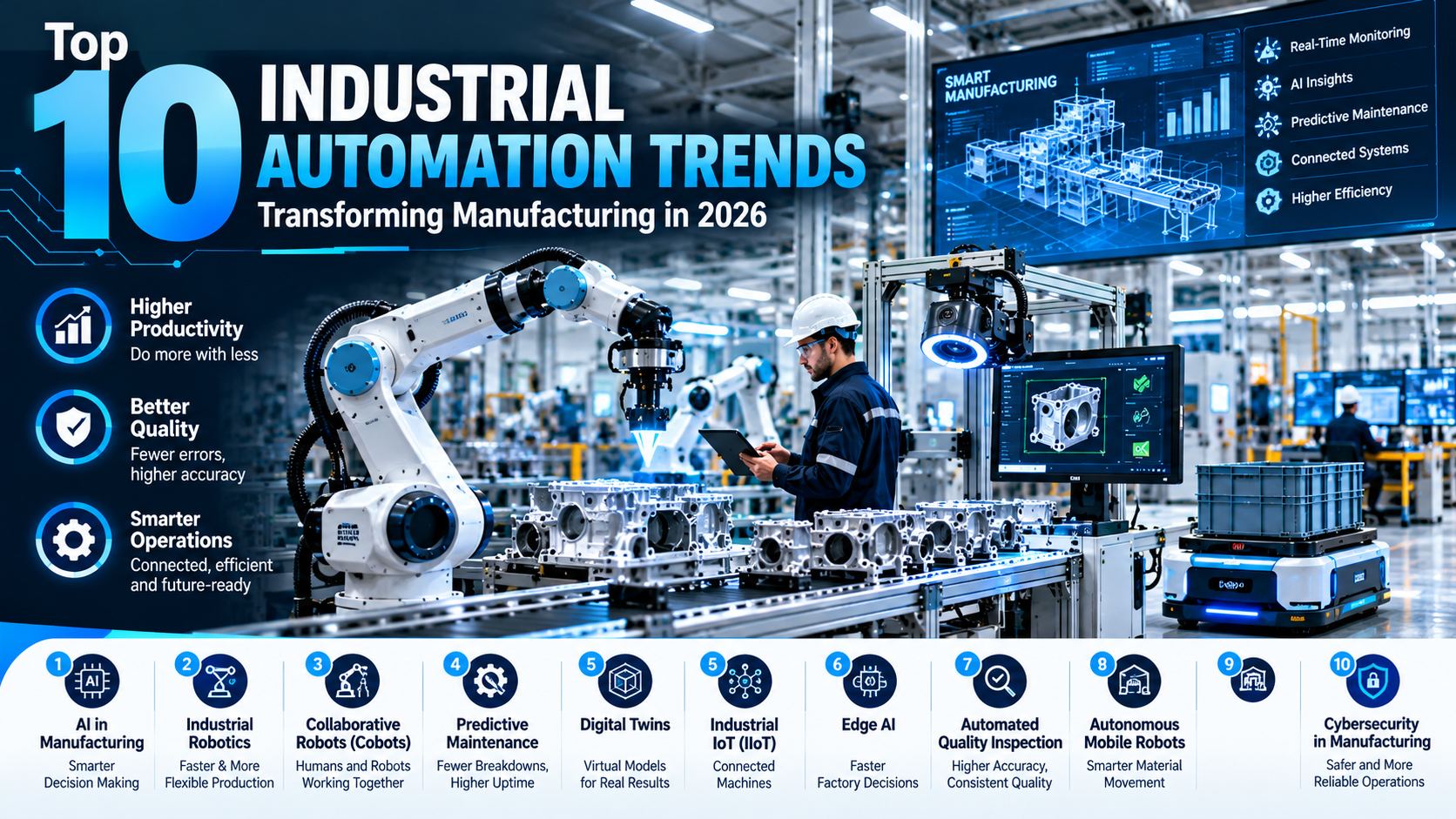
Manufacturing is changing rapidly as companies adopt new technologies to make production faster, safer, and more efficient. Machines that once followed simple instructions can now work with sensors, software, robots, and artificial intelligence (AI) to support more complex tasks.
This transformation is known as industrial automation. It helps manufacturers reduce repetitive manual work, improve product quality, monitor equipment, and manage production more effectively.
In 2026, technologies such as AI-powered machines, collaborative robots, smart sensors, and digital twins are becoming important parts of modern manufacturing. However, their benefits depend on how well companies implement and manage them.
Let’s explore 10 important industrial automation trends that are transforming manufacturing in 2026.
1. Artificial Intelligence in Manufacturing
How AI Is Making Factories Smarter
Artificial intelligence is becoming an important part of modern manufacturing. AI systems can analyze production data, identify patterns, detect unusual machine behavior, and help employees make better decisions.
For example, a manufacturing company can use AI to examine product images and identify scratches, cracks, or other defects. This can help quality-control teams inspect products more consistently.
AI can also help manufacturers understand production delays, improve scheduling, and identify opportunities to reduce waste.
Why Is AI Important for Manufacturing?
AI can help manufacturers make decisions based on real-time information instead of relying only on manual inspections or past experience. It can also support predictive maintenance and production planning.
However, AI systems need reliable data, proper testing, and human supervision to produce useful results.
2. Industrial Robotics and Smart Robots
Robots Are Doing More Than Repetitive Tasks
Industrial robots have been used in manufacturing for many years, particularly for welding, painting, assembly, and material handling. Newer systems are increasingly combining robotics with AI, cameras, and advanced sensors.
These technologies can help robots recognize objects, adjust to certain changes, and perform tasks with greater flexibility.
For example, a robot on an assembly line can pick up components, position them accurately, and help assemble a product. With suitable vision systems, it may also identify components in different positions.
Benefits of Industrial Robots
Industrial robots can perform repetitive tasks consistently, work at high speeds, and handle certain hazardous activities.
They can help companies improve production consistency and reduce the amount of repetitive work employees need to perform.
Nevertheless, robots require proper programming, maintenance, safety systems, and trained operators.
3. Collaborative Robots (Cobots)
Humans and Robots Working Together
Collaborative robots, commonly called cobots, are designed for applications where humans and robots work in shared or closely coordinated workspaces.
Unlike many traditional industrial robot installations, some cobot applications can be deployed without completely separating the robot and worker. However, appropriate risk assessments and safety measures are still necessary.
For example, a cobot may help a worker assemble small components, move materials, or perform repetitive screw-fastening tasks.
The worker can focus on tasks that require judgment and problem-solving while the robot assists with repetitive activities.
Why Are Cobots Becoming Popular?
Cobots can be useful for small and medium-sized manufacturers that want to automate selected tasks without redesigning an entire production line.
Depending on the application, they may offer flexible deployment, easier task changes, and support for human workers.
Their suitability depends on payload, speed, workspace, required safety measures, and the complexity of the task.
4. Predictive Maintenance Using AI and Sensors
Detecting Machine Problems Before Failure
Machine breakdowns can interrupt production, delay deliveries, and increase maintenance costs. Predictive maintenance helps manufacturers identify potential equipment problems before they cause major failures.
Sensors can monitor machine conditions such as vibration, temperature, pressure, and sound. Software can then analyze this information to identify unusual changes.
For example, if a motor begins vibrating differently from its normal operating pattern, a monitoring system may alert the maintenance team to investigate it.
Benefits of Predictive Maintenance
Predictive maintenance can help manufacturers plan repairs, reduce unexpected downtime, and use maintenance resources more effectively.
It may also help extend equipment life when problems are identified and corrected early.
However, its effectiveness depends on sensor quality, reliable data, appropriate analysis, and a maintenance team capable of acting on alerts.
5. Digital Twins in Smart Factories
What Is a Digital Twin?
A digital twin is a digital representation of a physical object, machine, process, or system. Depending on its design, it can use information from the real system to help engineers understand performance and test possible changes.
For example, a manufacturer can create a digital model of a production line to examine how changing machine speeds or rearranging equipment might affect production.
Instead of making every change directly on the factory floor, engineers can test selected scenarios in a digital environment first.
How Digital Twins Help Manufacturers
Digital twins can help companies understand machine performance, test production layouts, and identify potential bottlenecks.
When connected to suitable data sources, they can also help engineers compare expected performance with actual operations.
However, a digital twin is only as useful as its underlying model and data. A simulation does not automatically guarantee that the same results will occur in a real factory.
6. Industrial Internet of Things (IIoT)
Connecting Machines and Sensors
The Industrial Internet of Things, or IIoT, connects industrial equipment, sensors, and other devices so that they can collect and exchange operational information.
For example, sensors installed on a production machine can monitor temperature, operating speed, and energy consumption. This information can be sent to a monitoring system where employees can review machine performance.
Connecting machines helps manufacturers understand what is happening across their production operations.
Benefits of IIoT in Manufacturing
IIoT can support real-time monitoring, equipment maintenance, production tracking, and energy management.
It can also help employees identify problems that might otherwise remain unnoticed until production slows down or a machine stops working.
To implement IIoT successfully, manufacturers need reliable connectivity, compatible equipment, data management, and appropriate cybersecurity protections.
7. Edge AI for Faster Factory Decisions
Processing Data Near the Machine
Edge AI refers to running AI models on or near the equipment that generates the data instead of sending every task to a remote cloud system.
This can be useful when machines need to respond quickly to changing conditions.
For example, an industrial camera using edge AI can inspect products on a production line and identify certain defects immediately. The system may then flag the product for further inspection.
Why Is Edge AI Useful?
Processing data locally can reduce delays and limit the amount of information that needs to travel across a network.
It can also help certain factory systems continue operating when cloud connectivity is limited.
However, edge devices have computing and storage limitations. Manufacturers must choose suitable hardware and ensure that AI decisions are tested before they affect production or safety.
8. Automated Quality Inspection
Finding Product Defects More Consistently
Quality inspection is an essential part of manufacturing. Traditionally, many products have been checked manually, but automated inspection systems can help identify defects more quickly and consistently.
These systems may use industrial cameras, sensors, machine vision, and AI software to examine products during production.
For example, a camera system on a packaging line can check whether labels are positioned correctly, packaging is damaged, or required components are missing.
Benefits of Automated Quality Control
Automated inspection can help manufacturers identify defects earlier, reduce repeated manual checking, and collect useful information about product quality.
The collected data may also help companies identify recurring problems in their production processes.
Automated inspection still needs appropriate lighting, calibration, validation, and procedures for handling uncertain results or missed defects.
9. Autonomous Mobile Robots in Warehouses
Automating Material Movement
Autonomous mobile robots, often called AMRs, are designed to move materials through warehouses, factories, and other industrial environments.
Depending on the system, they may use sensors, cameras, and navigation software to move between locations while responding to certain obstacles and changes in their surroundings.
For example, an AMR can transport components from a storage area to a production line, reducing the need for employees to move every load manually.
How AMRs Improve Factory Operations
AMRs can support material delivery, warehouse workflows, inventory movement, and coordination between production areas.
They may also help reduce unnecessary walking and improve the flow of materials throughout a facility.
However, companies must consider floor layouts, traffic management, payload limits, charging requirements, and safe interaction with people and other vehicles.
10. Industrial Cybersecurity and Connected Factory Protection
Protecting Automated Machines and Systems
Modern factories increasingly connect machines, production software, sensors, and business systems. These connections help improve visibility and coordination, but they can also introduce cybersecurity risks.
If an industrial system is compromised, the consequences may include production interruptions, data loss, unauthorized changes, or safety problems.
Manufacturers therefore need to protect not only their computers and office networks but also the systems that monitor and control physical equipment.
How Can Manufacturers Improve Security?
Companies can strengthen industrial cybersecurity by controlling access to systems, updating software safely, monitoring network activity, maintaining backups, and separating critical operational networks where appropriate.
They should also develop recovery plans and train employees to recognize potential security threats.
Cybersecurity must be considered during the design and deployment of automation systems, rather than added only after a problem occurs.
What Do These Trends Mean for the Future of Manufacturing?
These 10 trends show that industrial automation is becoming more connected, data-driven, and adaptable.
AI can help analyze production information, robots can perform physical tasks, sensors can monitor equipment, and digital twins can help engineers test changes before implementing them.
When these technologies work together, manufacturers can gain a clearer understanding of their operations and identify opportunities to improve production.
However, successful automation requires more than buying new machines. Companies also need reliable data, trained employees, appropriate safety procedures, system integration, and long-term maintenance plans.
The most effective approach is to start with a clearly defined production problem, select suitable technology, measure the results, and expand automation when it delivers real value.
Conclusion
Industrial automation is helping manufacturers rethink how they produce goods, maintain equipment, inspect products, and manage factory operations.
In 2026, AI-powered systems, industrial robots, collaborative robots, predictive maintenance, digital twins, IIoT, and edge AI are important technologies to watch. Automated inspection, mobile robots, and industrial cybersecurity are also essential parts of the wider transformation.
Not every technology is suitable for every factory. The right solution depends on production requirements, available resources, workforce skills, and safety needs.
By choosing automation carefully and combining it with skilled human supervision, manufacturers can build more efficient, reliable, and adaptable production environments.
