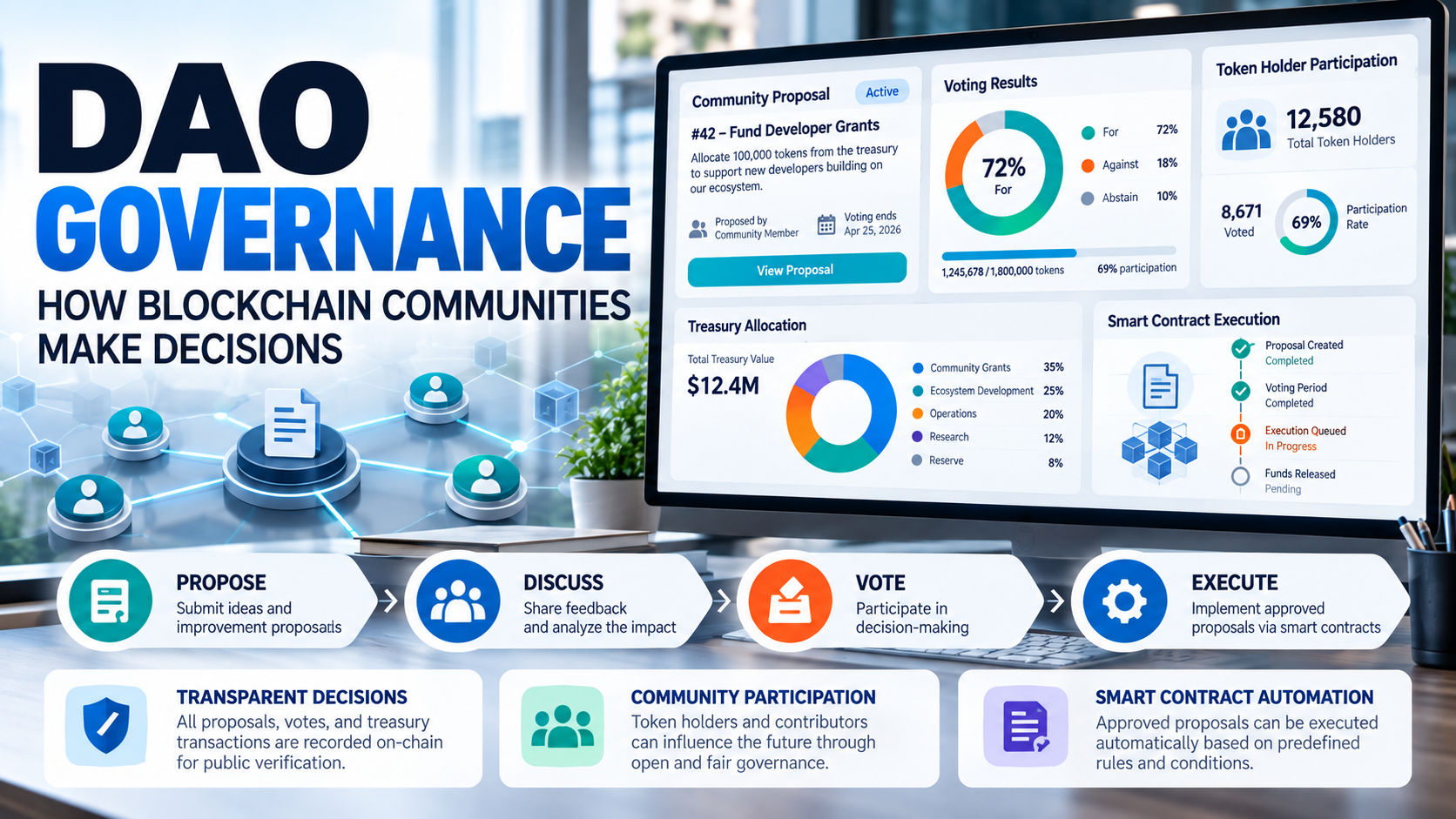
Blockchain technology is changing how digital communities, organizations, and online businesses make decisions. Traditionally, important decisions are made by company executives, managers, or centralized authorities. In decentralized ecosystems, however, communities can participate in decision-making through a system known as DAO governance.
DAO governance allows members of a Decentralized Autonomous Organization (DAO) to propose changes, vote on proposals, and influence how an organization operates. Instead of relying entirely on a central authority, a DAO uses blockchain technology, governance rules, and often smart contracts to coordinate decisions.
For example, a decentralized finance (DeFi) community may vote on changing lending parameters, allocating treasury funds, or introducing a new protocol feature. Depending on the governance design, voting power may be based on token ownership, delegated votes, reputation, or other membership rules.
DAO governance is an important part of the Web3 ecosystem because it enables transparent participation and community-driven coordination. However, it also introduces challenges involving voting power, security, participation, and accountability.
In this article, we will explore what DAO governance is, how it works, its major types, benefits, challenges, and practical applications in blockchain.
1. What Is DAO Governance?
DAO governance is the process through which members of a Decentralized Autonomous Organization make decisions about its rules, resources, operations, and future development.
A DAO is a collectively managed organization that uses blockchain technology and governance mechanisms to coordinate its members. Depending on its design, it may use smart contracts to manage voting, treasury funds, and approved actions.
Unlike a traditional organization, where executives or a board may have final decision-making authority, a DAO can distribute decision-making rights among its community members.
For example, imagine a blockchain project that wants to introduce a new feature. Instead of allowing only its founders to make the decision, the project may invite eligible members to submit proposals, discuss the changes, and vote on whether to approve them.
DAO governance typically covers:
-
Submitting and reviewing proposals.
-
Voting on protocol upgrades and new features.
-
Managing treasury funds and community grants.
-
Changing project parameters and governance rules.
-
Delegating voting power to trusted representatives.
-
Coordinating community development and project priorities.
However, decentralized governance does not automatically mean that every member has equal voting power. Some DAOs use token-weighted voting, while others use reputation, membership shares, delegated voting, or alternative governance mechanisms.
2. How Does DAO Governance Work?
DAO governance generally follows a structured process that allows community members to suggest changes, evaluate proposals, and decide which actions should be taken.
Step 1: Proposal Creation
A member suggests a change, such as funding a project or updating protocol rules.
Step 2: Community Discussion
Members review the proposal, discuss its benefits, and identify possible risks.
Step 3: Voting
Eligible participants vote according to the DAO’s governance rules.
Step 4: Proposal Validation
The system checks whether the proposal meets voting thresholds, quorum, and other requirements.
Step 5: Execution and Monitoring
An approved proposal is implemented according to the DAO’s execution rules, with follow-up monitoring where appropriate.
Not every DAO follows exactly the same process. Some execute approved proposals automatically through smart contracts, while others rely on multisignature wallets, designated contributors, or additional implementation steps.
Example of DAO Governance in Practice
Suppose a decentralized finance project wants to allocate 100,000 tokens from its community treasury to support new developers.
The governance process might look like this:
-
A community member submits a funding proposal.
-
Members discuss the project’s budget and expected benefits.
-
Eligible token holders cast their votes.
-
The proposal meets the DAO’s required approval threshold.
-
The funds are released according to the approved execution process.
This process allows community members to influence how shared resources are used without relying exclusively on a single decision-maker.
The exact voting requirements, treasury controls, and execution rules depend on the DAO’s design.
3. What Are the Different Types of DAO Governance?
DAO governance can be organized in several ways. Each model offers a different balance between participation, efficiency, security, and decision-making power.
3.1. Token-Based Governance
Token-based governance gives voting rights to members who hold a designated governance token.
In many implementations, voting power is proportional to the number of eligible tokens held or delegated. This allows token holders to vote on protocol changes, treasury allocations, and other organizational decisions.
Example: A decentralized protocol may allow governance token holders to vote on changes to transaction fees or lending parameters.
The main advantage is that voting rights can be integrated into blockchain-based systems. However, token-based voting can concentrate influence among large holders.
3.2. Delegated Governance
Delegated governance allows members to assign their voting power to another participant who represents their interests.
This approach can help members participate in governance without reviewing every technical proposal themselves.
Example: A token holder delegates voting power to a community representative who regularly evaluates protocol upgrades and governance proposals.
Delegation can improve participation, but members should consider how delegates vote, whether they disclose conflicts of interest, and how easily voting power can be reassigned.
3.3. Reputation-Based Governance
Reputation-based governance distributes influence according to contribution, participation, or reputation rather than relying entirely on token ownership.
A DAO may recognize members who contribute code, organize community activities, review proposals, or complete important tasks.
This approach can help reward meaningful participation, although the organization needs transparent rules for assigning and reviewing reputation.
3.4. Share-Based Governance
Share-based governance gives members voting rights through membership shares or another defined ownership mechanism.
It can be suitable for investment collectives, worker cooperatives, and other groups where membership is controlled through specific entry or contribution requirements.
The voting and exit rights depend on the DAO’s rules.
3.5. Multisignature-Assisted Governance
Some DAOs combine community voting with a multisignature wallet, which requires multiple authorized signers to approve a transaction.
For example, a proposal may receive community approval, after which several designated signers authorize the treasury transfer.
This can add an additional control layer, but it also means that execution depends on the signers and the powers assigned to them.
These models are not mutually exclusive. A DAO can combine token voting, delegated participation, and multisignature execution within the same governance structure.
4. On-Chain vs. Off-Chain DAO Governance
Another important distinction is where governance discussions, votes, and decisions take place.
| Feature | On-Chain Governance | Off-Chain Governance |
|---|---|---|
| Voting process | Votes are recorded on a blockchain | Votes or discussions occur through external platforms |
| Transparency | Transactions and votes can be publicly verifiable on-chain | Transparency depends on the platform and records |
| Transaction costs | May require blockchain transaction fees | May be free or less expensive to participate in |
| Execution | Can be automated through smart contracts | Often requires a separate implementation step |
| Flexibility | Constrained by the system’s programmed rules | Can support informal discussion and coordination |
On-chain governance can make voting and execution more verifiable. Off-chain governance can support discussion and coordination without requiring every interaction to be recorded as a blockchain transaction.
Some projects combine both approaches: community members discuss proposals off-chain, then submit a formal vote or executable proposal on-chain. Ethereum’s own protocol governance, for example, involves extensive off-chain discussion and coordination.
5. What Are the Benefits of DAO Governance?
DAO governance offers several potential benefits for organizations that need to coordinate participants across different locations.
5.1. Greater Transparency
When proposals, voting records, and treasury transactions are recorded on a public blockchain, participants can independently verify many governance activities.
This can help communities understand how decisions are made and how funds are allocated.
However, transparency depends on the DAO’s implementation. Not every discussion or off-chain decision is automatically visible on-chain.
5.2. Community Participation
DAO governance gives eligible members a structured way to influence project decisions.
Community participation can help organizations gather feedback from developers, users, contributors, and other stakeholders rather than relying exclusively on a small leadership group.
5.3. Global Collaboration
Blockchain-based communities can coordinate participants across different countries and time zones.
This makes DAO governance useful for open-source development, community grants, digital projects, and other collaborative initiatives.
5.4. Programmable Treasury Management
Smart contracts can enforce defined rules for releasing funds or executing approved transactions.
When properly designed, these mechanisms can reduce reliance on a single person controlling shared assets.
5.5. Clearer Decision Records
Formal proposals and voting records create a history of governance decisions. This can help participants understand why changes were approved and review earlier decisions when evaluating future proposals.
These benefits depend on sound governance design, effective participation, and appropriate security controls. Decentralization alone does not guarantee fair or successful outcomes.
6. What Are the Challenges of DAO Governance?
Despite its advantages, DAO governance has important limitations that organizations must address.
6.1. Concentration of Voting Power
In token-based systems, a small number of large holders may control a substantial share of the voting power.
This can undermine broad community participation and allow decisions to favor a small group of stakeholders. Research on DAO governance has identified the influence of large token holders as an important governance concern.
Possible solution: Consider delegation, transparent voting records, participation incentives, and voting models suited to the organization’s goals.
6.2. Low Voter Participation
Many members may not have enough time or technical knowledge to evaluate every proposal.
Low participation can make it easier for a small active group to influence outcomes.
Possible solution: Provide clear proposal summaries, sufficient discussion periods, accessible voting interfaces, and educational resources.
6.3. Smart Contract Vulnerabilities
If governance contracts or treasury mechanisms contain vulnerabilities, attackers may exploit them to manipulate votes or move funds.
Possible solution: Use independent security audits, comprehensive testing, controlled upgrade processes, and carefully designed emergency procedures.
6.4. Governance Attacks and Manipulation
An attacker may attempt to acquire voting power, exploit borrowing or delegation mechanisms, or manipulate a proposal process.
Possible solution: Evaluate voting-power concentration, proposal thresholds, voting periods, and safeguards against sudden or suspicious changes.
6.5. Slow Decision-Making
Community discussion and voting can delay decisions, especially when proposals involve complex technical or financial questions.
Possible solution: Define clear decision categories, use working groups where appropriate, and establish reasonable deadlines without removing necessary oversight.
6.6. Legal and Regulatory Uncertainty
A DAO’s legal status, liability, tax obligations, and regulatory responsibilities depend on its structure and jurisdiction.
Possible solution: Obtain appropriate legal advice and clearly document the organization’s responsibilities, membership rules, and treasury arrangements.
A well-designed DAO should treat governance security, participation, accountability, and legal compliance as ongoing responsibilities rather than problems solved by blockchain technology alone.
7. Real-World Applications of DAO Governance
DAO governance is used across several areas of the blockchain ecosystem. Its suitability depends on the organization’s objectives, community structure, and governance requirements.

7.1. Decentralized Finance (DeFi)
DeFi protocols may use DAO governance to decide on lending parameters, protocol upgrades, treasury allocations, and other operational changes.
Governance mechanisms allow eligible participants to influence how a protocol evolves.

7.2. Open-Source Software Development
Developer communities can use DAO governance to allocate grants, prioritize improvements, fund contributors, and coordinate development initiatives.

7.3. Community Grants and Funding
DAOs can pool resources and vote on proposals to support research, community initiatives, public goods, and ecosystem development.

7.4. Collective Ownership
Some DAOs coordinate the management of shared digital or physical assets, with governance rules defining how members make decisions about their use.

7.5. Creator and Digital Communities
Online communities can use governance mechanisms to decide how shared funds are spent, which projects receive support, and how community activities are organized.
These applications demonstrate how DAO governance can coordinate shared decisions and resources. However, a DAO is not automatically the best structure for every business; traditional management or a hybrid model may be more suitable for some organizations.
8. Examples of DAO Governance in the Blockchain Ecosystem
Several established blockchain communities illustrate different approaches to governance.
-
MakerDAO: Its governance system has historically used the MKR token for voting on decisions concerning the Maker Protocol. The project’s branding and governance arrangements have evolved, so consult current official documentation when describing its present structure.
-
ENS DAO: The Ethereum Name Service community uses governance and delegation mechanisms to allow eligible participants to influence decisions about the ENS ecosystem.
-
Nouns DAO: Nouns DAO is known for its community-driven proposal system and treasury governance, subject to its specific voting and execution rules.
These examples demonstrate that DAO governance can take different forms depending on the project’s objectives and design.
For accurate, up-to-date descriptions, consult the projects’ official governance documentation before publishing specific voting requirements, token details, or treasury figures.
9. Best Practices for Effective DAO Governance
A successful DAO needs more than a voting interface or a governance token. It needs clear rules, active participation, and safeguards against manipulation.
Here are important best practices for building effective DAO governance.
1. Establish clear governance rules. Document who can submit proposals, who can vote, how approval thresholds work, and how decisions are executed.
2. Make proposals easy to understand. Each proposal should explain its objective, expected benefits, costs, risks, and implementation plan.
3. Encourage meaningful participation. Provide educational resources, clear discussions, and sufficient time for members to evaluate proposals.
4. Reduce governance concentration risks. Monitor voting-power distribution and consider whether delegation or alternative voting mechanisms could improve participation.
5. Protect treasury funds. Use appropriate access controls, transaction limits, security reviews, and multisignature safeguards where suitable.
6. Audit smart contracts. Test governance logic and treasury mechanisms before deployment and review changes before implementation.
7. Track governance performance. Monitor voter participation, proposal outcomes, execution delays, treasury spending, and security incidents.
8. Establish emergency procedures. Define how the organization will respond to vulnerabilities, compromised accounts, or urgent operational risks without granting excessive unilateral control.
9. Maintain accountability. Record decisions, disclose relevant conflicts of interest, and make implementation progress visible to members.
The objective is to balance decentralization with security, efficiency, and responsible decision-making.
10. What Is the Future of DAO Governance?
DAO governance continues to evolve as blockchain infrastructure, voting mechanisms, and decentralized applications develop.
Several areas are worth watching:
-
Improved voting systems: Organizations are exploring different approaches to reduce the influence of concentrated voting power and encourage broader participation.
-
Delegation and governance tooling: Better interfaces and voting tools can help members understand proposals and participate more effectively.
-
Privacy-preserving voting: Cryptographic techniques may allow certain voting processes to protect voter privacy while supporting verifiable results.
-
AI-assisted governance: AI tools may help summarize proposals, organize discussions, and analyze potential risks. Human accountability and safeguards remain important.
-
Cross-chain governance: Some projects operate across multiple blockchains, creating a need for reliable coordination between networks.
-
More structured legal arrangements: DAOs may increasingly explore legal frameworks that clarify responsibilities, ownership, and liability.
These are developing areas, not guaranteed outcomes. Their effectiveness will depend on technical maturity, adoption, security, and the needs of individual communities.
Conclusion: Why Is DAO Governance Important for Web3?
DAO governance provides a framework for decentralized communities to make decisions, allocate resources, and coordinate activities using blockchain-based systems.
Through proposals, voting, delegation, and smart contract execution, DAOs can give eligible members a meaningful role in shaping an organization’s direction. These mechanisms can improve transparency, support global collaboration, and make certain decisions more verifiable.
However, DAO governance also presents challenges, including concentrated voting power, low participation, smart contract vulnerabilities, and legal uncertainty. Organizations must address these issues through thoughtful governance rules, security controls, clear accountability, and ongoing evaluation.
Ultimately, effective DAO governance is not just about allowing members to vote. It is about creating a fair, secure, transparent, and practical decision-making system that supports the organization’s long-term goals.
As the Web3 ecosystem develops, DAO governance will remain an important area to understand for developers, blockchain businesses, and communities exploring decentralized ways to coordinate people and resources.
