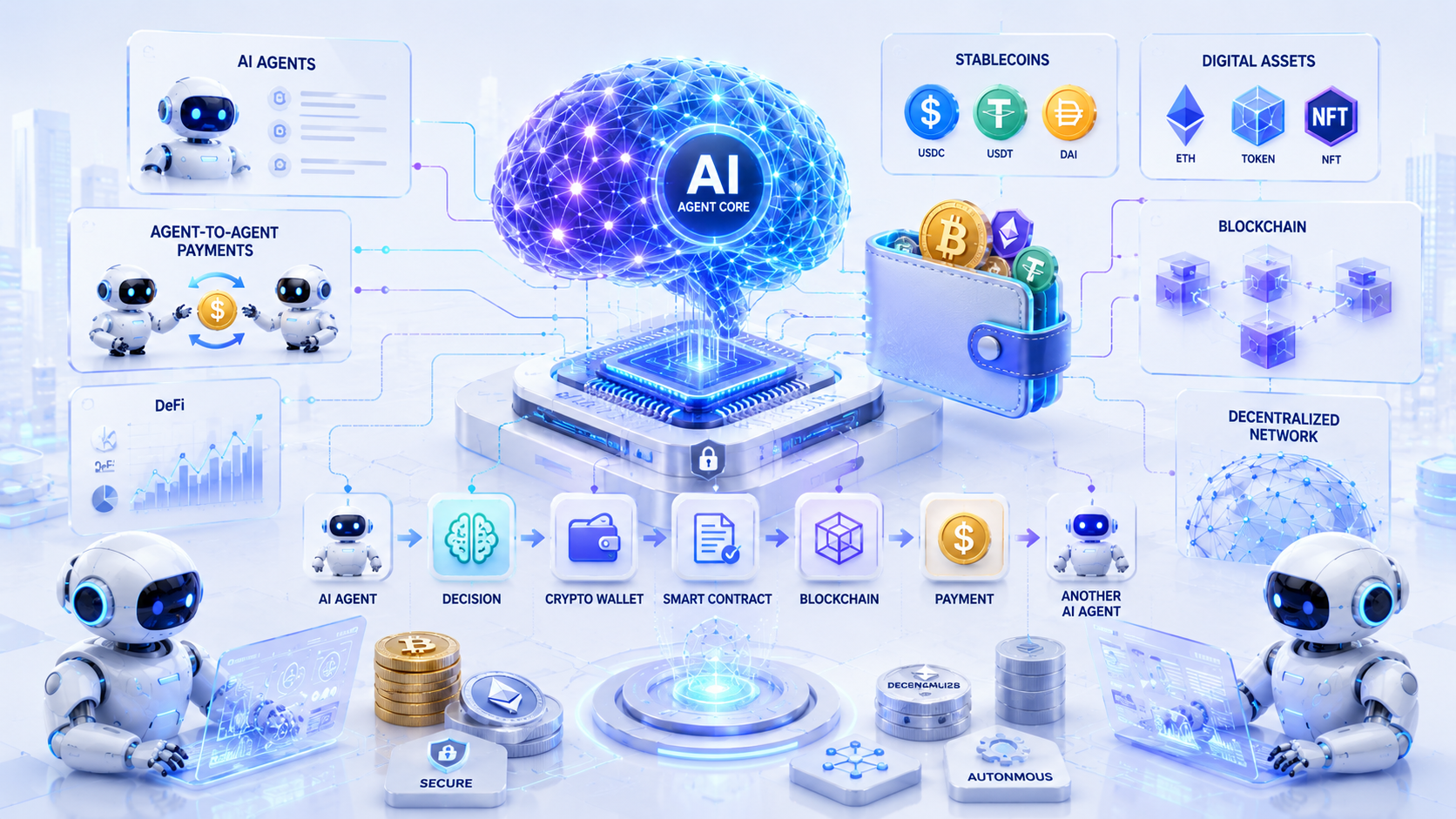
Artificial Intelligence and blockchain are two technologies that are changing the way we use software and digital services. AI helps machines understand information, make decisions, and complete tasks. Blockchain provides digital assets, secure transactions, smart contracts, and decentralized networks.
Now, these two technologies are starting to work together. This combination is often called AI × Crypto.
The idea is simple: AI gives software the ability to think and act, while blockchain can give it the ability to own digital assets, make payments, and interact with decentralized applications.
This could lead to a future where AI agents can perform tasks, purchase services, and communicate with other AI agents with less human involvement.
What Is AI × Crypto?
AI × Crypto means combining artificial intelligence with blockchain and cryptocurrency technologies.
AI systems can understand instructions, analyze information, make decisions, and complete tasks. Blockchain can provide a way for these AI systems to interact with digital money, smart contracts, wallets, and decentralized applications.
For example, an AI agent could be asked to find a particular online service. The agent could search for available options, compare prices, select the best option, and make a payment using a blockchain-based wallet.
In simple terms:
AI provides intelligence, while blockchain provides digital ownership, payments, and programmable transactions.
What Is an AI Agent?
An AI agent is a software system that can perform tasks based on a goal or instruction.
A normal chatbot usually waits for a question and then gives an answer. An AI agent can do more than that. It can understand a goal, create a plan, use tools, perform actions, and check the results.
For example, instead of asking an AI:
“What is the cheapest cloud storage service?”
You could eventually ask an AI agent:
“Find the cheapest suitable cloud storage service and purchase it if the monthly price is below $10.”
The agent could search for services, compare prices, check the user’s rules, and complete the approved transaction.
This ability to move from answering questions to taking actions is one of the most important ideas behind AI agents.
Why Would AI Agents Need Crypto?
One of the biggest questions about AI and cryptocurrency is: Why does an AI agent need crypto?
The answer is payments.
As AI agents become more independent, they may need to purchase digital services such as computing power, APIs, data, storage, software, or other services.
Traditional payment systems are mainly designed for people and businesses. AI agents may need faster and more programmable ways to make small digital payments.
Blockchain can provide programmable payment infrastructure that software can interact with directly.
For example:
AI Agent → Finds Service → Checks Price → Makes Payment → Receives Service
This could allow software to participate in digital commerce without requiring a human to manually approve every small transaction.
How Do AI Agents Use Blockchain?
AI agents can interact with blockchain networks through wallets, APIs, and smart contracts.
A simplified process could look like this:
User Goal → AI Agent → Decision → Wallet → Blockchain → Transaction → Result
Imagine that an AI agent needs to purchase a dataset.
First, the agent understands the user’s requirements. It then searches for suitable datasets, compares their prices and quality, and selects one that matches the user’s rules.
If the agent has permission to make the purchase, it can use a blockchain wallet to complete the transaction.
The blockchain records the transaction, and the agent can then use the purchased data.
This means the AI is not only generating information. It is actually interacting with a digital financial system.
What Are Autonomous AI Agents on Blockchain?
Autonomous AI agents on blockchain are AI-powered software systems that can perform blockchain-related tasks with limited human involvement.
Depending on their permissions, these agents may be able to:
- Check blockchain data
- Monitor wallets
- Interact with smart contracts
- Make approved payments
- Manage digital assets
- Use decentralized applications
- Communicate with other AI agents
However, autonomous does not mean the AI should have unlimited control.
A well-designed system should give the agent only the permissions it needs.
For example, an AI agent might be allowed to spend up to $20 per transaction but require human approval for anything larger.
AI Agents and Stablecoin Payments
Stablecoins could become an important part of AI-powered payments.
A stablecoin is a type of cryptocurrency designed to maintain a relatively stable value, often by being linked to a traditional currency such as the U.S. dollar.
This makes stablecoins potentially useful for digital payments.
Imagine an AI agent purchasing a small online service. Instead of using a traditional card payment system, the agent could use a stablecoin through a blockchain wallet.
This could support fast, programmable, and machine-friendly payments.
The idea is especially interesting for AI agents because software may need to make many small transactions automatically.
Can AI Agents Pay Other AI Agents?
One of the most interesting ideas in AI × Crypto is agent-to-agent payments.
Imagine two AI agents working together.
One agent needs a service, while another agent provides it.
For example:
Agent A: Needs a weather data report.
Agent B: Provides the weather data.
Agent A: Pays Agent B.
The entire process could potentially happen automatically.
This could create a new type of digital economy where AI agents can discover services, purchase resources, and pay other software systems.
Instead of humans controlling every transaction, software could handle many routine digital transactions automatically.
What Role Do Smart Contracts Play?
Smart contracts are programs that run on blockchain networks.
They automatically execute predefined rules when certain conditions are met.
Smart contracts can be useful when AI agents need to interact with blockchain systems.
For example, an AI agent might decide that a particular transaction should happen, while a smart contract or wallet policy ensures that the transaction follows specific rules.
Think of it this way:
AI decides what should happen.
Smart contracts enforce the rules.
This combination could make autonomous systems more controlled and predictable.
AI × Crypto and DeFi
AI agents could also change the way people use DeFi, or decentralized finance.
Today, users often need to manually compare different DeFi platforms, check rates, understand risks, and perform transactions.
An AI agent could potentially help automate some of these tasks.
For example, a user could give an agent a simple instruction:
“Find a suitable lending opportunity while keeping my risk below this limit.”
The agent could analyze available options, compare rates, evaluate the user’s rules, and interact with supported DeFi protocols.
However, financial automation also introduces risks. AI agents can make mistakes, misunderstand instructions, or interact with unsafe applications.
Therefore, financial AI agents need strong safety controls.
AI × Crypto Is More Than AI Cryptocurrency Tokens
AI × Crypto does not simply mean cryptocurrencies that use the word “AI” in their marketing.
The broader technology is about combining AI capabilities with blockchain infrastructure.
It includes areas such as:
- AI agents
- Blockchain wallets
- Stablecoins
- Smart contracts
- AI-powered DeFi
- Agent-to-agent payments
- Machine-to-machine commerce
- Decentralized applications
- Digital identity
- On-chain transactions
The important question is not:
“Which AI cryptocurrency should people buy?”
The more important technology question is:
“How can blockchain help autonomous software interact with digital economies?”
What Are the Benefits of AI × Crypto?
Combining AI and blockchain could provide several useful benefits.
Automated Payments
AI agents could make approved payments automatically instead of requiring users to complete every transaction manually.
24/7 Operation
AI agents can operate continuously, while blockchain networks can process transactions around the clock.
Programmable Transactions
Payments can be connected directly to software rules and workflows.
Machine-to-Machine Commerce
AI agents could potentially purchase services from other software systems without human involvement in every step.
Digital Ownership
Blockchain can provide systems for managing digital assets and ownership.
Transparent Transactions
Public blockchain networks can provide verifiable records of many transactions.
These features could make blockchain useful as part of the infrastructure supporting autonomous digital agents.
What Are the Risks of AI × Crypto?
AI × Crypto also introduces serious challenges.
An AI system that only generates text can make a wrong answer. An AI system that controls a wallet could potentially make a costly transaction.
Possible risks include:
- Incorrect transactions
- Excessive spending
- Unsafe smart contracts
- Fraudulent services
- Compromised wallets
- Malicious instructions
- Poor AI decisions
- Security attacks
- Privacy problems
For this reason, AI agents should not automatically receive unlimited access to cryptocurrency wallets.
Security needs to be built into the system from the beginning.
How Can AI Agents Be Made Safer?
One useful approach is limited or controlled autonomy.
Instead of giving an AI agent complete control over a wallet, developers can create specific rules.
For example:
- Maximum transaction: $20
- Daily spending limit: $100
- Only approved services
- Only approved blockchain networks
- Human approval for large payments
- Automatic transaction monitoring
- Block suspicious contracts
This allows the AI agent to perform routine tasks while keeping important financial decisions under control.
The goal is not to remove humans completely.
The goal is to give AI enough freedom to be useful without giving it unlimited power.
What Is the Future of AI × Crypto?
The future of AI × Crypto could involve AI agents becoming active participants in the digital economy.
Instead of humans performing every online task manually, AI agents could handle many repetitive activities.
For example:
Find Service → Compare Options → Make Decision → Pay → Use Service → Report Result
An AI agent could potentially purchase computing resources, access data, pay for APIs, interact with smart contracts, and communicate with other AI agents.
Blockchain could provide the payment, ownership, and transaction infrastructure needed for some of these activities.
However, widespread adoption will depend on solving important problems related to security, privacy, regulation, scalability, cost, and reliability.
AI × Crypto vs Traditional AI
The difference can be explained simply.
| Traditional AI | AI × Crypto |
|---|---|
| Generates information | Generates information and can perform transactions |
| Mainly interacts with users | Can interact with users, services, and other agents |
| Uses traditional APIs | Can interact with blockchain protocols |
| Usually does not control digital assets | Can use permission-based wallets |
| Limited financial capabilities | Can support programmable payments |
| Humans often complete transactions | Agents can complete approved transactions |
AI × Crypto is therefore not necessarily a replacement for traditional AI.
Instead, blockchain can give AI systems additional capabilities related to payments, ownership, identity, and digital transactions.
Is AI × Crypto the Future?
AI × Crypto is still an emerging technology. It is too early to say that blockchain will replace traditional payment systems for AI agents.
There are still many technical, security, regulatory, and usability challenges.
However, the concept is becoming more interesting as AI agents become more capable of taking actions instead of simply answering questions.
Once software can act independently, it needs ways to:
- Identify itself
- Receive permissions
- Pay for services
- Own digital assets
- Interact with other systems
- Prove what happened
Blockchain could potentially provide some of this infrastructure.
Conclusion
AI × Crypto represents the combination of artificial intelligence and blockchain technology.
AI gives software the ability to understand goals, analyze information, make decisions, and perform tasks. Blockchain can provide wallets, digital assets, smart contracts, and programmable payment systems.
Together, these technologies could create a new generation of autonomous AI agents that can interact with digital services and potentially make payments with limited human involvement.
The most interesting part of this technology is not simply AI-powered cryptocurrency trading. It is the possibility of creating a digital economy where software can discover services, pay for resources, communicate with other AI agents, and complete tasks automatically.
At the same time, safety will be extremely important. AI agents need limited permissions, spending controls, secure wallets, monitoring, and human oversight for sensitive actions.
The future of AI × Crypto could therefore be much bigger than cryptocurrency itself. It could become part of the infrastructure that allows autonomous software to participate safely in the digital economy.
