Introduction
Online shopping has become a part of our daily lives. Whether it is groceries, food, medicines, or electronics, people now expect fast and convenient delivery. To meet this growing demand, companies are looking for smarter ways to deliver packages. One of the biggest innovations in recent years is autonomous delivery robots.
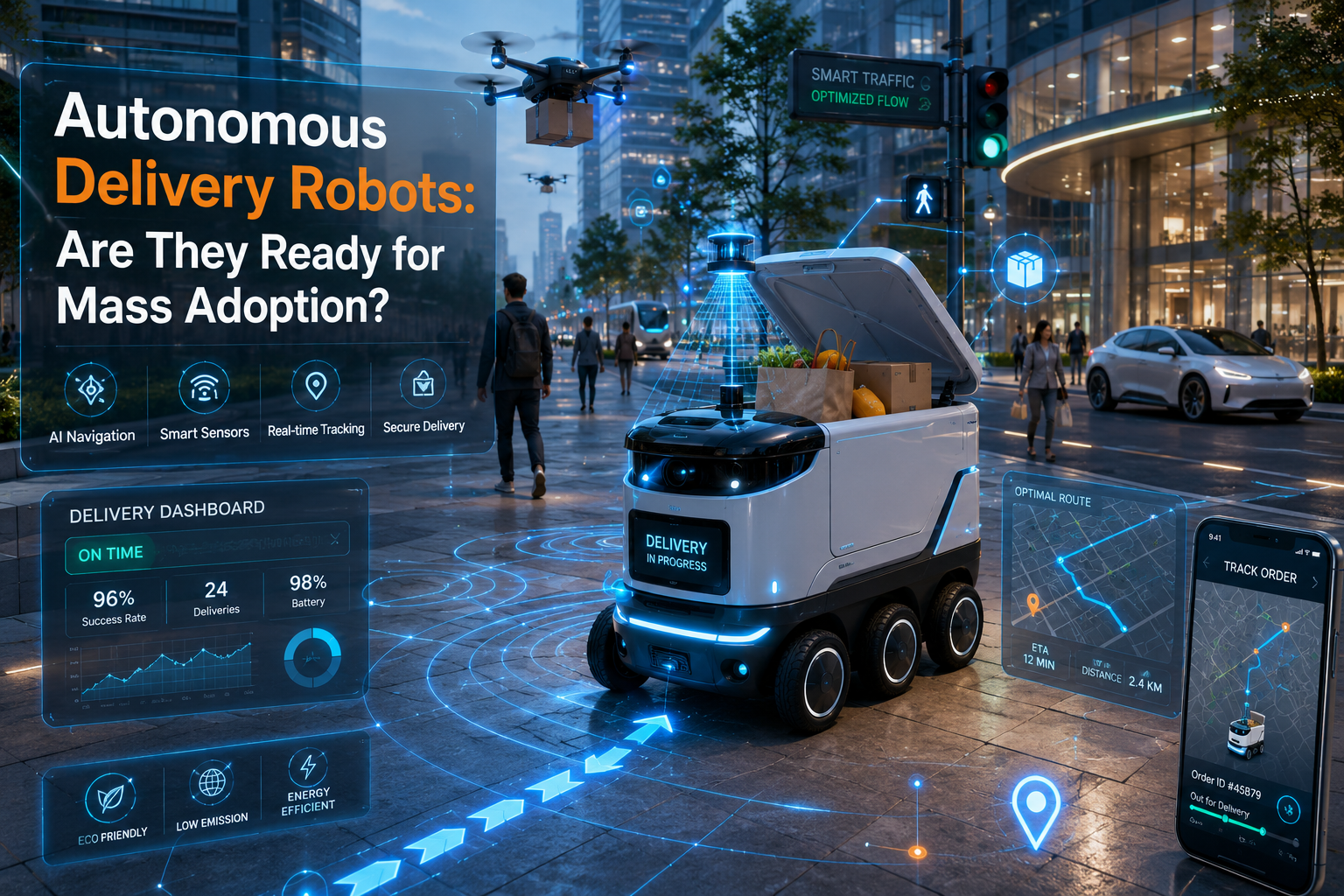
These robots can travel on their own without a human driver. They use Artificial Intelligence (AI), cameras, sensors, GPS, and advanced navigation systems to safely deliver packages from one place to another.
But are these robots really ready to become a common sight on our streets? In this article, we’ll explain everything in simple words, including how autonomous delivery robots work, where they are used, their advantages, challenges, and what the future holds.
What Are Autonomous Delivery Robots?
Autonomous delivery robots are small, self-driving machines that transport packages without needing a person to control them. They are mainly designed for short-distance deliveries such as food orders, groceries, medicines, and small parcels.
Most of these robots travel on sidewalks or inside private areas like university campuses, hospitals, business parks, and residential communities. They can safely move around people by detecting obstacles and choosing the best path to reach their destination.
These robots are powered by electricity, making them an eco-friendly alternative to traditional delivery vehicles.
How Do Autonomous Delivery Robots Work?
Autonomous delivery robots use several advanced technologies that work together to help them move safely and deliver packages accurately.
Artificial Intelligence (AI)
AI acts as the robot’s brain. It helps the robot understand its surroundings, recognize objects, and make decisions while moving.
Cameras and Computer Vision
The robot uses cameras to identify roads, sidewalks, traffic signs, pedestrians, and other vehicles. Computer vision allows it to understand what the cameras see.
LiDAR and Sensors
LiDAR uses laser technology to create a detailed map of the surroundings. Combined with other sensors, it helps the robot avoid obstacles and safely navigate busy areas.
GPS Navigation
GPS tells the robot where it is and helps it follow the best route to the delivery location.
Secure Package Delivery
When the robot arrives, the customer receives a notification on their phone. The storage compartment only opens after the customer confirms their identity, keeping the package safe during transit.
Where Are Autonomous Delivery Robots Used?
Although they are still developing, autonomous delivery robots are already being used in many places around the world.
Food Delivery
Many restaurants use delivery robots to bring meals directly to customers in nearby neighborhoods and university campuses.
Grocery Delivery
Supermarkets use robots to deliver groceries quickly and efficiently, especially for local orders.
Hospitals
Hospitals use autonomous robots to transport medicines, medical equipment, and laboratory samples between departments. This saves valuable time for healthcare workers.
University Campuses
Students can order food, drinks, or daily essentials and have them delivered by robots anywhere on campus.
Business Parks and Residential Communities
Companies use delivery robots to transport packages, office supplies, and online orders within private communities.
Why Are Companies Investing in Delivery Robots?
Businesses are investing in autonomous delivery robots because they offer several important benefits.
Faster Deliveries
Robots can work throughout the day without getting tired. This helps businesses complete more deliveries in less time.
Lower Operating Costs
Companies can reduce fuel expenses and delivery costs by using electric robots instead of traditional vehicles.
Environmentally Friendly
Since most delivery robots run on batteries, they produce zero direct emissions. This makes them a cleaner option for urban deliveries.
Contactless Delivery
Customers can receive their orders without interacting directly with a delivery person, making the process safer and more convenient.
Better Customer Experience
Real-time tracking and reliable delivery times improve customer satisfaction and build trust.
Challenges That Still Need to Be Solved
Even though delivery robots are becoming smarter every year, they still face some challenges before they can be used everywhere.
Government Regulations
Many countries are still creating rules for autonomous robots. Companies must follow local laws before deploying them on public roads or sidewalks.
Weather Conditions
Heavy rain, snow, flooding, and rough roads can make it difficult for robots to operate safely.
Limited Delivery Distance
Most delivery robots are designed for short trips. They are not yet suitable for long-distance deliveries.
Safety Concerns
Robots must safely avoid pedestrians, pets, bicycles, and unexpected obstacles while operating in busy public areas.
Theft and Damage
Although robots have security cameras and locked compartments, they can still be targets for theft or vandalism.
Are Autonomous Delivery Robots Safe?
Safety is one of the biggest priorities for companies developing delivery robots.
Modern robots use cameras, sensors, and AI to detect obstacles and stop automatically when someone crosses their path. They also travel at low speeds, making them much safer than regular vehicles.
Many robots are constantly connected to remote monitoring centers, where human operators can step in if the robot encounters a difficult situation.
The Future of Autonomous Delivery Robots
The future looks very promising for autonomous delivery technology.
As artificial intelligence continues to improve, delivery robots will become smarter, faster, and more reliable. Future robots will be able to travel longer distances, carry heavier packages, and make better decisions in complex environments.
Many experts believe that delivery robots will eventually work together with drones, smart traffic systems, and connected cities to create highly efficient delivery networks.
As e-commerce continues to grow, autonomous delivery robots are expected to become an important part of everyday life.
Are Autonomous Delivery Robots Ready for Mass Adoption?
The answer is almost—but not completely.
Today, autonomous delivery robots already work successfully in places like university campuses, hospitals, office parks, and residential communities. They have proven that they can deliver packages safely while reducing costs and improving delivery speed.
However, widespread use across every city still requires better infrastructure, clearer government regulations, improved weather performance, and greater public acceptance.
The technology is advancing quickly, and many experts believe that autonomous delivery robots will become much more common over the next few years.
Final Thoughts
Autonomous delivery robots are changing the future of logistics and package delivery. They offer faster deliveries, lower operating costs, improved efficiency, and environmentally friendly transportation.
Although there are still challenges to overcome, continuous improvements in artificial intelligence, robotics, and smart city technology are bringing us closer to a future where robot deliveries become a normal part of everyday life.
For businesses, adopting this technology can improve operations and customer satisfaction. For consumers, it means quicker, safer, and more convenient deliveries.
The future of delivery is becoming smarter, and autonomous delivery robots are leading the way.
