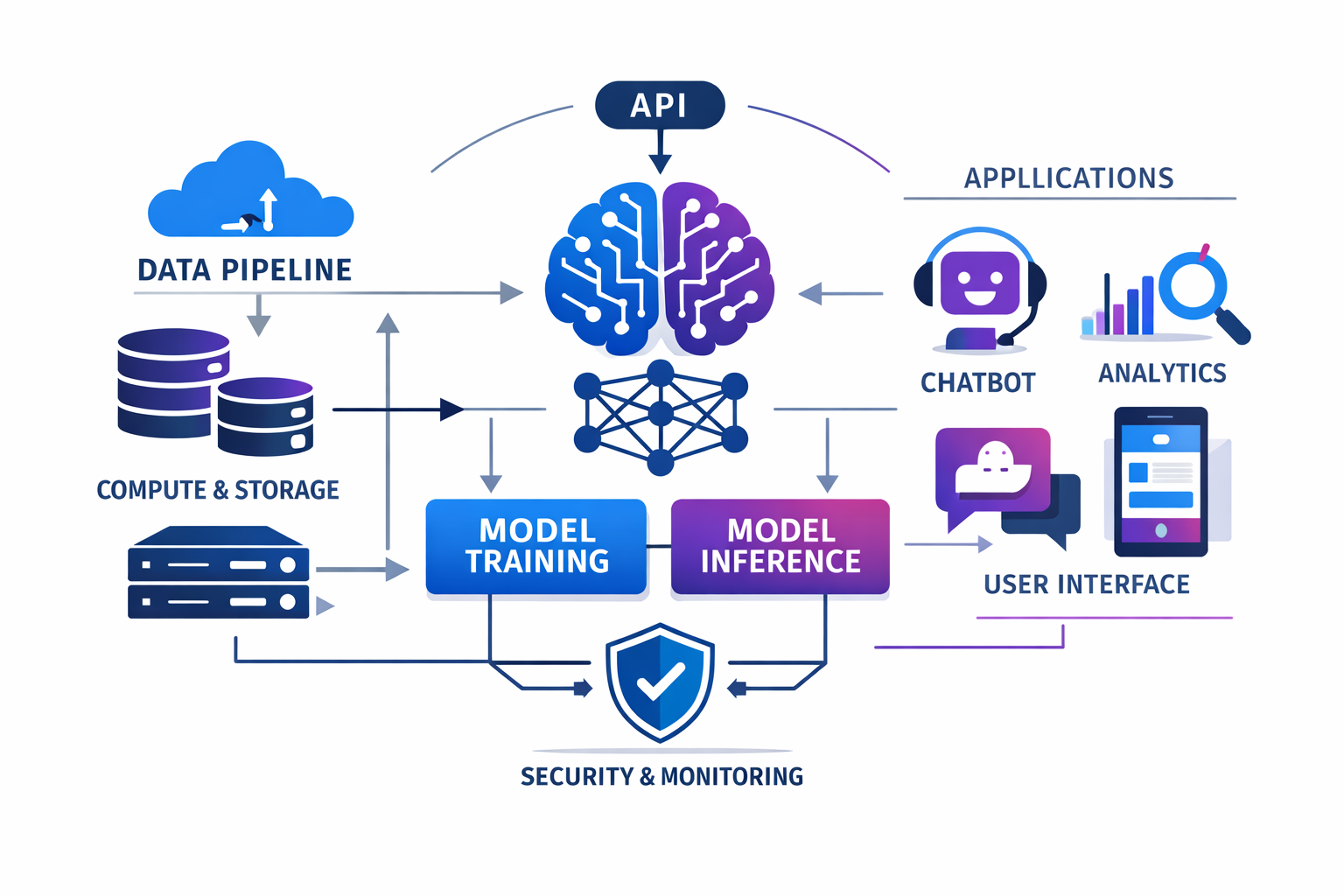
Artificial Intelligence is now a major part of modern software. Many applications depend on AI to make decisions, analyze data, and automate tasks. Because of this, software that uses a lot of AI needs a different kind of architecture compared to traditional apps. This article explains AI-heavy software architecture in a simple and easy way.
Understanding AI-Heavy Software Architecture
AI-heavy software architecture means designing software where AI models and data processing are the main components. In these systems, AI is not just an extra feature. It is responsible for the core functionality, such as predictions, recommendations, or automation.
These applications must handle large amounts of data, powerful computations, and continuous improvements to AI models.
Why AI Software Needs a Special Architecture
Traditional software architectures are not built to handle AI workloads. AI systems need more computing power, faster data access, and frequent model updates. Without a proper architecture, AI applications can become slow, unstable, and expensive to run.
A well-planned architecture helps the software stay fast, scalable, and reliable even when AI usage increases.
Role of Data in AI Applications
Data is the foundation of every AI system. AI-heavy software must collect data from different sources, clean it, and prepare it for training and predictions.
A good architecture ensures data flows smoothly through the system so AI models can learn and perform accurately.
Model Training and Learning Process
AI models need regular training to stay accurate. This training process requires strong computing resources and usually happens separately from the main application.
Keeping training separate prevents the application from slowing down while models learn from new data.
Using AI Models Inside Applications
Once AI models are trained, they are used to make predictions. This process is called inference. AI-heavy software architecture keeps models as independent services so they can be updated or scaled without affecting the whole application.
This approach improves performance and makes maintenance easier.
Connecting AI with the Application Interface
The application interface shows AI results to users. This could be a recommendation list, chatbot response, or prediction result.
The interface communicates with AI services instead of handling AI logic directly. This keeps the application simple and easier to manage.
Monitoring AI Performance Over Time
AI models do not stay accurate forever. Data changes, and models may start giving wrong results. Monitoring helps detect performance issues early.
Feedback from users and system data can be used to retrain and improve models automatically.
Popular Architecture Styles for AI Applications
Many AI-heavy applications use microservices, cloud-based systems, and event-driven designs. These styles allow different AI components to scale independently and handle large workloads efficiently.
They also make it easier to add new AI features in the future.
Handling Scalability and Performance
AI applications often face sudden spikes in usage. Without proper scaling, systems may crash or slow down.
Modern architectures use auto-scaling and load balancing to manage high traffic and heavy AI processing smoothly.
Security and Data Protection in AI Systems
AI software often handles sensitive data. Protecting this data is critical. Strong security practices like encryption, secure APIs, and controlled access help keep AI systems safe.
Security also protects valuable AI models from misuse or theft.
Future Direction of AI Software Architecture
AI software architecture is evolving quickly. New trends include AI-native systems, edge AI, and autonomous AI agents.
These innovations will make AI software faster, smarter, and more efficient in the coming years.
Final Thoughts
Software architecture for AI-heavy applications focuses on scalability, performance, and continuous improvement. By separating AI components, managing data properly, and monitoring performance, developers can build strong and future-ready AI systems.
A well-designed architecture is the key to successful AI-powered software.
