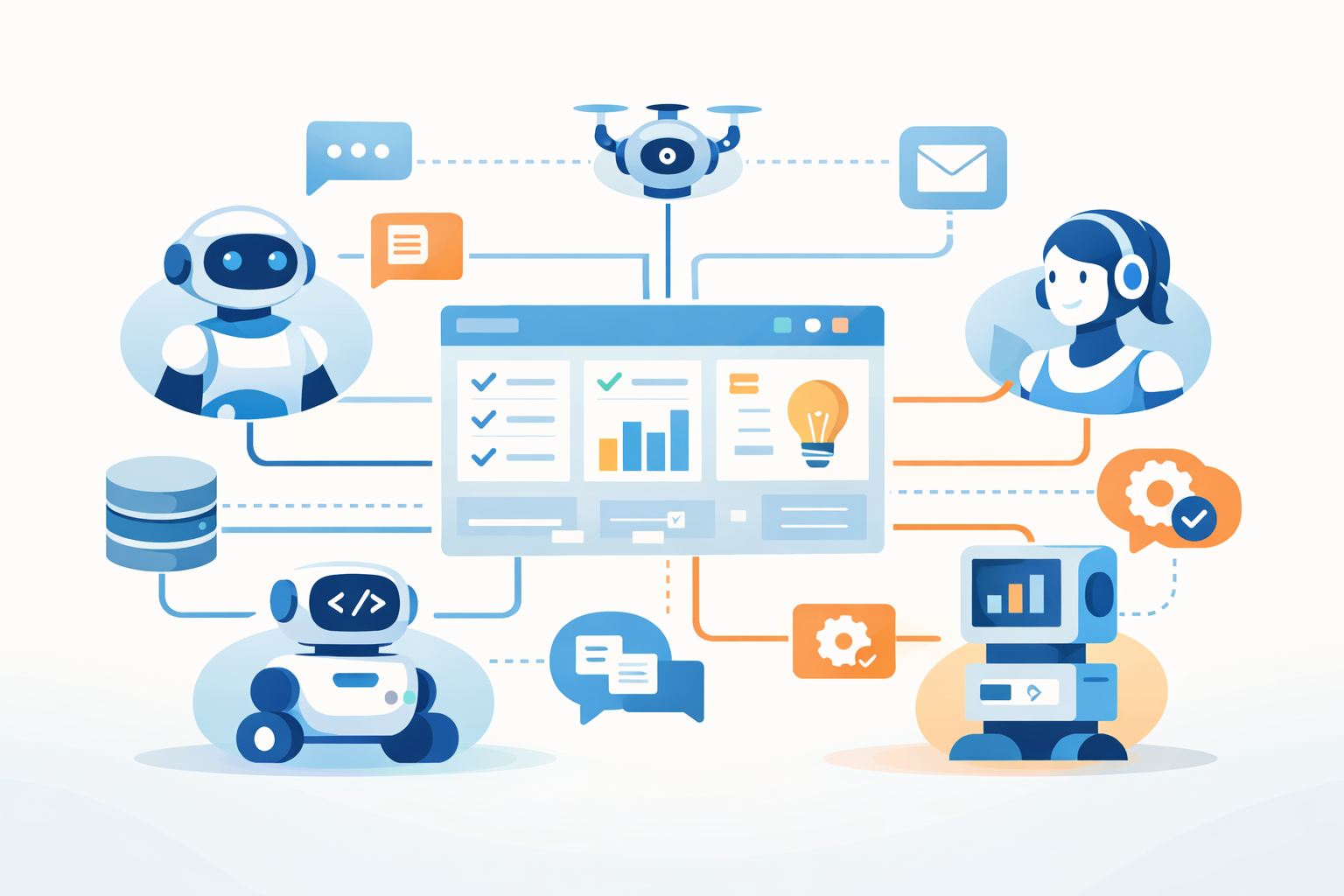
Introduction to AI Agent Collaboration
Artificial Intelligence is no longer limited to single tools doing individual tasks. Today, AI systems are becoming smarter by working together. This new approach is called AI agent collaboration. To make this teamwork possible, AI protocols are used. These protocols act like rules that help different AI agents communicate, cooperate, and complete tasks efficiently.
This trend is changing how businesses use automation and intelligent systems.
Understanding AI Agents
AI agents are smart software programs that can think, decide, and act on their own to complete tasks. They can answer questions, analyze data, manage schedules, or even control systems. Each agent is designed to handle a specific responsibility.
When multiple AI agents work together, they can solve bigger and more complex problems than a single AI system.
What Are AI Collaboration Protocols
AI collaboration protocols are standard methods that allow AI agents to talk to each other and share information. These protocols ensure that agents understand instructions, exchange data safely, and coordinate their actions smoothly.
You can think of AI protocols as a common communication language that allows different AI tools to work as a team, even if they come from different developers or platforms.
Why AI Agent Collaboration Is Becoming Popular
Businesses today need faster and smarter automation. Simple AI tools are no longer enough. Collaborative AI agents can manage complex workflows like planning, decision-making, and execution at the same time.
Another reason for their popularity is flexibility. Companies can add or remove AI agents without changing the entire system. This makes AI solutions more scalable and cost-effective.
How AI Agents Work Together
In a collaborative system, each AI agent has a specific role. One agent may plan tasks, another may perform actions, while a third monitors results. Communication protocols help them stay connected and aligned.
This teamwork allows AI systems to work more accurately and complete tasks faster with minimal human involvement.
Real-World Applications of AI Agent Collaboration
AI agent collaboration is already being used in many industries. In customer support, different agents handle conversations, analyze customer mood, and decide when to involve humans. In businesses, AI agents manage reports, approvals, and data processing.
In software development, one AI agent can write code, another can test it, and another can deploy it. This improves productivity and reduces errors.
Benefits of Using AI Collaboration Protocols
Collaborative AI systems improve efficiency by dividing work among agents. They reduce human workload and speed up decision-making. These systems are also more reliable because tasks are handled by specialized agents.
Businesses benefit from better automation, improved accuracy, and faster operations.
Challenges in AI Agent Collaboration
Despite the advantages, AI collaboration also has challenges. Data security and privacy must be carefully managed. Errors in one agent can affect others. It is also important to ensure that AI decisions remain transparent and accountable.
Well-designed AI protocols help reduce these risks by setting clear rules and safeguards.
Future of AI Agent Collaboration
As AI technology advances, collaborative agent systems will become more intelligent and independent. In the future, AI agents may work like digital teams, managing tasks across entire organizations.
Companies that adopt AI collaboration early will gain a strong advantage in productivity and innovation.
Conclusion
The rise of AI protocols for agent collaboration marks a major step forward in artificial intelligence. Instead of isolated tools, AI is becoming a connected system where agents work together to solve complex problems. This approach is shaping the future of automation and smart business operations.
