Introduction
As software applications grow, they become more difficult to manage. More users, more data, and more features can make an application slower and harder to maintain.
This is where the CQRS Pattern becomes useful.
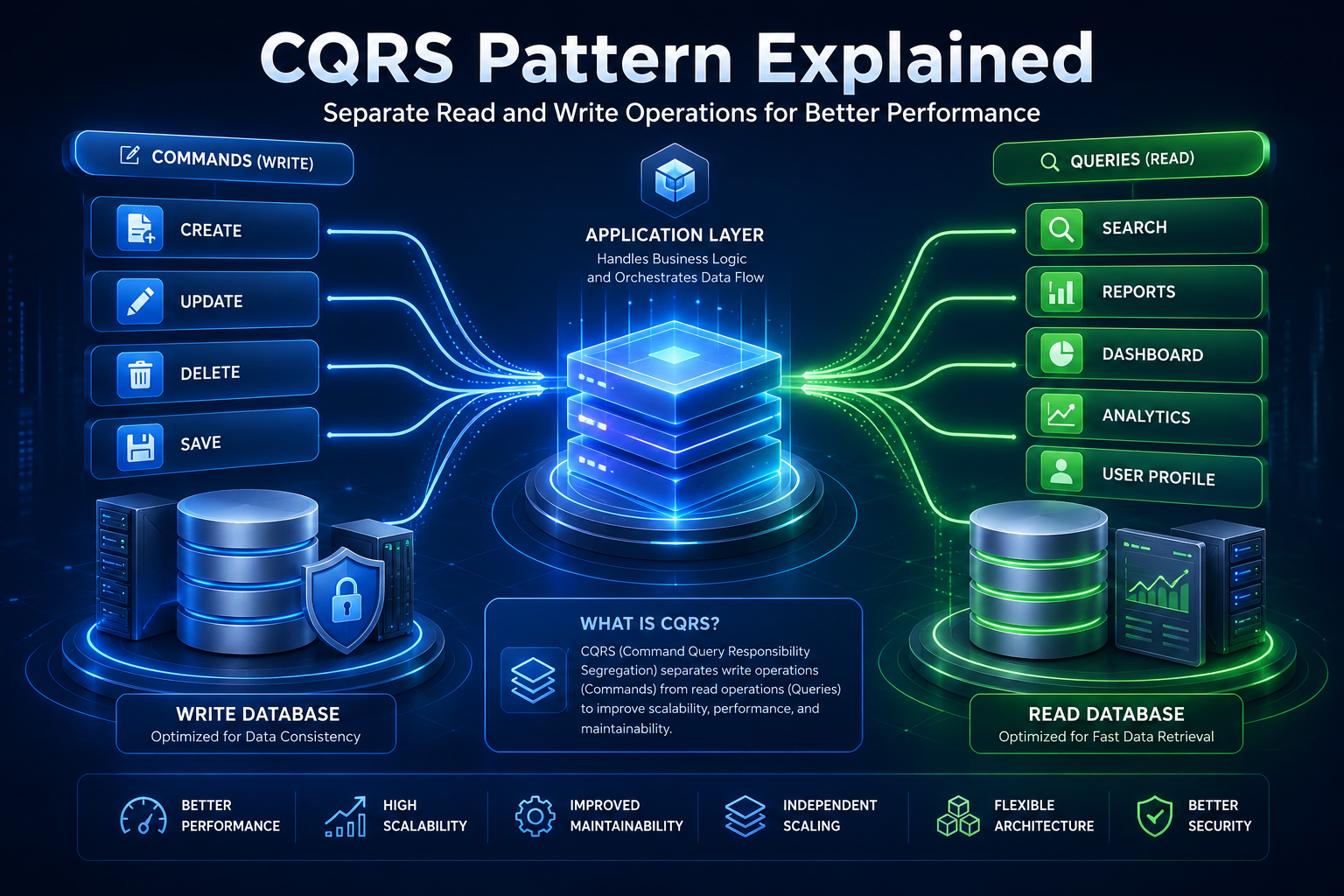
CQRS is a software architecture pattern that separates the work of changing data from the work of reading data. Instead of using the same logic for both operations, CQRS creates separate paths for each. This makes applications faster, easier to manage, and more scalable.
In this blog, you’ll learn what the CQRS Pattern is, how it works, its advantages and disadvantages, and the situations where it is the right choice.
What is the CQRS Pattern?
CQRS stands for Command Query Responsibility Segregation.
Although the name sounds technical, the idea is actually simple.
Every application mainly performs two types of work:
- It stores or changes data.
- It reads or displays data.
CQRS separates these two responsibilities.
A Command is used whenever data needs to be created, updated, or deleted.
A Query is used only to read data. It never changes anything.
Instead of using one model for both operations, CQRS uses separate models for reading and writing data.
This separation helps developers build applications that perform better and are easier to maintain.
Understanding Commands
Commands are responsible for making changes to the application’s data.
For example, when a user performs actions like:
- Creating an account
- Updating a profile
- Placing an order
- Cancelling a booking
- Deleting a product
These actions modify data, so they are handled as Commands.
A command usually returns a simple response such as Success or Failed because its main purpose is to perform an action.
Understanding Queries
Queries are responsible only for displaying information.
They never change any data.
Some common examples include:
- Viewing a user profile
- Searching products
- Checking an order history
- Opening a dashboard
- Viewing sales reports
Since queries only read data, they can be optimized to return information much faster.
How Does the CQRS Pattern Work?
In many traditional applications, the same database model handles both reading and writing data.
This works well for smaller applications.
However, as the application grows, handling everything through one model can slow down the system.
CQRS solves this by separating both operations.
When a user updates information, the request goes through the Command side.
When someone wants to view information, the request goes through the Query side.
Since both sides work independently, developers can improve each one without affecting the other.
A Simple Real-Life Example
Imagine an online shopping website.
Thousands of people visit the website every minute.
Most visitors are simply browsing products, reading reviews, and searching for items.
Only a small number of users are actually placing orders.
Without CQRS, both activities use the same system, which can create unnecessary load.
With CQRS:
- Product browsing uses the Query side.
- Order placement uses the Command side.
Because these operations are separated, customers enjoy faster product searches while orders continue to be processed smoothly.
Why Developers Use the CQRS Pattern
Better Performance
Most applications receive far more read requests than write requests.
Since the reading process is separate, developers can optimize it for speed.
This helps dashboards, search pages, and reports load much faster.
Easier to Scale
Sometimes only the read side needs more resources.
With CQRS, developers can scale the read side without changing the write side.
This improves performance while reducing infrastructure costs.
Cleaner Code
Commands handle business logic.
Queries only fetch data.
Because each responsibility is separate, the code becomes easier to understand, test, and maintain.
Easier Maintenance
As applications become larger, making changes can become risky.
CQRS keeps responsibilities separate, making updates safer and reducing the chance of introducing bugs.
Better Security
Not every user should be allowed to change data.
For example:
- Customers can view products.
- Admins can update products.
CQRS makes it easier to manage these permissions because reading and writing are handled separately.
Challenges of Using CQRS
Although CQRS offers many benefits, it is not the best choice for every project.
More Complex Development
Instead of managing one model, developers maintain separate command and query models.
This increases the amount of code and planning required.
More Components
Large CQRS applications often include message queues, background workers, caching systems, and multiple databases.
Managing these components requires additional knowledge and maintenance.
Data May Not Update Instantly
In some CQRS implementations, the read database updates a short time after the write database.
This means users might not immediately see the latest changes.
This delay is called eventual consistency.
When Should You Use the CQRS Pattern?
CQRS is a great choice when an application has many more read operations than write operations.
It works especially well for:
E-commerce Applications
Customers spend most of their time browsing products, while fewer users place orders.
CQRS keeps browsing fast even during heavy traffic.
Banking Systems
Money transfers require strong business rules, while users frequently check balances and transaction history.
Separating these operations improves reliability and performance.
Hospital Management Systems
Doctors and staff constantly view patient records, while updates happen less frequently.
CQRS helps maintain both speed and data accuracy.
ERP Software
Large business systems handle finance, inventory, payroll, and sales.
CQRS allows different parts of the system to grow independently.
Analytics and Reporting Applications
Reports often require large amounts of data.
Using a separate query model allows reports to load quickly without slowing down the main application.
When Should You Avoid CQRS?
CQRS is not always necessary.
For small applications, using a simple CRUD architecture is usually the better choice.
Examples include:
- Personal projects
- Portfolio websites
- Small business websites
- Basic admin panels
- Simple inventory systems
- MVP products
- Small internal tools
Adding CQRS to these applications often creates unnecessary complexity.
CQRS vs Traditional CRUD
Traditional CRUD uses one model to create, read, update, and delete data.
CQRS separates reading and writing into different models.
CRUD is easier to build and works well for small projects.
CQRS requires more planning but offers better scalability and performance for large applications.
In simple words:
- CRUD is simple.
- CQRS is powerful.
Choose the one that matches your project’s needs.
Best Practices for Using CQRS
If you decide to use CQRS, keep these best practices in mind:
- Keep commands focused on one task.
- Never allow queries to modify data.
- Write clear business rules inside command handlers.
- Optimize query models for fast performance.
- Use caching for frequently requested data.
- Monitor synchronization between read and write models.
- Avoid using CQRS unless your application truly needs it.
Keeping the architecture simple whenever possible will save development time and reduce maintenance costs.
Final Thoughts
The CQRS Pattern is a smart architectural approach for applications that need high performance, scalability, and clean code.
By separating read and write operations, developers can optimize each part independently, making the application faster and easier to maintain.
However, CQRS is not a solution for every project. If you’re building a small application, a traditional CRUD approach is often simpler and more practical.
The best architecture is the one that fits your application’s size, complexity, and future growth. If your system is expected to handle large amounts of data, heavy traffic, or complex business rules, CQRS can be an excellent choice.
