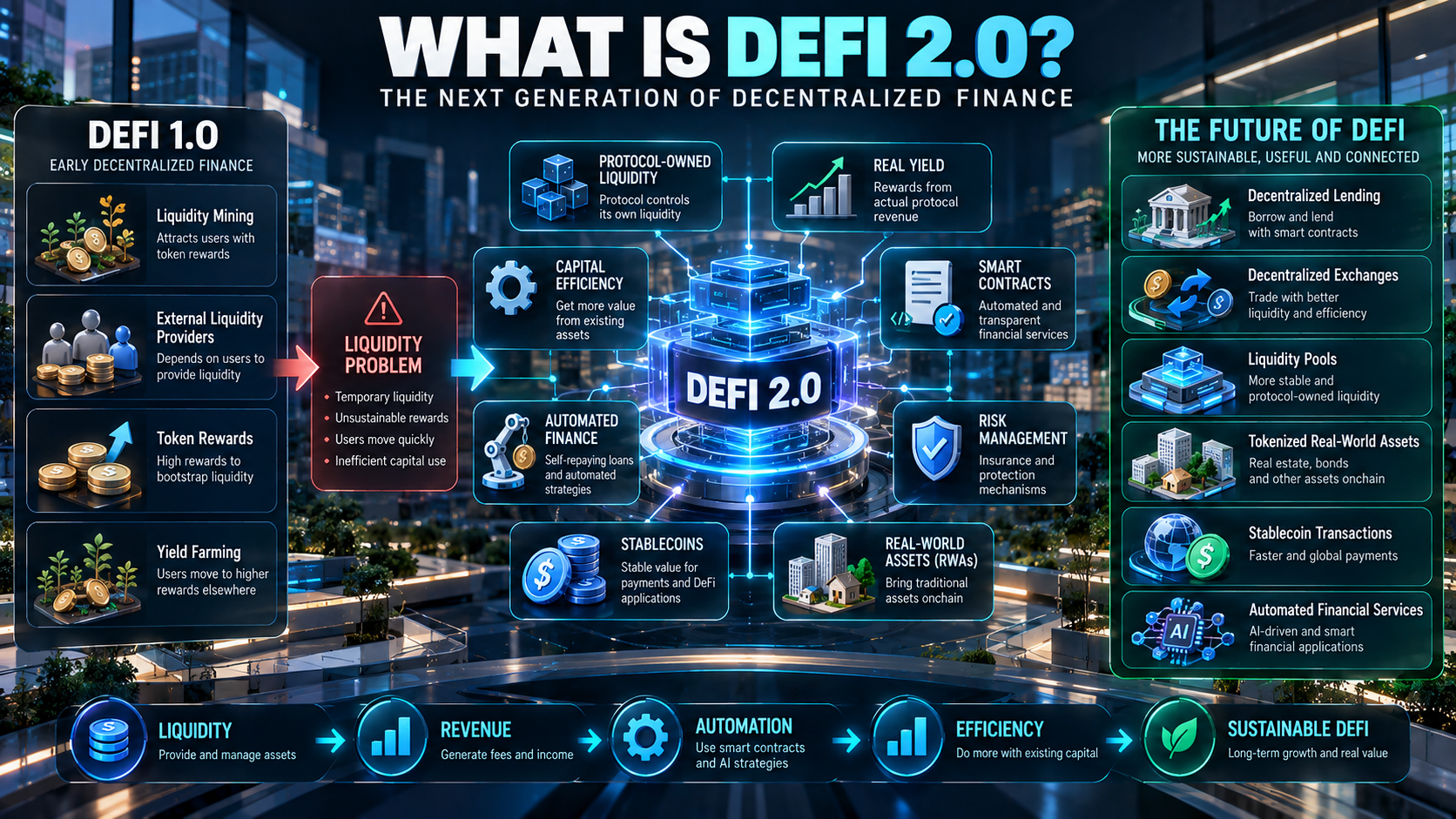
Before understanding DeFi 2.0, let’s first understand DeFi.
DeFi stands for Decentralized Finance. It is a collection of financial applications built on blockchain networks that allow people to access services such as lending, borrowing, trading, and earning returns without depending entirely on traditional financial institutions.
Instead of a bank controlling every transaction, DeFi applications use smart contracts. These are blockchain programs that automatically execute predefined rules.
For example, instead of asking a bank for a loan, a DeFi application can use a smart contract to manage collateral, borrowing, interest, and repayment.
What Is DeFi 2.0?
DeFi 2.0 is a broad term used for the next generation of decentralized finance.
The main goal is to improve some of the problems that appeared in early DeFi applications.
Early DeFi proved that financial services could work through blockchain networks. However, it also faced problems such as temporary liquidity, inefficient use of capital, complicated user experiences, smart-contract risks, and unsustainable token rewards.
DeFi 2.0 tries to build better solutions around these problems.
Why Did DeFi 2.0 Become Necessary?
Early DeFi became popular partly because users could earn large rewards by providing liquidity to different protocols.
This created a simple cycle:
High Rewards → More Users → More Liquidity
But there was also a problem.
When rewards became smaller, some users moved their money to another protocol offering better returns.
This meant that a protocol could lose a large amount of liquidity very quickly.
DeFi 2.0 explores ways to make liquidity more stable and sustainable instead of depending entirely on short-term rewards.
What Is Protocol-Owned Liquidity?
One of the most important ideas associated with DeFi 2.0 is Protocol-Owned Liquidity, or POL.
In traditional DeFi liquidity farming, a protocol may offer tokens to users in exchange for providing liquidity.
The users control their liquidity and can remove it whenever they want.
With protocol-owned liquidity, the protocol attempts to build and control its own liquidity reserves.
In simple terms:
DeFi 1.0:
“Provide liquidity and we will reward you.”
DeFi 2.0:
“The protocol tries to own part of its liquidity.”
The goal is to reduce dependence on temporary liquidity providers and create a more stable liquidity base.
How Does Protocol-Owned Liquidity Work?
One method involves bonding.
A user may provide certain assets or liquidity positions to a protocol and receive the protocol’s token under predefined conditions.
The protocol then gains control of the liquidity.
This can give the protocol a liquidity reserve that it can continue using even when external users stop providing liquidity.
However, protocol-owned liquidity does not remove financial risk. The protocol can still be affected by market movements, token prices, liquidity conditions, and its own economic model.
What Is Real Yield in DeFi?
Another important concept connected with modern DeFi is real yield.
Real yield generally refers to returns supported by actual protocol revenue rather than relying mainly on creating new tokens to pay rewards.
For example, a DeFi protocol may generate revenue through:
- Trading fees
- Lending fees
- Borrowing interest
- Other protocol services
If a protocol earns revenue and uses part of that revenue to support rewards, the reward system has a stronger connection to real economic activity.
Why Is Real Yield Important?
Imagine a DeFi protocol earns $100,000 in fees but distributes $500,000 worth of newly created tokens as rewards.
That model may be difficult to maintain forever.
Now imagine another protocol earns $100,000 and distributes rewards supported mainly by its actual revenue.
The second model has a stronger connection between income and rewards.
This is why users should look beyond a large APY number and ask:
“Where does this yield actually come from?”
A high APY does not automatically mean a better or safer investment.
What Is Yield Farming?
Yield farming is a DeFi strategy where users provide cryptocurrency to a protocol and receive rewards.
For example:
Deposit crypto → Provide liquidity → Earn rewards
Yield farming helped early DeFi protocols attract users and liquidity.
However, if rewards depend heavily on newly issued tokens, the system may become difficult to sustain when token incentives decline.
How Does DeFi 2.0 Try to Improve Yield Farming?
DeFi 2.0 does not necessarily remove yield farming.
Instead, it tries to create more sustainable models around liquidity and rewards.
For example, protocols may focus more on:
- Protocol-owned liquidity
- Actual protocol revenue
- Better capital efficiency
- Automated strategies
- Sustainable incentives
- Improved liquidity management
The broader goal is to make DeFi less dependent on short-term rewards.
What Is Capital Efficiency in DeFi?
Capital efficiency means getting more useful financial activity from the assets already available.
Imagine you have $10,000 in crypto.
If most of that money must remain unused to support one financial activity, the capital is not being used very efficiently.
DeFi 2.0 aims to create systems where the same capital can potentially support more useful financial activities.
This can include better lending systems, liquidity management, collateral mechanisms, and automated financial strategies.
What Are Self-Repaying Loans?
Some DeFi 2.0 designs explore the idea of self-repaying loans.
The basic concept is simple:
Deposit collateral → Generate yield → Use yield to repay debt
For example, suppose a user deposits an asset into a DeFi protocol and receives a loan.
Instead of manually making every repayment, the yield generated by the deposited asset can be used to gradually reduce the debt.
Once enough yield has been generated, the loan can potentially be repaid.
This is an interesting example of how smart contracts can automate financial processes.
However, the exact mechanics and risks depend on the specific protocol.
Can DeFi 2.0 Reduce Financial Risk?
DeFi 2.0 aims to address some risks, but it does not eliminate risk.
Some protocols have explored insurance-like mechanisms that can provide protection against certain smart-contract exploits or other losses.
These systems can potentially give users additional protection.
However, users must carefully check what is actually covered because different protocols have different rules and limitations.
What Is DeFi Insurance?
DeFi insurance is designed to provide protection against certain risks associated with decentralized finance.
For example, an insurance mechanism may provide coverage for a specific type of smart-contract exploit under specific conditions.
This can be useful because users may have significant funds locked inside smart contracts.
But insurance does not mean that all losses are automatically covered.
Users need to understand:
- What is covered
- What is not covered
- How claims work
- Who provides the coverage
- What conditions apply
How Is DeFi 2.0 Different From DeFi 1.0?
The easiest way to understand the difference is to look at the main goals.
| DeFi 1.0 | DeFi 2.0 |
|---|---|
| Built basic decentralized financial services | Attempts to improve those services |
| Relied heavily on liquidity providers | More focus on protocol-owned liquidity |
| Liquidity mining was widely used | More focus on sustainable incentives |
| Capital could remain inefficiently locked | Greater focus on capital efficiency |
| High token rewards were common | More focus on revenue-backed rewards |
| Basic DeFi building blocks | More advanced financial mechanisms |
DeFi 2.0 is therefore better understood as an evolution of DeFi, not a completely separate financial system.
Is DeFi 2.0 a New Blockchain?
No.
DeFi 2.0 is not a blockchain like Ethereum or another Layer 1 network.
It is a broad term describing different technologies, protocols, and financial mechanisms designed to improve decentralized finance.
These applications can operate on different blockchain networks.
What Are the Main Features of DeFi 2.0?
Several ideas are commonly associated with DeFi 2.0.
Protocol-Owned Liquidity
Protocols can attempt to own and manage their own liquidity instead of continuously renting it through rewards.
Real Yield
Protocols can focus on generating rewards from actual economic activity and revenue.
Capital Efficiency
The goal is to make existing capital more productive.
Automated Finance
Smart contracts can automate lending, borrowing, repayments, and other financial processes.
Better Risk Management
Some protocols experiment with insurance-like mechanisms and other risk-management systems.
Improved User Experience
Newer DeFi applications are also trying to make decentralized finance easier for ordinary users.
These ideas are part of a broader effort to make DeFi more sustainable and useful.
What Are the Risks of DeFi 2.0?
DeFi 2.0 is not risk-free.
Smart Contract Risk
A bug in a smart contract can potentially lead to financial losses.
Market Risk
Crypto prices can move quickly and significantly.
Liquidity Risk
Even protocols that own liquidity can face liquidity problems during extreme market conditions.
Token Risk
Some protocols depend heavily on their own tokens. A major decline in token value can affect the entire ecosystem.
Economic Model Risk
A protocol may look attractive on paper but fail when market conditions change.
Governance Risk
Some decentralized projects may still have concentrated voting power among large token holders.
User Security Risk
Users can lose funds through phishing, malicious contracts, incorrect transactions, or compromised wallets.
So, DeFi 2.0 should not be considered automatically safer than traditional DeFi.
Why Should Users Be Careful About High APY?
A very high APY can look attractive.
But users should always ask:
“Why is the protocol paying this much?”
The reward could come from:
- Real protocol revenue
- Trading fees
- Lending activity
- New token emissions
- Treasury funds
- A combination of different sources
A high APY alone does not tell you whether the system is sustainable.
Understanding the source of the yield is more important than simply looking at the percentage.
Can AI Make DeFi 2.0 Smarter?
AI could become an important part of future DeFi applications.
AI systems could potentially help with:
- Risk monitoring
- Market analysis
- Fraud detection
- Liquidity management
- Portfolio analysis
- Automated strategies
- Smart-contract monitoring
AI agents could also interact with blockchain applications and execute authorized actions.
However, giving an AI system access to financial assets creates additional security and permission risks.
AI should therefore be treated as a tool rather than a guarantee of financial safety.
Can DeFi 2.0 Work With Real-World Assets?
Yes, DeFi is increasingly being connected with real-world assets, or RWAs.
These can include assets such as:
- Government securities
- Credit
- Real estate
- Other traditional financial assets
Tokenization can bring these assets onto blockchain networks, where they can potentially interact with DeFi applications.
This could create new financial products combining traditional assets with decentralized applications.
Current DeFi research shows that tokenized real-world assets are already being used inside parts of the DeFi ecosystem, although the technology is still developing.
What Could the Future of DeFi 2.0 Look Like?
The future of DeFi could involve much more automation and integration.
We may see stronger connections between:
DeFi + Stablecoins + AI Agents + RWAs + Blockchain Identity + ZK Technology
For example, an AI agent could potentially analyze financial conditions, interact with a DeFi protocol, manage an authorized position, and report the results to a user.
At the same time, tokenized real-world assets could provide new sources of on-chain financial activity.
This could make DeFi more connected to the wider digital financial system.
Is DeFi 2.0 the Future of Decentralized Finance?
DeFi 2.0 is best viewed as an evolution rather than a complete replacement for DeFi 1.0.
The first generation proved that lending, borrowing, trading, and other financial services could operate using blockchain and smart contracts.
The next generation is focused on improving sustainability, liquidity, capital efficiency, automation, and user experience.
Whether every DeFi 2.0 idea succeeds is still an open question.
The real test will be whether these models can continue working during different market conditions without depending on unsustainable incentives.
Conclusion: Why DeFi 2.0 Matters
DeFi 2.0 represents a new approach to building decentralized financial applications.
Instead of focusing only on attracting users with high token rewards, newer DeFi designs are exploring protocol-owned liquidity, real yield, capital efficiency, automated finance, better risk management, and real-world asset integration.
The goal is simple:
Make decentralized finance more sustainable, useful, and efficient.
However, DeFi 2.0 does not remove the risks of cryptocurrency or smart contracts. Users should always understand how a protocol works, where its yield comes from, what risks it carries, and how its assets are protected.
If these challenges can be addressed successfully, DeFi could become an increasingly important part of the future digital financial system.
