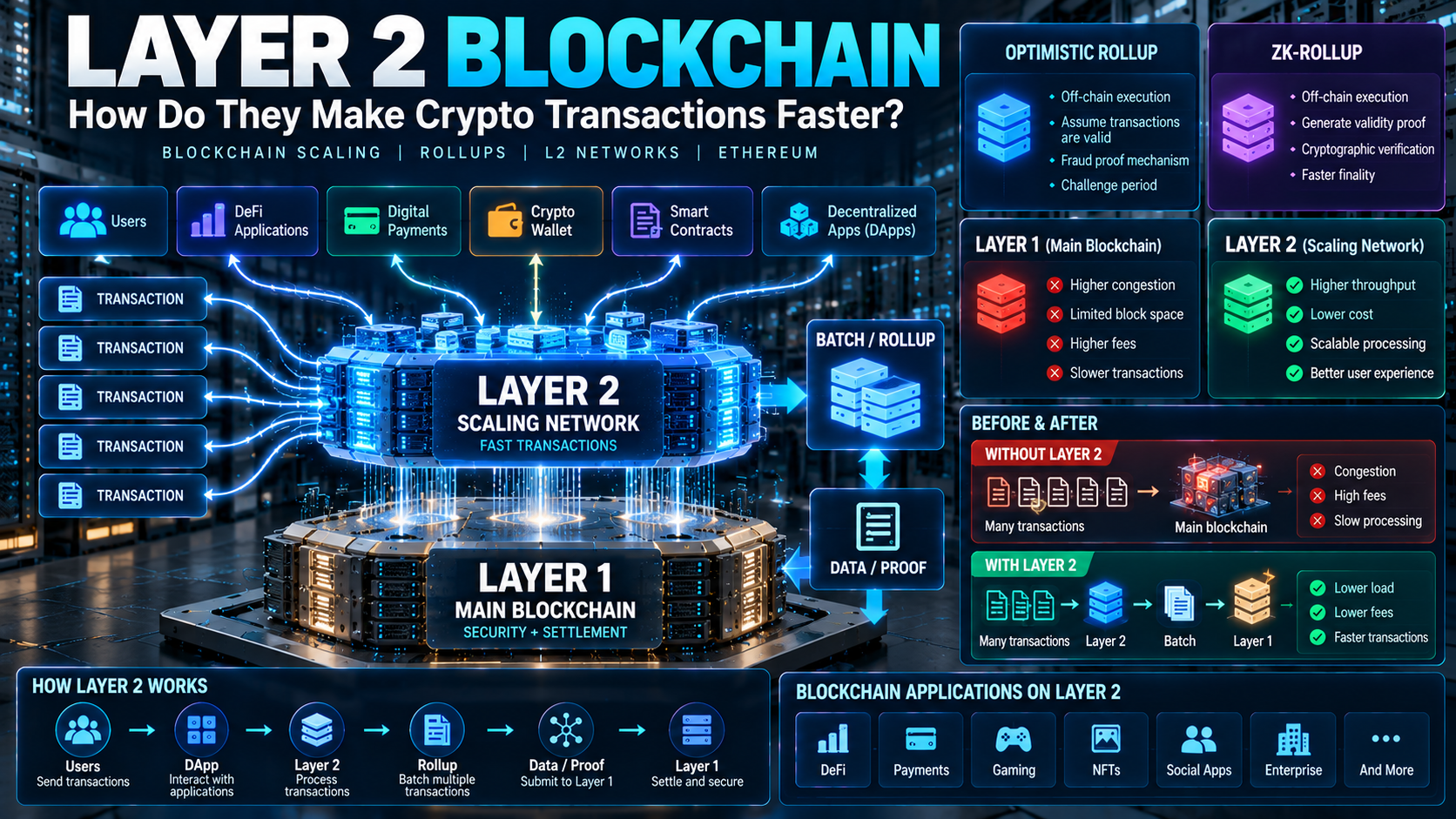
Blockchain technology has made it possible to send digital assets and use applications without depending on a traditional central authority. However, popular blockchain networks can become busy when many people use them at the same time.
When a blockchain becomes congested, transactions can take longer and fees can increase. Layer 2 blockchain networks are designed to help solve this problem by processing transactions away from the main blockchain while still using the main network for important security and settlement functions.
This raises an important question: How can Layer 2 networks make blockchain transactions faster and cheaper?
What Is a Layer 2 Blockchain?
A Layer 2 blockchain, often called an L2, is a separate network built on top of a Layer 1 blockchain.
The Layer 1 blockchain is the main network. For example, Ethereum Mainnet is a Layer 1 blockchain. A Layer 2 network can process many transactions separately and then send the necessary information back to Ethereum.
In simple terms:
Layer 1 = Main Blockchain
Layer 2 = Additional Processing Layer
Instead of making the main blockchain handle every transaction directly, Layer 2 takes some of the workload away from it.
Why Is Blockchain Speed a Problem?
Traditional blockchain networks have limited space in each block. When many users compete for that space, the network can become congested.
Think about a busy highway. If only a limited number of cars can use the road at one time, traffic increases when too many cars arrive.
Blockchain congestion works in a similar way.
More users → More transactions → More competition for block space → Higher fees and slower processing
Layer 2 networks are designed to provide additional capacity without requiring every transaction to be processed directly on the main blockchain.
How Does Layer 2 Make Transactions Faster?
The basic idea behind Layer 2 is simple.
Instead of sending every transaction directly to Layer 1, users send transactions to the Layer 2 network. The Layer 2 processes those transactions and can combine many of them into a batch.
That batch is then connected back to Layer 1.
The simplified process looks like this:
Many Transactions → Layer 2 → Batch Processing → Layer 1
Because Layer 2 handles much of the transaction processing separately, the main blockchain does not have to perform all the work individually.
What Is the Difference Between Layer 1 and Layer 2?
Layer 1 is the underlying blockchain that provides the core security, consensus and settlement infrastructure.
Layer 2 works above that blockchain and focuses mainly on improving transaction capacity and efficiency.
| Feature | Layer 1 | Layer 2 |
|---|---|---|
| Role | Main blockchain | Scaling network |
| Processing | Directly on main chain | Mainly handled separately |
| Main goal | Security and settlement | Speed and scalability |
| Transaction capacity | More limited | Generally higher |
| Fees | Can become expensive during congestion | Usually lower |
| Example | Ethereum Mainnet | Ethereum rollup |
The exact architecture and security model can differ between individual Layer 2 networks, so all L2s should not be treated as identical.
What Are Layer 2 Rollups?
Rollups are one of the most important Layer 2 technologies.
A rollup processes transactions outside Layer 1 and then sends transaction data or cryptographic information back to the main blockchain.
Instead of Ethereum processing every transaction separately, hundreds of transactions can be grouped together.
This helps distribute the cost of interacting with Layer 1 across many users.
The basic concept is:
100s of Transactions → Rollup → One Batch → Layer 1
This is one of the main reasons rollups can reduce transaction costs and increase scalability.
What Are Optimistic Rollups?
Optimistic Rollups are a type of Layer 2 technology that generally assumes submitted transactions are valid unless someone challenges them.
Transactions are processed outside Ethereum and then grouped into batches. The relevant transaction data is published back to Ethereum.
If someone believes that a transaction result is incorrect, a fraud-proof process can be used to challenge it.
The simplified process is:
Transactions → L2 Processing → Batch → Ethereum → Challenge Period → Finalization
This approach allows large amounts of transaction processing to happen away from the main blockchain.
What Are ZK-Rollups?
ZK-Rollups, or Zero-Knowledge Rollups, use cryptographic validity proofs.
Instead of simply assuming that a batch is correct, the Layer 2 generates a proof that helps demonstrate that the transactions were processed correctly.
Ethereum can verify the proof on the main blockchain without having to perform all of the same computation again.
The basic process is:
Transactions → L2 Processing → Generate Proof → Ethereum Verifies Proof
This makes ZK-Rollups an important approach to blockchain scalability.
Optimistic Rollups vs ZK-Rollups
Both technologies are designed to move transaction processing away from Layer 1, but they use different approaches.
| Feature | Optimistic Rollups | ZK-Rollups |
|---|---|---|
| Main idea | Assume transactions are valid | Provide validity proof |
| Security approach | Fraud proofs | Cryptographic proofs |
| Transaction execution | Off-chain/L2 | Off-chain/L2 |
| Layer 1 role | Settlement and security | Settlement and proof verification |
| Main challenge | Challenge/finalization periods | Proof-generation complexity |
Neither approach should be viewed as universally suitable for every application. Each has different technical and operational trade-offs.
How Do Layer 2 Networks Reduce Crypto Fees?
Layer 2 can reduce transaction costs because many transactions can share the cost of submitting information to Layer 1.
Imagine that 1,000 users need to submit transactions.
If each transaction has to use Layer 1 independently, each user competes for limited block space.
With a rollup, many transactions can be grouped together and submitted as a batch.
So instead of:
User 1 → L1
User 2 → L1
User 3 → L1
…
Layer 2 can use:
User 1 + User 2 + User 3 + … → L2 Batch → L1
This can make the cost per transaction much lower.
Are Layer 2 Transactions Really Faster?
Layer 2 networks can significantly improve transaction throughput and user experience, but “faster” does not always mean every part of the process happens instantly.
There is a difference between transaction execution and final settlement.
A transaction can be processed quickly on Layer 2 while final settlement or moving assets back to Layer 1 may follow a different process.
Therefore, users should consider the entire transaction lifecycle rather than looking only at execution speed.
What Is Transaction Batching?
Transaction batching means combining many transactions together instead of submitting every transaction independently.
For example:
Transaction A
Transaction B
Transaction C
Transaction D
can become:
Batch A → Submitted to Layer 1
This reduces repeated data and helps the network use block space more efficiently.
Rollups use batching and data-compression techniques to improve scalability.
What Is Data Availability in Layer 2?
Layer 2 networks still need to make important transaction information available so that their state can be checked and reconstructed when necessary.
Rollups therefore publish transaction data or compressed information to Layer 1.
This creates an important relationship:
Layer 2 → Transaction Execution
Layer 1 → Data Availability, Settlement and Security
The exact design varies between different Layer 2 systems, but data availability is an important part of the scaling architecture.
Why Is Layer 2 Important for Ethereum?
Ethereum supports a large ecosystem of decentralized applications, smart contracts, DeFi applications and digital assets.
As activity grows, processing every transaction directly on Ethereum Mainnet can become expensive or inefficient.
Layer 2 networks help move transaction execution away from the main chain while still connecting back to Ethereum.
Ethereum’s own scaling documentation describes Layer 2 as a way to handle transactions away from Mainnet while using Ethereum’s underlying security model.
How Can Layer 2 Help DeFi?
Decentralized finance, or DeFi, can require users to make many blockchain transactions.
For example:
Connect Wallet → Swap Tokens → Provide Liquidity → Borrow → Repay
If every action costs a high fee, using DeFi applications can become difficult for smaller transactions.
Layer 2 networks can reduce transaction costs and increase capacity, making blockchain applications more practical for frequent users.
Can Layer 2 Improve Blockchain Payments?
Payments are another area where Layer 2 technology can be useful.
For everyday payments, users generally expect transactions to be affordable and responsive.
A Layer 2 can process many transactions separately and use the underlying blockchain for settlement.
This creates a possible architecture for high-volume blockchain payments:
User → Payment App → Layer 2 → Batch → Layer 1
The technology therefore has applications beyond cryptocurrency trading.
What Are the Other Types of Layer 2 Scaling?
Rollups are not the only scaling approach.
Another technology is state channels, where participants can conduct multiple transactions away from the main blockchain and later settle the result on Layer 1.
There are also other scaling architectures such as validiums and sidechains, but their security and data-availability models can differ from true Layer 2 rollups.
Understanding these differences is important because the term “Layer 2” is sometimes used broadly for several different scaling technologies.
What Are the Benefits of Layer 2 Blockchain Networks?
Layer 2 networks can provide several important benefits:
Faster Transaction Processing
Moving execution away from Layer 1 can increase transaction capacity.
Lower Transaction Fees
Batching transactions can reduce the cost associated with each individual transaction.
Less Layer 1 Congestion
Layer 2 can reduce the number of transactions competing directly for Layer 1 block space.
Better Scalability
Applications can support more users without putting the entire workload on the main blockchain.
More Practical Applications
Lower costs can make blockchain-based payments, gaming, DeFi and other applications more practical.
Ethereum identifies increased throughput, reduced congestion and lower fees among the key goals of Layer 2 scaling.
What Are the Challenges of Layer 2?
Layer 2 networks also have challenges.
Different networks can have different:
- Security models
- Sequencer designs
- Withdrawal processes
- Bridging systems
- Smart-contract risks
- Decentralization levels
- Data-availability approaches
- User experiences
Some Layer 2 systems are also relatively young compared with established Layer 1 networks. Ethereum’s documentation recommends understanding the specific risks and trust assumptions of each L2 rather than assuming every Layer 2 has the same security properties.
What Is a Layer 2 Sequencer?
Many Layer 2 systems use a sequencer.
A sequencer receives transactions from users, orders them and helps create Layer 2 blocks or batches.
A simplified flow is:
User → Sequencer → Layer 2 Block → Batch → Layer 1
The role of sequencers is important because their design can affect transaction ordering, availability and decentralization.
Different Layer 2 projects use different approaches to sequencing.
Can Layer 2 Networks Be Hacked?
Layer 2 networks can introduce additional software and infrastructure, which means security remains important.
Potential risks can involve:
- Smart-contract vulnerabilities
- Bridge vulnerabilities
- Sequencer issues
- Incorrect implementations
- Wallet mistakes
- Malicious applications
- Governance risks
This does not mean Layer 2 networks are inherently unsafe. It means users should understand that each network has its own technology and trust assumptions.
Does Layer 2 Replace Layer 1?
No.
Layer 2 is generally designed to work with Layer 1 rather than replace it.
The two layers have different roles.
Layer 1
Provides the underlying blockchain infrastructure, security and settlement.
Layer 2
Provides additional transaction processing capacity.
A simplified architecture is:
Users → Applications → Layer 2 → Layer 1 → Settlement
This layered approach allows blockchain systems to separate high-volume transaction processing from the underlying settlement layer.
Why Is Layer 2 Important for the Future of Blockchain?
Blockchain adoption requires networks that can handle more users and transactions without making every transaction expensive.
Layer 2 provides one way to increase capacity while keeping a connection to the underlying blockchain.
Ethereum’s 2026 strategy continues to treat Layer 1 and Layer 2 as parts of a broader scaling system rather than completely separate technologies.
At the same time, the blockchain ecosystem is evolving, and improvements to Layer 1 itself are also changing the scaling equation.
What Could Layer 2 Look Like in the Future?
Future blockchain infrastructure is likely to involve multiple layers working together.
A simplified future architecture could look like:
Users
↓
Blockchain Applications
↓
Specialized Layer 2 Networks
↓
Rollups and Data Availability
↓
Layer 1 Blockchain
↓
Settlement and Security
Different Layer 2 networks may also become specialized for areas such as payments, gaming, DeFi, trading, enterprise applications and other high-volume workloads.
Layer 1 vs Layer 2: A Simple Example
Imagine a large city with one main highway.
The highway represents Layer 1.
When too many vehicles use it, traffic becomes heavy.
Now imagine several additional express roads being built above or around the main highway.
These express roads represent Layer 2.
Most traffic can use the express roads, while the main highway remains the underlying transportation infrastructure.
In blockchain terms:
Layer 1 = Main Road
Layer 2 = Express Road
Transactions = Vehicles
Blockchain Congestion = Traffic
This is a simple way to understand why Layer 2 can improve blockchain scalability.
So, How Do Layer 2 Networks Make Crypto Transactions Faster?
Layer 2 networks make blockchain systems more scalable by moving much of the transaction processing away from the main blockchain.
They can process transactions separately, combine many transactions into batches and send relevant data or proofs back to Layer 1.
The basic process is:
Users → Layer 2 → Process Transactions → Batch/Proof → Layer 1
This can increase transaction capacity, reduce congestion and lower the cost of individual transactions.
Conclusion:
Layer 2 networks are an important part of the blockchain scaling landscape.
They do not simply try to make the main blockchain work harder. Instead, they add another processing layer that can handle large numbers of transactions more efficiently.
Optimistic Rollups and ZK-Rollups demonstrate two different approaches to this idea, while other scaling technologies provide additional options.
As blockchain applications continue to grow, the combination of Layer 1 security + Layer 2 scalability could become an important foundation for faster and more affordable blockchain applications.
The key idea is simple:
Layer 1 provides the foundation. Layer 2 provides additional scale.
