Introduction
Space technology used to be something only large space agencies could afford. Building and launching traditional satellites required huge budgets, complex engineering, and many years of development. Today, things are changing quickly. Small satellites, especially CubeSats, are making space exploration easier, faster, and more affordable.
Mini satellites and CubeSats are opening new opportunities for universities, startups, researchers, and even small countries to participate in space missions. Because of their small size and lower cost, they are becoming an important part of modern space engineering and satellite technology.
What Are Mini Satellites and CubeSats
Mini satellites are small spacecraft that are much lighter than traditional satellites. While large satellites can weigh several tons, mini satellites usually weigh between 10 kg and 500 kg.
CubeSats are a special type of mini satellite designed using a standard cube-shaped structure. A basic CubeSat unit measures 10 × 10 × 10 centimeters and weighs around 1 kilogram. Engineers can combine multiple units to build larger CubeSats depending on the mission.
Because they follow a standard design, CubeSats are easier to build, test, and launch compared to traditional satellites. This standardization has helped engineers and researchers develop satellites much faster.
Why CubeSats Are Becoming Popular in Space Engineering
One of the biggest reasons for the popularity of CubeSats is their low cost. Traditional satellites can cost hundreds of millions of dollars, but CubeSats can be built with a much smaller budget. This allows universities, startups, and research organizations to participate in space missions.
Another important advantage is faster development time. Large satellites can take many years to develop, while CubeSats can often be designed and launched within a much shorter period. This helps engineers test new ideas and technologies quickly.
CubeSats also make it easier for students and researchers to gain real experience in space engineering. Many universities now build CubeSats as part of educational and research programs.
How CubeSats Are Used in Real Life
CubeSats are used for many different purposes in space missions. One of their most important roles is Earth observation. These small satellites can capture images of the planet and monitor environmental changes such as climate change, deforestation, and ocean pollution.
They are also used for communication systems. Some companies are developing large groups of small satellites that work together to provide internet access to remote areas around the world.
CubeSats are also valuable for scientific research. Scientists use them to study space weather, radiation, and atmospheric conditions. Because CubeSats are smaller and cheaper, they allow more experiments to be conducted in space.
Another important use is testing new space technologies. Engineers can test new sensors, communication systems, and navigation technologies using CubeSats before applying them to larger missions.
Challenges of CubeSat Technology
Even though CubeSats offer many advantages, they also have some limitations. Because they are small, they have limited space for power systems, communication equipment, and onboard computers.
Their small size also means they may have a shorter operational lifespan compared to large satellites. Engineers must carefully design these satellites to use power and space efficiently.
However, technology is improving rapidly. Advances in mini electronics, artificial intelligence, and satellite components are helping overcome many of these challenges.
The Future of Mini Satellites and CubeSats
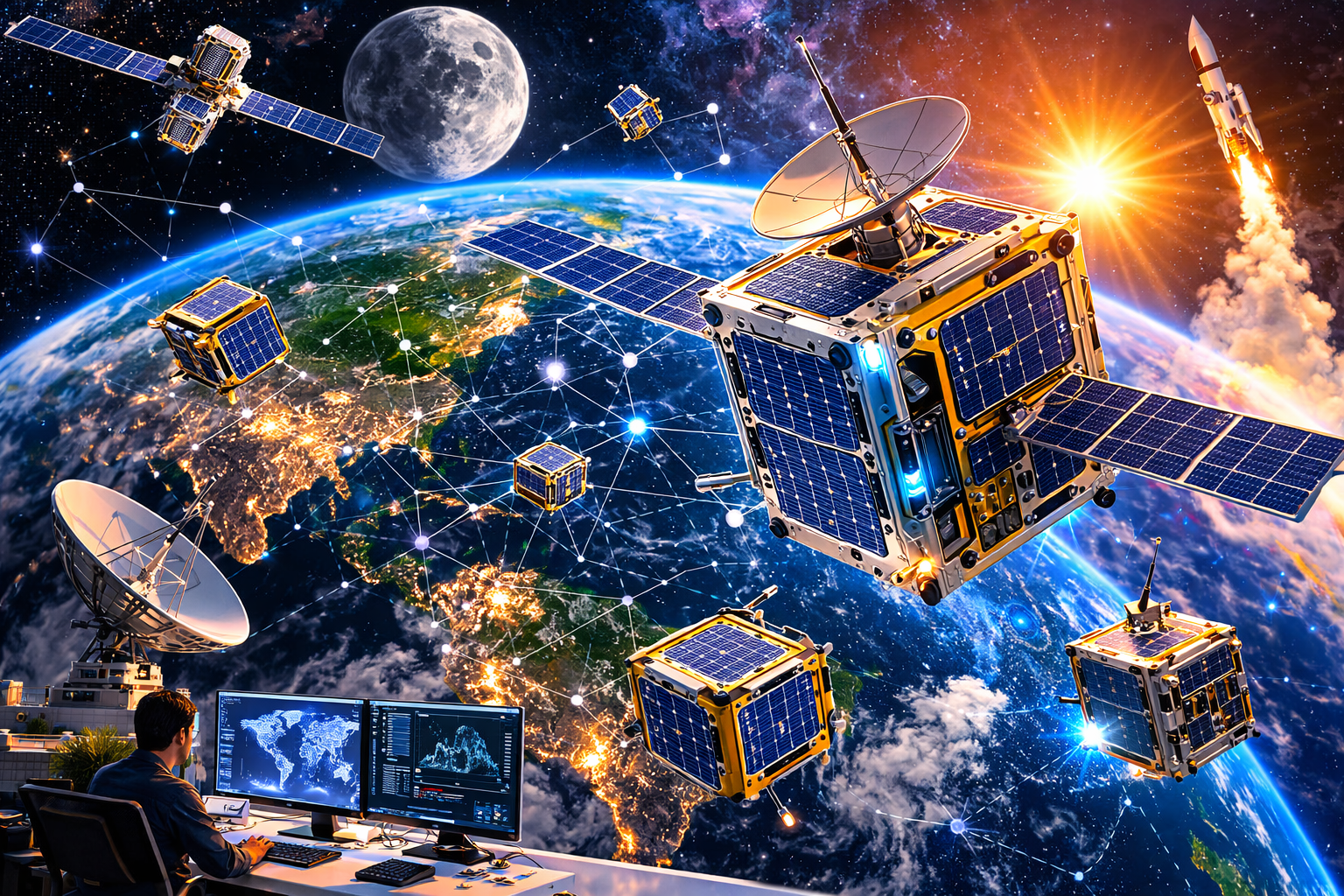
The future of space engineering will likely include many more small satellites working together. Instead of relying on a single large satellite, engineers are now launching constellations of CubeSats that orbit the Earth and work as a network.
These satellite networks can provide better global coverage for communication, navigation, and Earth monitoring.
CubeSats may also play an important role in future deep space missions. Scientists are already exploring how these small satellites could be used for exploring the Moon, Mars, and other parts of our solar system.
As technology continues to advance, CubeSats will become even more powerful and capable, helping engineers explore space in new and innovative ways.
Conclusion
Mini satellites and CubeSats are changing the way we explore space. Their small size, lower cost, and faster development make them an attractive solution for modern space missions.
They allow researchers, universities, startups, and space agencies to experiment, innovate, and expand our understanding of space. With improvements in technology, CubeSats are expected to play a major role in the future of space engineering, satellite communication, and space exploration.
The growing use of these small satellites shows that the future of space technology is not just bigger satellites, but smarter and more efficient ones.
