Introduction
The rise of online shopping has completely transformed global logistics. Customers expect faster deliveries, real-time tracking, and seamless returns. To meet this demand, warehouses are becoming smarter — and AI-powered robots are leading the change.
Major innovators like Amazon Robotics, Ocado Technology, KUKA, and GreyOrange are deploying intelligent robotic systems across fulfillment centers worldwide.
These aren’t simple machines following fixed instructions. They are AI-driven systems that learn, adapt, and optimize operations in real time.
Let’s explore how warehouse robotics is reshaping the future of automation.
The E-Commerce Pressure Problem
Online retail has created enormous pressure on supply chains. Warehouses must now handle:
- Same-day delivery expectations
- Massive order volumes
- Seasonal demand spikes
- Complex inventory management
- Quick return processing
Traditional manual systems struggle to keep up. That’s where AI-powered warehouse robots step in.
They bring speed, accuracy, and continuous operation — all essential for modern fulfillment.
How AI Makes Warehouse Robots Smarter
AI enables robots to go beyond repetitive motion tasks. Instead of fixed programming, modern systems use machine learning and computer vision to adapt dynamically.
AI warehouse robots can:
- Identify products using visual recognition
- Navigate crowded warehouse floors
- Optimize picking routes
- Predict demand trends
- Automatically reorganize inventory
By analyzing large volumes of data, these robots improve efficiency over time.
The more they work, the smarter they become.
Smart Picking and Sorting Systems
One of the most important warehouse tasks is order picking.
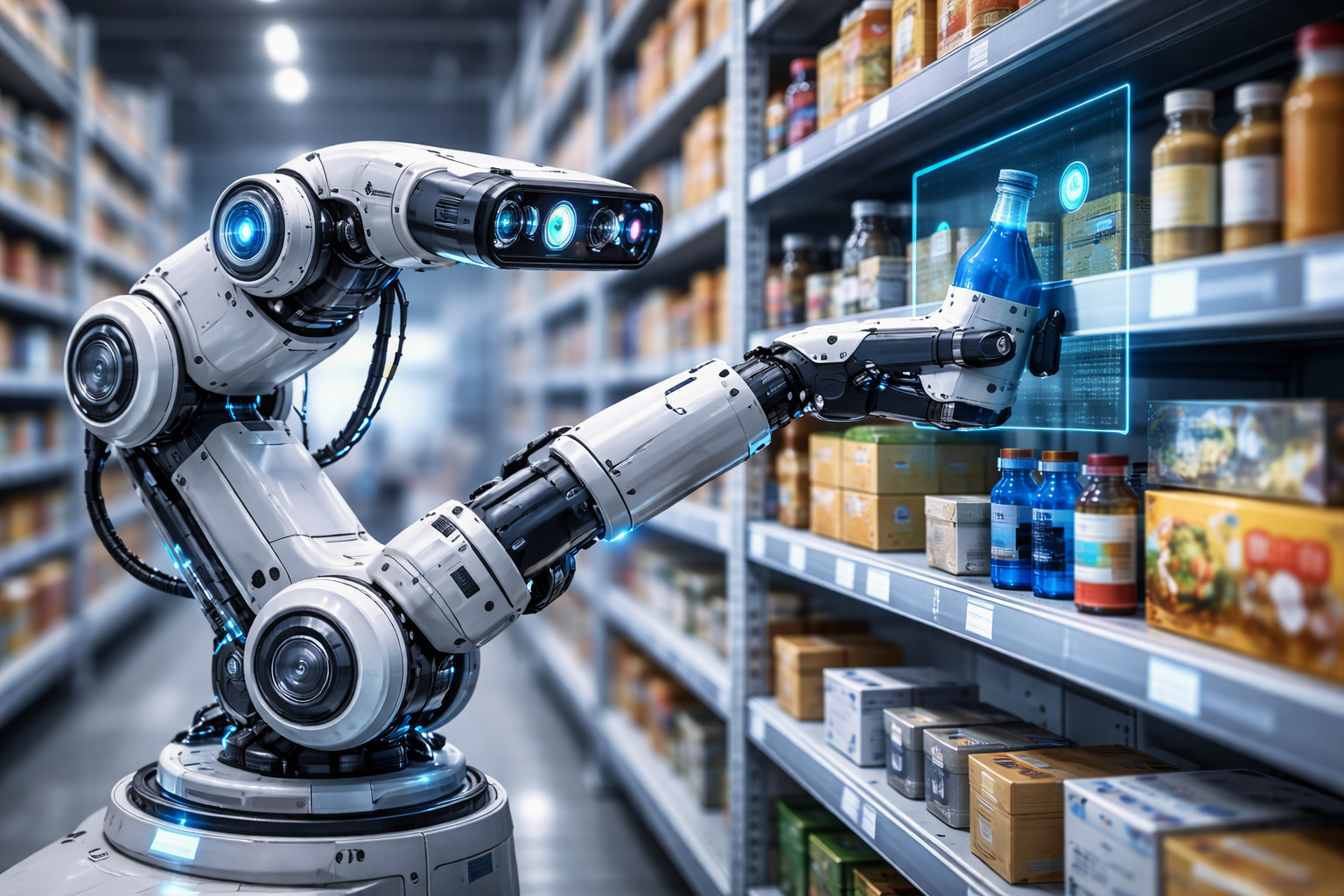
AI-driven robots use advanced cameras and gripping systems to:
- Recognize different product shapes
- Handle fragile items carefully
- Sort packages accurately
- Minimize picking errors
Even complex items with irregular packaging can now be handled by robotic arms equipped with AI-enhanced vision.
This dramatically reduces mistakes and speeds up processing time.
Autonomous Mobile Robots in Action
Autonomous mobile robots are transforming warehouse movement.
Unlike traditional conveyor belts, these robots move freely across the floor, transporting goods between stations.
They can:
- Avoid obstacles automatically
- Coordinate with other robots
- Choose optimal travel paths
- Adjust routes in real time
This flexibility allows warehouses to scale operations quickly without redesigning the entire facility.
Efficiency increases while operational costs decrease.
Real-Time Inventory Intelligence
Inventory management is one of the biggest challenges in logistics.
AI-powered robotic systems constantly monitor stock levels and product movement. They can detect shortages, identify misplaced items, and even forecast future demand.
Benefits include:
- Reduced overstocking
- Lower storage costs
- Faster restocking
- Improved order accuracy
With predictive analytics, warehouses can prepare for demand surges before they happen.
This gives companies a competitive edge in fast-moving markets.
Enhancing Human and Robot Collaboration
Contrary to popular belief, warehouse robots are not replacing human workers entirely. Instead, they are working alongside them.
Robots handle repetitive and physically demanding tasks such as lifting, transporting, and sorting. Humans focus on supervision, quality control, and complex problem-solving.
This collaboration:
- Reduces workplace injuries
- Improves productivity
- Enhances job satisfaction
- Increases operational efficiency
The future of automation is not about humans versus robots — it’s about humans with robots.
Faster Deliveries and Customer Satisfaction
The biggest winner in robotic warehouse automation is the customer.
AI-powered systems allow companies to:
- Process orders faster
- Reduce shipping delays
- Improve tracking accuracy
- Handle returns more efficiently
When fulfillment centers operate smoothly, customers receive products quicker and with fewer errors.
This strengthens brand loyalty and trust.
Challenges in Warehouse Robotics
Despite rapid growth, challenges remain.
Warehouses must address:
- High initial investment costs
- Integration with existing systems
- Cybersecurity concerns
- Ongoing maintenance needs
However, as technology becomes more accessible and scalable, these barriers are gradually decreasing.
Automation is becoming less of a luxury and more of a necessity.
The Future of AI in Logistics
The next generation of warehouse robotics will likely include:
- Fully autonomous fulfillment centers
- Advanced AI demand forecasting
- Energy-efficient robotic fleets
- Real-time global supply chain optimization
- Greater integration with smart transportation systems
As AI continues to evolve, logistics will become faster, smarter, and more sustainable.
We are moving toward an era where automation handles complexity seamlessly in the background.
Conclusion
AI-powered warehouse robots are transforming e-commerce fulfillment at an incredible pace. From smart picking systems to autonomous mobile robots and predictive inventory management, automation is redefining logistics operations.
While challenges remain, the benefits are clear: faster deliveries, greater accuracy, and improved efficiency.
In the world of online retail, speed and precision matter more than ever — and intelligent robotics is making it all possible.
The warehouse of the future isn’t just automated.
It’s intelligent.
