Simple Introduction
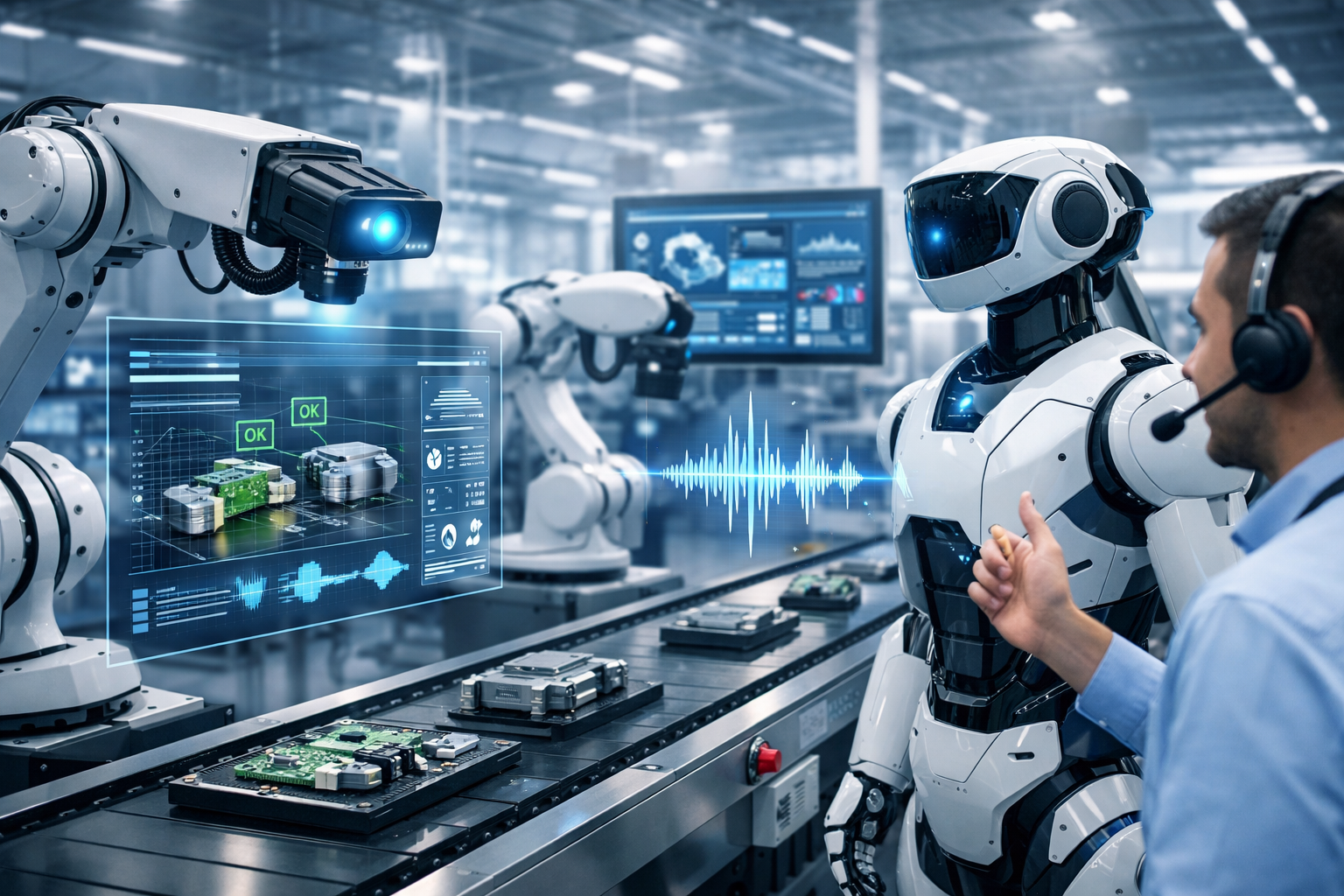
AI-enabled machine vision and voice control help machines see, understand, and respond like humans. These technologies make automation smarter and easier to use. Robots no longer work only with fixed programs — they can now analyze visuals and listen to voice commands to perform tasks more accurately.
This innovation plays an important role in modern automation, smart factories, and robotics systems.
Understanding AI-Enabled Machine Vision
Machine vision allows robots to see the world using cameras and sensors. With the help of artificial intelligence, machines can understand images and videos instead of just capturing them.
Traditional vision systems followed fixed rules. AI-enabled machine vision is different — it learns from data, improves over time, and works well even in complex environments.
What Machine Vision Can Do
- Identify objects and products
- Detect defects and errors
- Measure size, shape, and position
- Track moving items in real time
- Analyze images with high accuracy
This makes machine vision very useful in manufacturing, quality control, and logistics.
Understanding Voice Control in Automation
Voice control allows people to operate machines using spoken commands. It uses AI technologies like speech recognition and natural language processing to understand what a person is saying.
Instead of using buttons or writing code, users can simply talk to the robot, making automation easy for everyone.
How Voice Control Helps
- Hands-free operation
- Faster communication with machines
- Easy use for non-technical workers
- Improved safety in industrial environments
Voice control is especially useful where quick responses or clean environments are required.
How Machine Vision and Voice Control Work Together
When machine vision and voice control are combined, robots become more intelligent and interactive.
For example, a worker gives a voice command to pick a faulty product. The robot listens to the command, uses machine vision to identify the defect, and completes the task automatically.
This combination improves speed, accuracy, and flexibility in automation systems.
Use of AI-Enabled Vision and Voice Control in Industries
Manufacturing and Smart Factories
Robots inspect products, detect defects, and respond to voice commands on the production floor. This increases productivity and reduces human error.
Warehouse and Logistics
Machines sort packages, track inventory, and follow spoken instructions. Autonomous robots move safely and efficiently inside warehouses.
Healthcare and Laboratory Automation
Robots perform precise tasks using vision systems while voice control allows hands-free operation, maintaining hygiene and safety.
Automotive and Electronics Industry
AI vision detects tiny defects in components, while voice control helps manage complex assembly processes.
Collaborative Robots in Workplaces
Cobots work alongside humans safely. Voice commands make interaction simple and natural without advanced training.
Benefits of AI-Enabled Machine Vision & Voice Control
- Higher accuracy and efficiency
- Reduced human errors
- Faster decision-making
- Better workplace safety
- Lower training costs
- Easy adoption for small and medium businesses
These benefits make automation more reliable and scalable.
Role in Smart Industry Systems
AI-enabled vision and voice technologies support smart automation systems by enabling real-time monitoring, predictive maintenance, and smooth coordination between humans and machines.
In human-centric automation, robots assist workers instead of replacing them, creating a more balanced work environment.
Future of AI-Enabled Vision and Voice Control
As AI technology improves, machines will become even smarter. Future systems may understand emotions, support multiple languages, and make decisions faster using edge computing.
These advancements will make automation more adaptive, intelligent, and human-friendly.
Final Thoughts
AI-enabled machine vision and voice control are changing the way automation works. By giving machines the ability to see and listen, businesses can achieve better productivity, safety, and ease of use. This technology is becoming essential for the future of robotics and smart automation.
