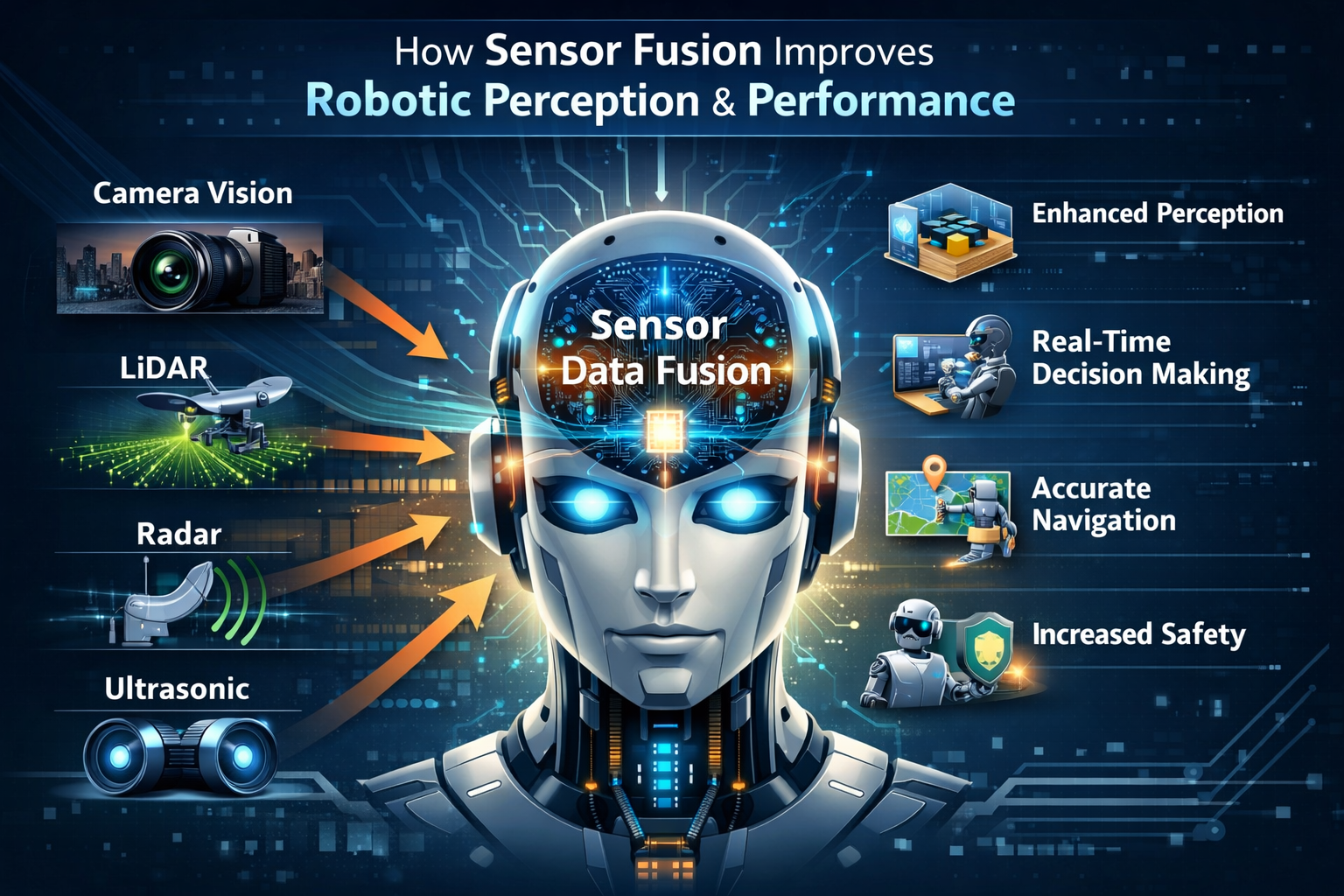
Robots are becoming smarter and more capable every year. To work properly in the real world, robots must understand their surroundings clearly. Sensor fusion helps robots do exactly that by combining information from multiple sensors into one accurate view.
This technology plays a key role in modern automation, robotics, and AI-powered machines.
Understanding Sensor Fusion in Simple Words
Sensor fusion means using multiple sensors together instead of relying on just one. A robot collects data from different sensors like cameras, LiDAR, radar, and motion sensors, then combines all that information to understand what is happening around it.
Just like humans use eyes, ears, and touch together, robots use sensor fusion to make better decisions.
Why Robots Cannot Depend on One Sensor
Every sensor has strengths and weaknesses. Cameras can see colors and shapes but struggle in darkness. LiDAR measures distance accurately but may not detect textures. Radar works well in rain or fog but lacks fine detail.
When robots depend on only one sensor, mistakes can happen. Sensor fusion solves this problem by balancing the limitations of one sensor with the strengths of another.
Clearer View of the Environment
Sensor fusion gives robots a more complete understanding of their surroundings. For example, a camera can identify an object, while LiDAR confirms how far away it is. Together, they provide a clearer picture.
This helps robots recognize obstacles, people, and objects more accurately.
Better Reliability and Safety
Robots often work in factories, hospitals, and warehouses where safety is critical. If one sensor stops working or gives wrong data, other sensors can still provide correct information.
Because of this backup effect, sensor fusion makes robots more reliable and safer, especially when working near humans.
Faster and Smarter Decision Making
When robots combine sensor data in real time, they can react quickly to changes in their environment. Whether avoiding an obstacle or adjusting movement, decisions happen instantly.
This improves robot speed, accuracy, and smooth performance.
Improved Navigation and Position Tracking
Robots need to know where they are and where they are going. Sensor fusion helps robots track their position by combining data from motion sensors, cameras, and distance sensors.
This allows robots to move confidently, even in unfamiliar or changing environments.
Safer Human and Robot Collaboration
In collaborative robotics, robots work side by side with humans. Sensor fusion helps robots detect human presence, movement, and distance accurately.
As a result, robots can slow down, stop, or change direction to prevent accidents, making human-robot interaction much safer.
Smart Software Behind Sensor Fusion
Special algorithms process the combined sensor data and turn it into meaningful information. These algorithms filter noise, predict movement, and help robots understand what actions to take next.
Modern robots also use AI and machine learning to improve sensor fusion over time.
Where Sensor Fusion Is Used Today
Sensor fusion is already part of many real-world robotic systems. It is used in warehouse robots, self-driving vehicles, medical robots, agricultural machines, and industrial automation systems.
Any robot that needs accuracy, safety, and autonomy benefits from sensor fusion.
How Sensor Fusion Boosts Overall Performance
By combining multiple sensors, robots become more accurate, efficient, and adaptable. They can handle complex tasks, work in difficult environments, and perform consistently.
This directly improves productivity and reduces errors.
The Future of Sensor Fusion in Robotics
As AI and edge computing continue to advance, sensor fusion will become even more powerful. Future robots will rely on smarter fusion techniques to operate independently in complex real-world conditions.
Sensor fusion will remain a foundation for next-generation autonomous systems.
Final Thoughts
Sensor fusion helps robots see better, think faster, and act safer. By combining multiple sensor inputs into one system, robots gain a deeper understanding of their environment and deliver higher performance.
In modern automation and robotics, sensor fusion is no longer optional—it is essential.
