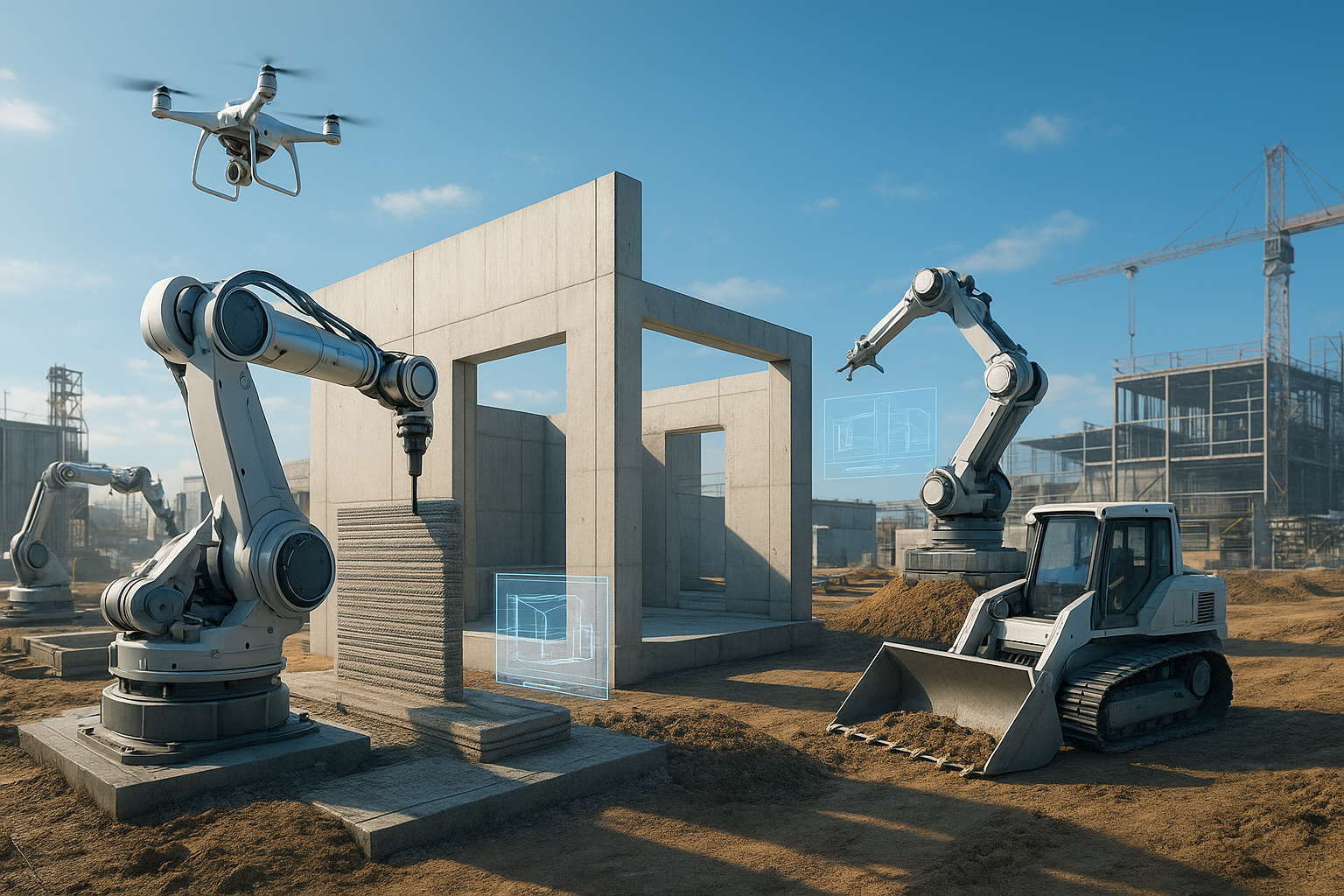
Autonomous construction engineering requires the less human intervention process to be carried out by robots, AI, and large 3D printers. Machines continue to perform heavy, risky, and repetitive tasks that people would have done, but faster and more safely. As per the current technology, it can do the building of walls, concrete laying, material handling, and even checking the buildings on its own.
How Robotics Is Changing Construction
Construction sites are experiencing the robots as helpful comrades. One of theirs capabilities is to construct concrete walls through printing. Also, robots can load and unload the bricks and other materials for building. They can examine the terrains by using sensors and do the hard work with the help of the heavy lifting tools. They are able to erect buildings with 100% precision. In addition, drones take over the job of filming the construction site, checking the progress, and ensuring that all is correct. The use of these robotic devices enhances the industry by increasing safety, reducing errors, and expediting the entire process of the building.
The Rise of 3D Printing in Building Projects
In the construction area, 3D printing or can be termed as additive manufacturing has turned out to be the major breakthrough behind the rise of large printers that can create walls and other parts of buildings through layering concrete or any other special materials. The main reasons for the rapid expansion of 3D printing technology are to be able to make houses in just 1â2 days, and to lower the production costs through the reduction of the waste and workers. Besides, the use of 3D printing in building allows for making unique designs and gives freedom of creativity which would have been impossible otherwise, for the structures to be very strong and exact in all details. A number of nations have already used this technique for printing buildings and bridges.
Combining Robotics and 3D Printing
The major innovation is the use of both, robotics and 3D printing. An entirely automated system may comprise robots that are preparing and leveling the ground, a 3D printer that is constructing the building, drones that are checking the precision of the work, AI software that is controlling the whole operation and autonomous machines that are installing utilities like pipes or cables. Such collaboration results in a very precise, rapid and practically-human-free construction workflow.
Benefits of Autonomous Construction
The use of autonomous construction methods could be very beneficial:
Faster Building Time
Building time is shortened dramatically, thus, what used to take months can be done in weeks.
Lower Costs
Ideally, the number of workers and the volume of materials are both reduced.
High Precision and Quality
The precision to the very last detail is the main strength of robots and 3D printers as they digitally read the designs and carry them out without fail thus lowering the number of mistakes.
Better Safety
In the areas where there are risks of falling, or heavy materials, one can be sure that the devices that hold the work will be machines.
Eco-Friendly Results
The technology used in 3D printing works with less material and wastage is minimal which are both good for the environment.
The Future of Fully Automated Building Sites
The construction industry is on the verge of fully automated job sites. We may have an opportunity to watch the following scenarios in the next time:
- Robot cells functioning in unison.
- Construction vehicles with autonomous driving abilities.
- AI teams managing the entire flow of a project.
- Buildings with customized architecture made skins-first from their digital templates.
This new age in construction will bring about the positive features of making the process faster, safer, and more eco-friendly.
