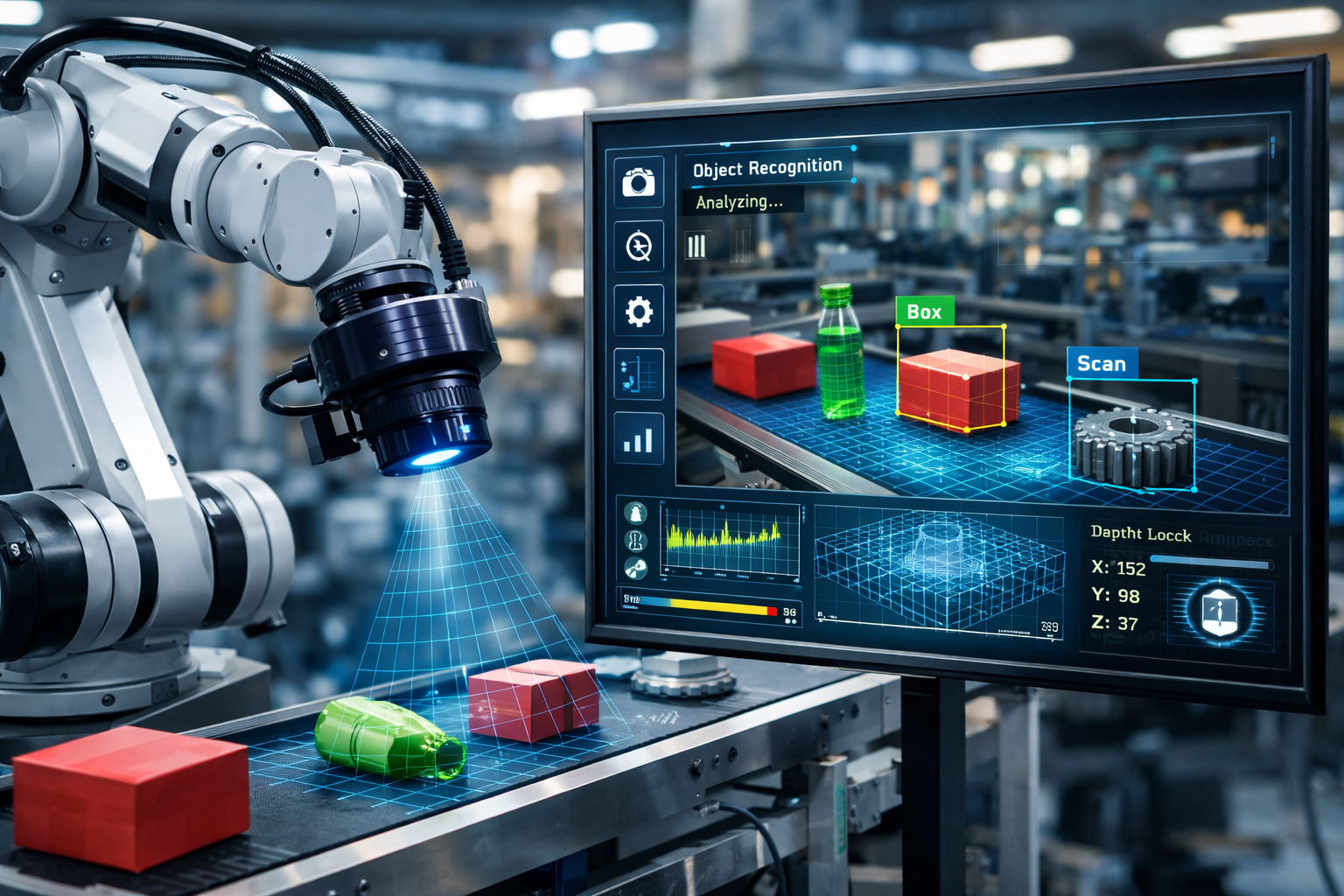
📌 What is Vision Control in Robots?
Vision control means giving robots the ability to see and understand their surroundings using cameras and smart software.
Just like humans use eyes to see objects and decide what to do, robots use cameras + computer vision to look at things and take action.
Without vision → Robots move blindly in fixed paths.
With vision → Robots can adjust their movement based on what they see.
👁️ How Do Robots “See”?
Robotic vision systems usually have three main parts:
🔹 Cameras & Sensors
These capture images or videos of objects, parts, or the surrounding area.
🔹 Image Processing Software
This software analyzes the images and answers questions like:
- Where is the object?
- What shape is it?
- Is it damaged?
- Which direction is it facing?
🔹 Robot Control System
After understanding the image, the system sends instructions to the robot like:
👉 “Move left”
👉 “Pick this part”
👉 “Avoid this obstacle”
🧠 Types of Vision Used in Robots
📷 2D Vision
Basic cameras detect position (left, right, up, down).
Used in simple tasks like sorting items on a conveyor belt.
🧊 3D Vision
Advanced cameras measure depth and height, so robots understand size and distance.
Useful in bin picking and complex assembly.
🎯 AI Vision
AI helps robots recognize objects even if they are:
- Different shapes
- Randomly placed
- Moving
This makes robots smarter and more flexible.
✅ Benefits of Vision-Controlled Robots
✔️ Better Accuracy
Robots can place parts exactly where needed with fewer mistakes.
✔️ More Flexibility
No need for perfect positioning. Robots adjust automatically if parts move.
✔️ Quality Checking
Robots can inspect products and find defects instantly.
✔️ Safer Work Environment
Vision systems help robots detect humans and avoid collisions.
✔️ Faster Production Changes
Switching between products becomes easier because adjustments are software-based.
🏭 Where Vision Controls Are Used
🔧 Manufacturing
Robots identify parts and assemble them correctly.
📦 Warehouse Automation
Robots find packages, sort them, and avoid obstacles.
🧩 Bin Picking
Robots pick randomly placed objects from a box using 3D vision.
🔍 Quality Inspection
Checking for defects, cracks, or wrong assembly.
🤝 Collaborative Robots (Cobots)
Robots safely work with humans because they can “see” nearby movement.
🚀 Why Vision Control is Important Today
Modern factories need systems that are:
- Fast
- Smart
- Flexible
Vision-controlled robots help businesses reduce errors, improve speed, and handle changing tasks — which is why this technology is growing rapidly in Industry 4.0 and smart factories.
