Introduction
A digital twin is a virtual copy of a real-world object, system, or process. It uses real-time data from sensors, software, and connected devices to mirror how something works in the physical world. Digital twin technology helps businesses and governments monitor performance, predict problems, and make better decisions without taking risks in the real environment.
Today, digital twins are widely used across industries — from manufacturing plants to smart cities.
What Is Digital Twin Technology
Digital twin technology creates a digital model of machines, buildings, vehicles, or entire cities. This model continuously receives data from the physical system and updates itself in real time.
Engineers and planners can use the digital twin to:
- Test changes before applying them
- Monitor system health
- Improve efficiency
- Reduce downtime and costs
This makes digital twins a powerful tool for engineering and emerging technologies.
Digital Twins in Manufacturing and Factory Floors
In factories, digital twins are used to create virtual replicas of machines, production lines, and entire plants.
Manufacturers use digital twins to:
- Track machine performance
- Predict equipment failures
- Optimize production processes
- Reduce unplanned downtime
- Improve product quality
By simulating different scenarios, factories can increase productivity while reducing waste and maintenance costs.
Digital Twins in Smart Infrastructure
Digital twins are also used in buildings, bridges, roads, and power systems. Engineers create virtual models to monitor structural health and energy usage.
This helps organizations:
- Detect faults early
- Plan maintenance efficiently
- Improve safety and reliability
- Reduce operational risks
Smart infrastructure powered by digital twins leads to better long-term planning and sustainability.
Digital Twins in Smart Cities
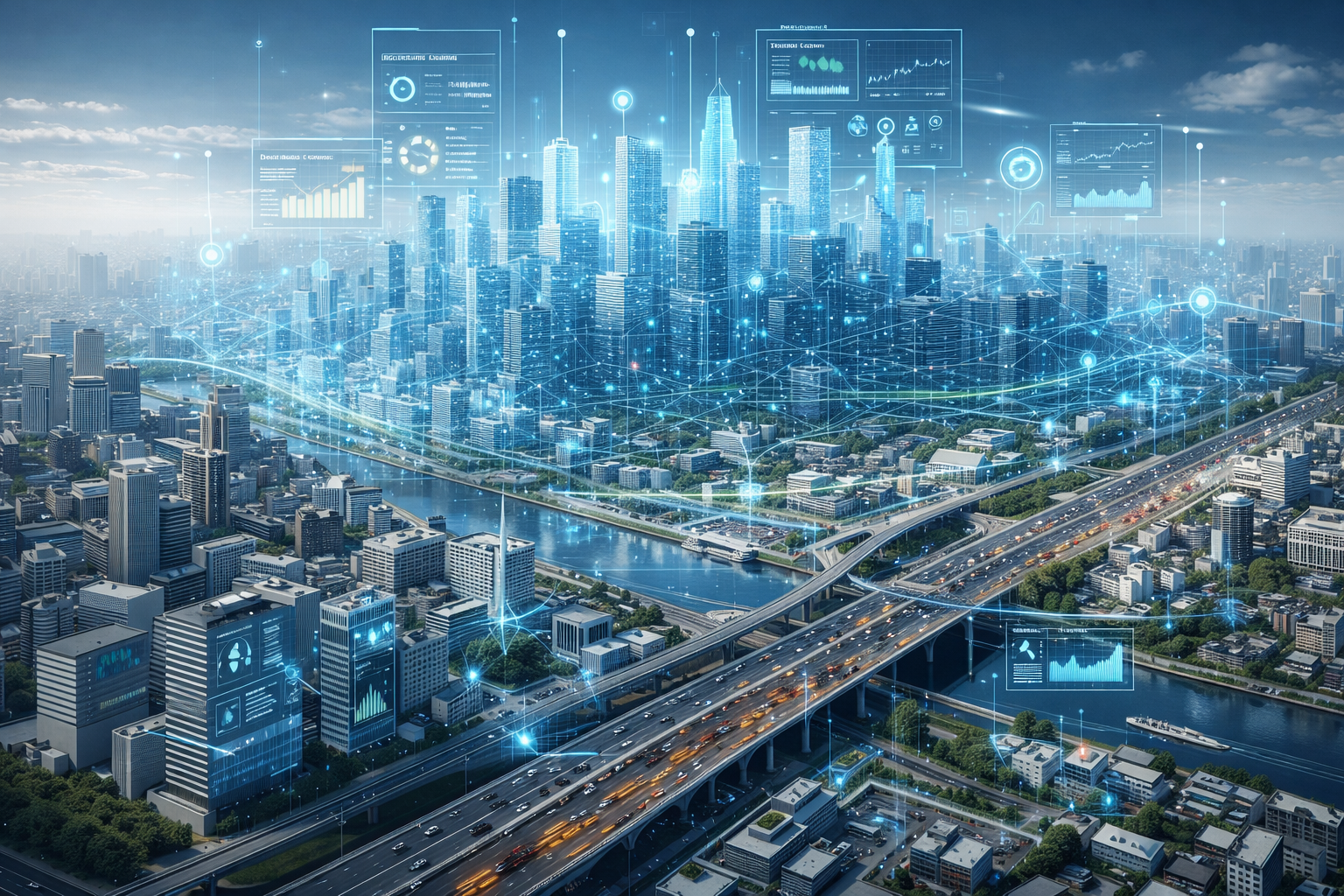
In smart cities, digital twins represent entire urban environments, including traffic systems, utilities, buildings, and public services.
City planners use digital twins to:
- Manage traffic flow and reduce congestion
- Improve public transport systems
- Monitor energy and water usage
- Plan city expansion and development
- Enhance emergency response systems
Digital twins help cities become more efficient, sustainable, and citizen-friendly.
Role of AI, IoT, and Cloud in Digital Twins
Digital twin technology works with:
- Internet of Things (IoT) sensors to collect real-time data
- Artificial Intelligence (AI) to analyze patterns and make predictions
- Cloud and edge computing to process and store large volumes of data
Together, these technologies make digital twins smarter and more accurate.
Benefits of Digital Twins in Real-World Applications
Digital twins provide many advantages, such as:
- Real-time monitoring and insights
- Predictive maintenance and reduced downtime
- Better decision-making
- Lower operational costs
- Improved safety and efficiency
- Sustainable resource management
These benefits make digital twins essential for modern engineering systems.
Digital Twins and the Future of Engineering
As technology advances, digital twins will become more detailed and intelligent. Future systems will simulate human behavior, environmental changes, and complex systems with higher accuracy.
Digital twins will play a key role in:
- Industry 4.0 and Industry 5.0
- Smart cities and urban planning
- Autonomous systems and robotics
- Sustainable engineering solutions
Conclusion
Digital twins are transforming how industries and cities operate. From factory floors to smart cities, they help organizations visualize, analyze, and optimize real-world systems without risk. As emerging technologies continue to evolve, digital twins will become a core foundation of smart engineering and digital transformation.
