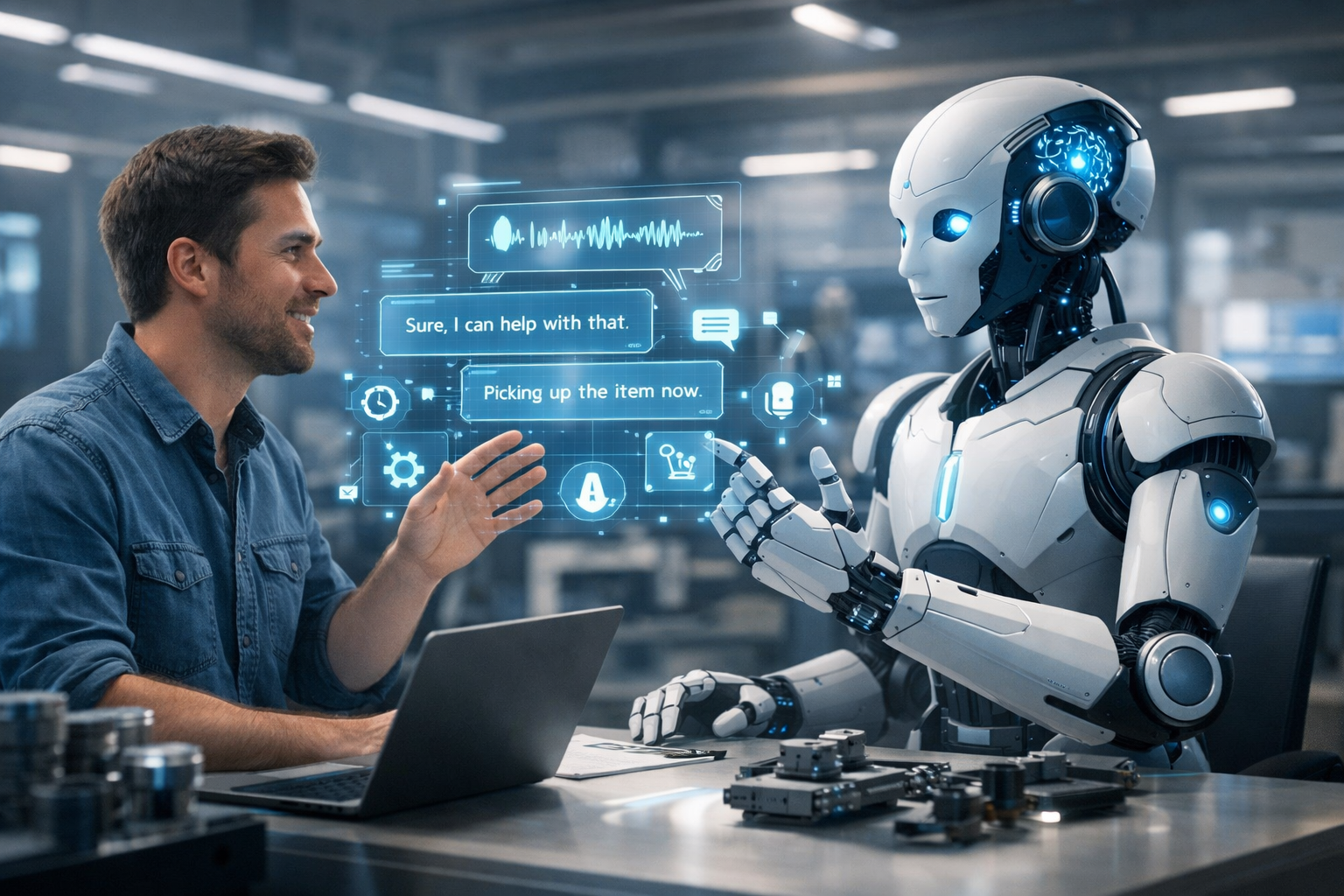
Introduction to Human-Robot Collaboration
Human-robot collaboration is the involvement of humans and robots in performing tasks in the same environment. Unlike traditional robots that do not interact with humans, modern robots are made to provide assistance to humans in a safe manner. Via the use of Artificial Intelligence (AI) and Natural Language Processing (NLP), robots are now capable of receiving instructions, replying in a natural manner, and adjusting to the needs of humans. That is why the collaboration is less of a problem and has more efficiency.
What Is Natural Language Processing in Robotics
Natural Language Processing enables a robot to comprehend human language the same way people do. There is no need for complicated programming or control panels when communicating with robots through speech or by using text commands. In fact, NLP is responsible for understanding words, sentences, and even the sense of the given instructions.
To illustrate, an employee could utter the words, “Pick up the box and place it on the shelf,” and the robot will not only understand but also complete the task.
How AI Makes Robots Smarter
Artificial Intelligence is the helper of a robot that desires to learn from its experience and make decisions. AI equips a robot with skills to process the given data, identify the patterns, and enhance progress to the limit of its lifetime. When AI is used together with NLP, robots are not mere followers of orders, they are now thinkers who comprehend the situations and thus respond in an intelligent way.
AI additionally makes possible the devices’ agility adjustment, their motion, or the activities they do when a person is present, hence securing the work atmospheres and raising the productivity level as well.
Better Communication Between Humans and Robots
Improved communication is one of the most important advantages of NLP. On top of that, humans no longer require technical knowledge to operate robots. Voice commands of daily language such as “stop”, “slow down”, or “help me with this task” will suffice.
This mode of communication reduces the number of mistakes, saves time, and strengthens the relationship between the humans and the robots involved.
Improving Safety in Shared Workspaces
Robots empowered by AI are made in a way that they can work side by side with humans without any danger. They have sensors, cameras, and AI software that help them locate people and prevent accidents from happening. For instance, it can be a matter of a few seconds before a human’s arrival near a certain spot the robot recognizes thus it automatically slows down or stops.
Moreover, with the help of NLP, workers can also give emergency voice commands, thus enhancing safety at work even more.
Easy Training and Faster Adoption
Conventional robots are usually hard to learn. This condition demands specialized skills in training and programming. The introduction of AI and NLP has eliminated this problem The transition of training workers from traditional methods to verbally communicating with robots on how tasks are to be done makes it a piece of cake for enterprises to welcome automation extension.
Having this advantage over time for training is reduced thus, companies are given opportunities to operate robots without the need for recruiting staff with great technical skills.
Real-World Uses of Human-Robot Collaboration
Robots in the industry are used to mechanically assemble items, pack goods, and perform quality checks. In distribution centers, a voice-operated robot that can aid in picking and sorting is available. In hospitals, robots are capable of lightening the burden on medical staff through the delivery of necessities and even attending to patients.
However, retail and customer service industries also greatly benefit by utilizing AI-powered robots to efficiently respond to inquiries and provide directions to clients.
Challenges in Human-Robot Collaboration
Despite having cutting edge AI and NLP technology, there are still obstacles to overcome. The robots may on some occasions confuse the accent with the instruction or fail to recognize the certain words in the sentence. The matters of response and data security in real-time are among the biggest concerns as well.
However, upgrading of AI is fastening the pace at which these problems are being solved, thus the robots’ reliability is increasing.
The Future of Human-Robot Collaboration
The future of the interaction between humans and robots is bright. In the near future, robots will not only be able to understand the speech but also the feelings, the movements, and the facial features of a person. This will let machines act in a more natural way and be similar to humans in terms of interaction.
As AI continues its development, the position of robots will be that of a trusted teammates rather than mere machines.
Summary
AI and NLP are revolutionizing the collaboration of humans and robots. These advancements accomplish natural communication, facilitate safety, and simplify the operations thereby making automation more feasible and efficient. The companies that implement human-robot collaboration will be able to perform at a higher level, have better security and satisfied employees.
