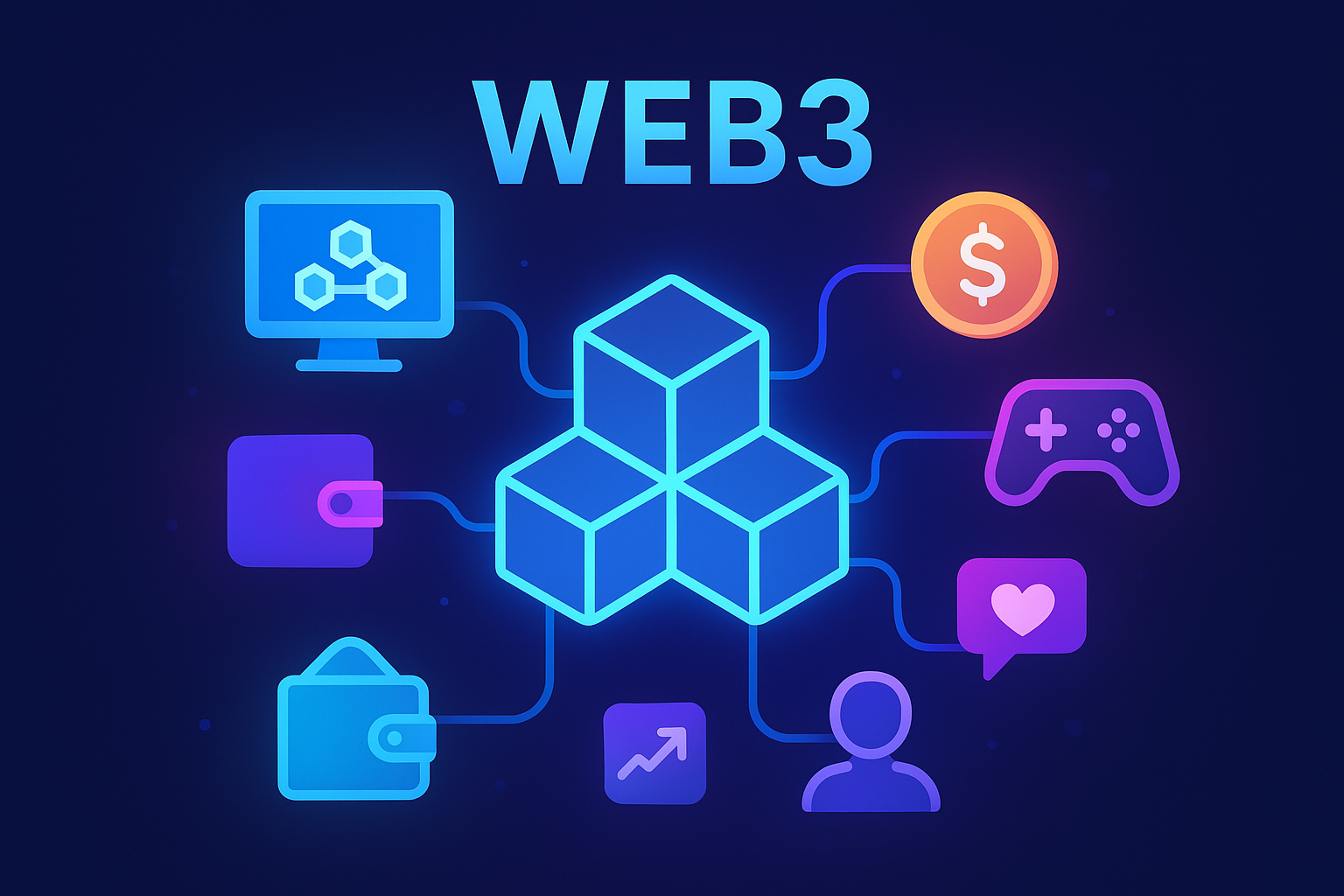
Understanding Web3 Ecosystems
A Web3 ecosystem is the future version of the internet that is powered by blockchain technology. In contrast to the current Web2 platforms that are dominated by big corporations, Web3 users have the authority and control over their data, identity, and digital assets.
By employing gadgets such as smart contracts, cryptocurrencies, and decentralized apps (dApps), an internet is created whereby users have the command, not companies.
Why Web3 Ecosystems Are Essential
Web3 ecosystems are essential because they transform the net into a more accessible and just place.
Without the need for intermediaries, Web3 leverages blockchain to facilitate interactions that are transparent and do not require trust. In this way, the users are enabled to do activities such as exchanging digital assets, handling money, or playing games — all in a manner that is free from any central authority.
User Ownership and Control
One of the major points in favor of Web3 is the fact that users are the real owners of their digital environment.
The data, digital assets, and identity are yours — not something that is stored or controlled by a corporation. Tokens, NFTs, and blockchain wallets are the tools that help in making ownership evident, safe, and transferable.
Smart Contracts and Trustless Systems
Smart contracts are the ones that perform the tasks on the blockchain automatically.
They execute the given instructions exactly, and there is no need for a mediator. As a result, the issues of risk are minimized, customer confidence is maximized, and the overall speed of operations is increased. It is one of the most widespread uses of smart contracts in Web3 ecosystems that they are the backbone of financial apps, marketplaces, gaming systems, etc.
Decentralized Finance (DeFi) Role
DeFi, the short form for decentralized finance, is the envelope that holds all the financial functions (borrowing, lending, trading, staking, etc.) which users can carry out without bank intervention.
It is like an open door to the whole world of finance, thereby giving the users a total control over their funds and the operations they would like to do.
Community Governance through DAOs
The use of DAOs (Decentralized Autonomous Organizations) is common among Web3 projects when the question of decision-making arises, instead of companies making decisions.
In this case, it is the community — not the board of directors — that decides on the updates, rules, and future change by voting. The platform becomes one that is more transparent and fairer for the users.
Main Components of Web3 Ecosystems
The Web3 ecosystem is a complex system that has the following components which are interconnected:
- Blockchain networks (Ethereum, Solana, Polygon)
- Decentralized applications (dApps)
- Cryptocurrencies
- Smart contracts
- NFTs and tokenized assets
- Decentralized identity systems
- Storage networks like IPFS
- DAOs
- Cross-chain tools and bridges
The interaction of all these components is a smooth one with the result being a user-controlled digital economy.
Expanding Use Cases of Web3
Web3 is the engine for a number of quickly expanding industries, for instance:
- Decentralized finance platforms
- Play-to-earn games
- Metaverse projects
- Decentralized social media
- NFTs as enablers for the creator economy
- Tokenization of real-world assets
- AI + blockchain integrated apps
These innovations are making Web3 ecosystems more popular every year.
SEO-Friendly Summary
Web3 ecosystems are changing the internet into a decentralized, user-owned digital environment. By implementing blockchain, smart contracts, and decentralized apps, Web3 ensures digital ownership, secure transactions, community governance, and broad financial access. With increasing adoption, Web3 ecosystems are poised to become the infrastructure for next gen apps, digital assets, and online experiences.
