Robots are now widely-powered and complicated machines inventively designing by humans, and thus, along with the other software agents in an automation task, they are machines that can hardly be called “robots”. Actually with modern epoch api sensors and network automatization, bots for certain industries achieve task completions following certain all the rule described in a head operator’s hand book turned obsolescent and it’s against the rule that there are quite extremely folded bots and surveys designing in the next generations. Next billion B2B processes are suing care we are actually quite safe and our task timed are getting even quicker because of the comparation of automation labor processes that something is new emerging is universal behind us it called iteration.
Here is the sketch of the global movement set out with how and why robotics are expanding in the new sectors:
Why Robots Are Moving Beyond Traditional Industries
Robots are becoming smart and flexible
Robotics Modern systems are equipped with AI and machine vision capabilities thus they can image, analyse and take in concrete info from their environment by themselves and hence they can make decision based on it. Such a feature is attractive to certain sectors that highly have variable tasks e.g. logistics, healthcare or even constructions.
Automation is becoming affordable
Once the tool is just Conception it was costly for the big manufacturing plants and heavy industrial machines, now with the advent of collaborative robots (cobots) and ready-to-use systems the automation technology is already affordable and easy to install which allows SMEs to invest in robotic deployment without large capital being blocked.
Labor Shortages in Many Sectors
Handing sectors like health-care, farming, retail and warehousing has demanded on-going worker shortages. To solve this issue, robots can take the burden of mundane yet labor intensive tasks.
Companies want faster and safer operations
Robots reduce errors, speed up processes, and improve safety — a big reason why new sectors are now adopting them.
Industries Rapidly Adopting Robotics
Healthcare & Hospitals
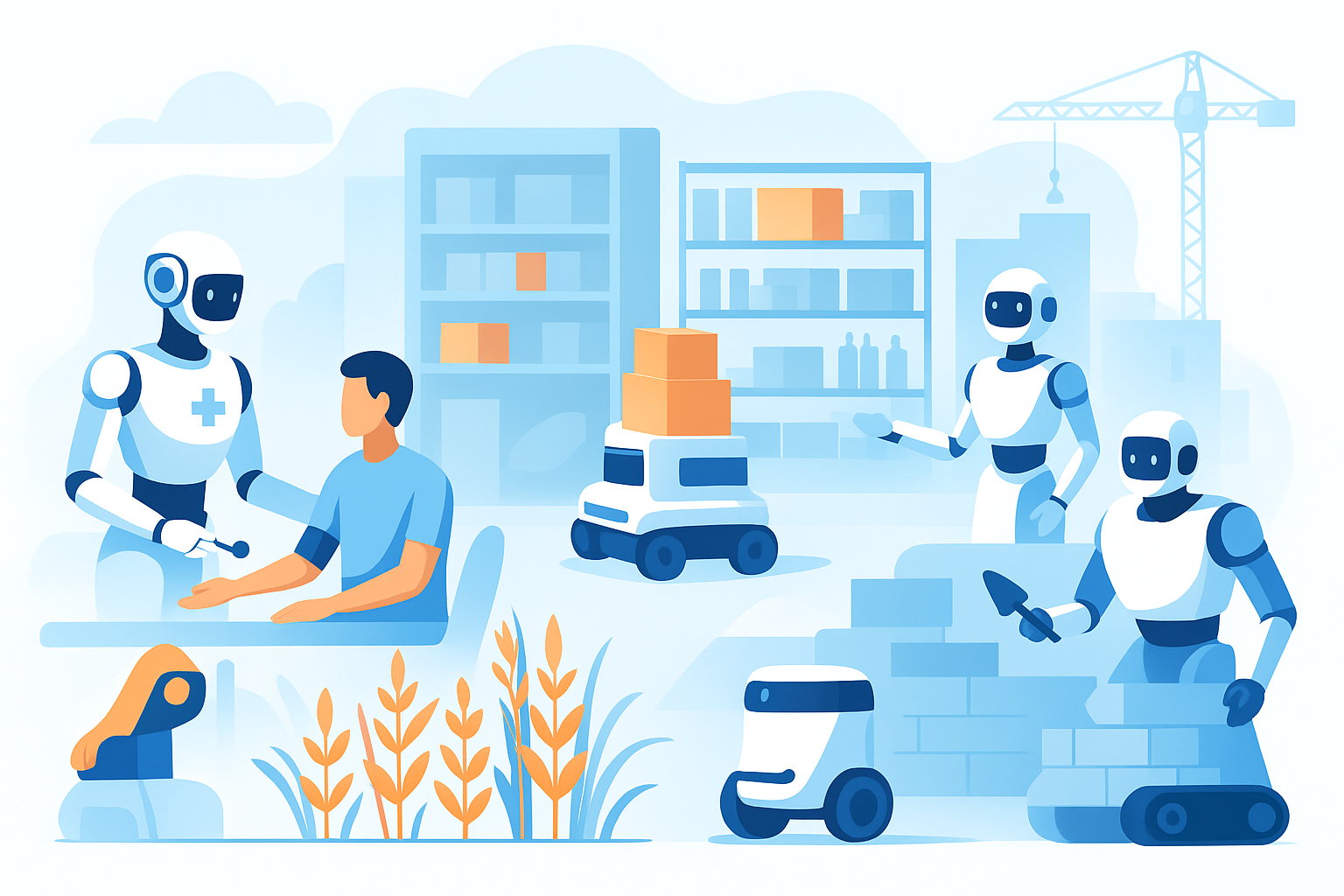
Robots equip the medical doctors and support staff with machinery performing tasks such as acting as surgical aide, patient care, sterilization, drug delivering and sample testing.
Benefits: Better hygiene, fewer human errors, and faster patient service.
Warehousing & Logistics
Automated Mobile Robots (AMRs) transport commodities, sort parcels, and assist in fulfilment of online purchasing.
Benefits: 24/7 operation, faster delivery, and reduced manual workload.
Construction & Infrastructure
Machines that are powered in an automated fashion can do laying bricks and welding, 3D print construction and inspection of a building.
Benefits: More security, quicker completion of the tasks, and higher efficiency.
Retail & Hospitality
Robots are implemented in activities such as shelf scanning, ground cleaning, food preparation, and customer servicing.
Benefits: Higher service quality and lower operating costs.
Agriculture & Food Processing
Robots are designed to harvest the crops, manage the farm machines, and sort various food items.
Benefits: Higher crop yield, less waste, and reduction in labor dependency.
Laboratories & Pharma
Scientific lab robots take on the monotonous scientific tasks of mixing chemicals, performing test samples, and preparing medicines.
Benefits: Greater precision and more rapid research results.
What This Means for the Future
Robot deployment outside traditional industrial settings is rising at an unprecedented speed. They will become:
- Small businesses will be able to afford them more
- Smarter and more multi-functional
- Present in daily life scenarios such as hospitals, retail shops, farms, and restaurants
- Easier rental through RaaS (Robotics-as-a-Service)
This implies that next to the manufacturing sector, which is traditionally known for using robots, other sectors will have to deal with robotics in one way or the other.
